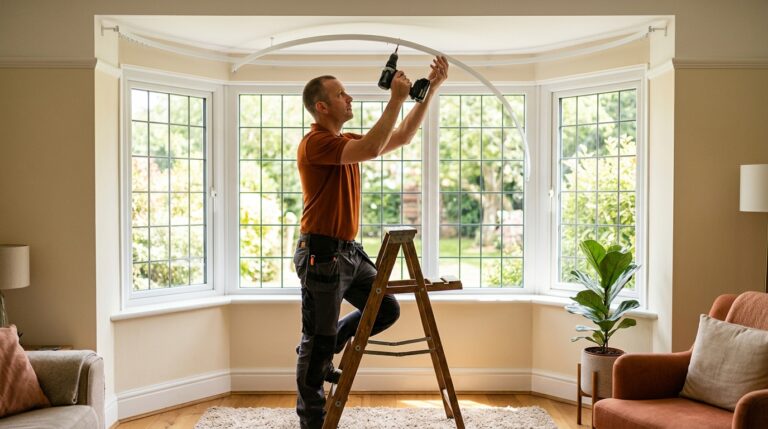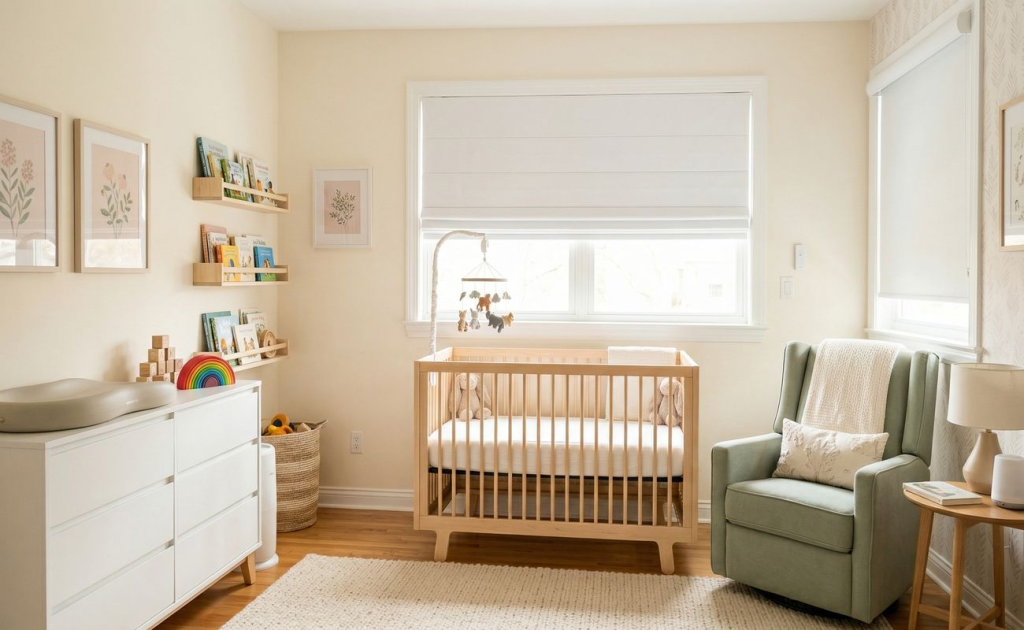
When you have young children or pets at home, the safety of every detail matters — including your window treatments. Traditional corded blinds and shades have been linked to strangulation injuries in children for decades, and the risk is more serious than most parents realize. The Consumer Product Safety Commission reports that incidents can happen in under a minute, often silently, even with an adult in the next room.
The good news: today’s child-safe window treatments have eliminated the cord hazard entirely. Cordless shades, motorized blinds, and inherently cord-free shutters give you every bit of light control, privacy, and style that corded products offered — without a single dangerous loop, chain, or dangling cord anywhere in your home.
This guide covers what parents need to know: the current safety standards, the safest treatment options for each room, which rooms to prioritize for upgrades, and what to do about existing corded treatments that may still be in your home.
Why Window Treatment Safety Matters
Corded blinds and shades create a hazard that’s easy to underestimate. The risk comes from free-hanging pull cords, continuous loop cords, and inner cords that can form loops — any of which a young child can reach, wrap around their neck, and become entangled in before a parent can intervene.
The statistics are sobering. The CPSC has documented hundreds of child strangulation incidents involving window covering cords since the 1970s. What makes these incidents particularly tragic is how quickly and quietly they happen — a child can become entangled during a nap, while playing near a window, or in the brief moments a parent steps out of the room. Pets face similar risks, particularly cats and small dogs that are drawn to dangling cords.
Modern cordless and motorized window treatments remove this hazard completely. There are no cords to pull, no loops to form, and nothing dangling within a child’s reach. For families with young children, making the switch isn’t just a convenience upgrade — it’s one of the most impactful safety decisions you can make in your home.
What the New Safety Standards Require
Window treatment safety regulations have changed significantly. Here’s what parents and homeowners need to know about the current standards:
The ANSI/WCMA A100.1-2022 standard took effect on June 1, 2024. This regulation, enforced by the U.S. Consumer Product Safety Commission (CPSC), requires most new window treatments — both stock products sold in stores and custom-made products — to be cordless or to have inaccessible cords. Any operating cord on a product must be 8 inches or shorter when the treatment is fully lowered. Non-compliant products cannot be manufactured for or sold in the United States.
This is a major shift from previous years, when custom window treatments were exempt from many safety requirements. The 2022 standard closed that loophole, bringing custom products under the same safety umbrella as retail products.
Important for homeowners: you are not legally required to replace existing corded treatments already installed in your home. The regulation applies to new products manufactured after June 2024. However, the CPSC strongly recommends replacing corded treatments in any home where children or pets are present, because retrofit solutions (cord cleats, tension devices) reduce the risk but don’t eliminate it.
When shopping for new treatments, look for the “Best for Kids” certification label, which indicates the product meets the latest safety standards. All Hunter Douglas products sold today comply with ANSI/WCMA A100.1-2022 requirements.
The Safest Window Treatment Options for Families
Cordless Shades and Blinds — The New Standard
Cordless operation is now the default for new window treatments — not a premium upgrade. You raise the shade by pushing up on the bottom rail and lower it by pulling down. A spring-tension mechanism inside the headrail does most of the work, making operation smooth and easy. There are no cords, chains, or loops anywhere on the treatment.
Cordless operation is available across virtually every product type: cellular shades (Duette®), roller shades (Designer Roller Shades), Roman shades (Vignette®), and faux wood blinds (EverWood®). Because cordless is now standard rather than optional, pricing is comparable to what corded products used to cost — there’s no significant price premium for the safer option.
Motorized Window Treatments — Hands-Free and Cord-Free
If cordless is the safest standard, motorized is the safest possible option. There’s nothing to pull, grab, push, or touch. Shades raise and lower via remote control, smartphone app, or voice commands through Amazon Alexa or Google Assistant. Children can’t interact with the mechanism because there is no physical mechanism to interact with.
Hunter Douglas PowerView® Automation takes safety a step further with schedule-based operation. Program your nursery shades to lower at naptime and raise in the morning — the adjustment happens automatically without anyone touching the treatment. Power options include battery wands (easy to install, no wiring), rechargeable batteries, and hardwired systems for permanent installation.
Motorized treatments are the top recommendation for nurseries, children’s bedrooms, and playrooms — the rooms where children spend unsupervised time and the stakes are highest.
Plantation Shutters — Inherently Cordless
Shutters deserve special mention because they’re cord-free by design — they’ve never had cords. Louvers tilt open and closed via a tilt bar or hidden tilt mechanism, and the panels open and close on hinges. There’s nothing dangling, nothing detachable, and nothing a child can wrap or pull.
All three Hunter Douglas shutter lines — Heritance® Hardwood, Palm Beach™ Polysatin™, and NewStyle® Composite — are inherently cordless. Their solid, permanently mounted construction also means they can’t be pulled down by a curious child the way a shade or blind potentially could if improperly installed. For families who want the safest possible treatment with zero maintenance and zero safety concerns, shutters are hard to beat.
Vertical Blinds and Panel Tracks — Safe Options for Doors
Sliding glass doors are one of the most common spots where children encounter window treatment cords. Traditional vertical blinds used pull cords and chain loops to traverse and tilt — both hazardous. Modern vertical options have solved this with safety wand operation.
Hunter Douglas Skyline® Panel-Track Blinds use a wand to glide panels smoothly across the track — no cords involved. Somner® Custom Vertical Blinds feature a safety wand for traversing and tilting. Cadence® Vertical Blinds offer elegant, drapery-like folds with smooth, cord-free movement. For families with sliding doors that children use daily, these wand-operated options eliminate a hazard that many homes still have.
Child-Safe Treatment Comparison
This table summarizes how each option eliminates cord hazards and where each works best.
|
Treatment Type |
Cord Risk |
Operation |
Best Rooms |
Hunter Douglas Option |
|
Cordless Shades/Blinds |
None — no cords |
Push up / pull down |
Any room; nurseries, bedrooms |
Duette®, EverWood®, Vignette® |
|
Motorized Shades |
None — no physical contact |
Remote, app, or voice |
Nurseries, playrooms, hard-to-reach |
PowerView® on any shade/blind |
|
Plantation Shutters |
None — inherently cord-free |
Tilt bar or hidden tilt |
Any room; high-traffic areas |
Heritance®, Palm Beach™, NewStyle® |
|
Vertical / Panel Track |
None — safety wand |
Wand traverse |
Sliding doors, patio doors |
Skyline®, Somner®, Cadence® |
Which Rooms to Prioritize for Child-Safe Upgrades
If you’re replacing corded treatments room by room rather than all at once, prioritize based on where children spend the most time — especially unsupervised time.
Nurseries and Children’s Bedrooms
This is the highest-priority room. Children sleep, play, and spend time alone here more than anywhere else. Cribs and beds are often positioned near windows, putting cords within easy reach. The recommended upgrade is motorized blackout cellular shades (Duette® with LightLock®) or cordless roller shades in a room-darkening fabric. The blackout function supports better sleep, and the cordless or motorized operation eliminates the risk entirely. For detailed guidance, read our nursery window treatment guide.
Playrooms and Family Rooms
Active play near windows is common in these rooms, and children are more likely to pull, climb, or grab at treatments during play. Cordless cellular shades, plantation shutters, or motorized roller shades are all strong choices. Shutters are particularly resilient in play areas because their solid construction withstands the kind of contact that children naturally create.
Living Rooms and Common Areas
These high-traffic spaces are where children move freely throughout the day. Shutters provide inherent safety with a polished, design-forward look. Cordless sheer shades (Silhouette®) or cordless cellular shades maintain light control and privacy without any cord risk. Motorization adds convenience for parents managing multiple rooms — adjust all living area shades from your phone without interrupting what you’re doing.
Kitchens and Bathrooms
These rooms need moisture-resistant treatments that are also cordless. Cordless faux wood blinds (EverWood®) handle humidity and eliminate cords. Cordless vinyl roller shades offer the same combination. Palm Beach™ Polysatin™ Shutters provide inherent safety plus full moisture-proofing. In these rooms, going cordless also eliminates cords near water — an additional safety benefit beyond the child-safety angle.
What About Existing Corded Treatments?
If your home currently has corded blinds or shades, here’s what you need to know:
You’re not required to replace them. The June 2024 regulation applies to new products — it doesn’t mandate replacement of existing installations. However, the CPSC strongly recommends replacing corded treatments in any home where children under 8 or pets are present.
Retrofit options exist but don’t eliminate the hazard. Cord cleats (mounted at least 60 inches from the floor), tension devices, and cord shrouds can reduce access to cords, but they don’t remove the cords entirely. A child who can climb furniture can still reach a cord secured with a cleat. Replacement is the only way to fully eliminate the risk.
Prioritize replacement in the most critical rooms. If you can’t replace every window at once, start with nurseries and children’s bedrooms, then playrooms and family rooms. Move cribs, beds, and climbable furniture away from windows with corded treatments in the meantime.
Free retrofit kits are available. The Window Covering Safety Council offers free retrofit kits for certain corded products. These can help as a temporary measure, but they should not be considered a permanent solution. The goal should be full replacement with cordless or motorized treatments when your budget allows.
Child-Safe Window Treatment FAQs
Are Cordless Blinds More Expensive Than Corded?
Not anymore. Since cordless became the required standard in June 2024, it’s now the default configuration for most window treatments — not a premium add-on. Pricing for cordless shades and blinds is in line with what corded products cost before the regulation. Motorized options do carry a premium, but the cost has come down substantially in recent years as the technology has become mainstream. For nurseries and children’s rooms, many parents find the motorized premium well worth the added safety and convenience.
Are Cordless Treatments Harder to Operate?
Not at all. Cordless shades use a simple push-up / pull-down mechanism on the bottom rail. A spring-tension system inside the headrail does the heavy lifting — raising and lowering requires minimal effort. Most people find cordless easier to use than corded, because there are no tangling cords, no chain loops to align, and no risk of the cord getting stuck. Motorized options are the easiest of all: press a button, use an app, or say a voice command.
What Should I Look for When Shopping for Child-Safe Treatments?
Start with these five criteria: look for the “Best for Kids” certification label, which verifies compliance with current safety standards. Confirm the product complies with ANSI/WCMA A100.1-2022 — any reputable dealer will verify this. Choose cordless or motorized operation with no free-hanging cords of any kind. Ensure professional installation, because even cordless treatments can pose a risk if improperly mounted (a shade that falls could injure a child). And work with an authorized dealer like The Curtain who can assess your home room by room and recommend the safest options for each space.
Make Your Home Safe for Your Family
Cordless and motorized window treatments have made it possible to have every room in your home free of cord hazards — without sacrificing style, light control, or privacy. Shutters are inherently cord-free. Cordless shades and blinds are now the standard, not the upgrade. And motorized options provide the highest level of safety with the added benefit of hands-free convenience. Start with the rooms where your children spend the most time, and work through the rest of the house when your schedule and budget allow.
At The Curtain, every product we install complies with current ANSI/WCMA safety standards. We offer free in-home consultations where we assess your existing treatments, identify any cord hazards, and recommend the safest options room by room — with no pressure and no obligation. With 18+ years of experience and 300+ five-star reviews from families across New Jersey and New York, we’re here to help you make your home as safe as it is beautiful.
Ready to make your home child-safe?
Schedule your free in-home safety consultation: (201) 302-9111 or Request a Consultation
The Curtain | Good Choice, Good Life | Family-Owned Since 2007
Request Your Free In-Home Consultation