Traffic on Route 4. A neighbor’s landscaping crew at 8 AM. The steady hum of a busy street that never quite fades. If you live in New Jersey or New York, outside noise is part of the deal — and your windows are the weakest link in your home’s defense against it.
The right noise-reducing window treatments won’t turn your living room into a recording studio, but they can make a meaningful, noticeable difference in how much outside sound reaches you. The key is understanding which treatments actually absorb sound, how layering multiplies the effect, and which combinations deliver the strongest results for your specific situation.
This guide covers the best options for reducing noise through your windows, explains why layering is the most effective strategy, and gives you practical installation tips that maximize every treatment’s sound-dampening performance.
Can Window Treatments Actually Reduce Noise?
Let’s start with an honest answer: window treatments alone will not soundproof a room. True soundproofing requires structural changes — double or triple glazing, acoustic seals, insulated walls, and specialized construction. If you live directly under an airport flight path, no curtain is going to fix that.
What window treatments can do is absorb sound waves, dampen vibrations, reduce echo, and create a noticeably quieter indoor environment. The difference between a bare window and a well-chosen treatment is genuinely perceptible — especially for the kinds of ambient noise most NJ and NY homeowners deal with: traffic, street activity, neighborhood sounds, and general urban hum.
Hunter Douglas reports that their Duette® Honeycomb Shades can absorb up to 70% of sound energy — a substantial reduction that makes rooms feel calmer and more insulated from the outside world. Even a moderate reduction of 5 to 12 decibels is perceived by most people as a significant improvement, and layered treatments can push that even higher.
The treatments that perform best for noise reduction share common characteristics: dense or multi-layered materials, tight mounting with minimal gaps, and construction that traps or absorbs sound waves rather than letting them pass through. Let’s look at which specific options deliver these qualities.
The Best Window Treatments for Noise Reduction
Cellular Shades — The Top Performer
Cellular shades are the single most effective window treatment for noise reduction. The honeycomb air pockets that make them energy-efficient also trap sound waves, absorbing and dissipating vibrations before they reach the room. The more cell layers, the better the performance: double-cell and triple-cell (Architella®) constructions provide noticeably more sound absorption than single-cell options.
Hunter Douglas Duette® Honeycomb Shades are the standout choice here, absorbing up to 70% of sound energy. For maximum noise reduction, choose a room-darkening or blackout fabric (denser materials absorb more sound than light-filtering options) and mount outside the window frame with generous overlap — two to three inches past the frame on all sides — to cover the gaps where sound would otherwise slip through.
Cellular shades are the top recommendation for bedrooms, nurseries, home offices, and any room where you need both quiet and comfort. They also provide energy insulation and UV protection simultaneously — a combination no other single treatment can match.
Heavy Drapery — Sound Absorption Through Mass
Dense, heavy fabrics absorb sound through sheer mass. Velvet, wool blends, and triple-weave polyester are particularly effective because their thick construction catches and dampens sound waves that lighter fabrics would let pass through. The heavier the curtain, the more sound it absorbs — this is the one area where “more is more” genuinely applies.
For the best noise reduction from drapery, choose custom drapes with a multi-layer construction. Carole Fabrics Custom Drapes offer tailored liners including room-darkening, premium, and interlining options (with brushed flannel between the lining and face fabric). The interlining option adds the most mass and creates the most effective sound barrier. Install panels floor-to-ceiling and extend them several inches past the window frame on each side to minimize gaps where sound can bypass the fabric.
Heavy drapery is most effective when paired with an underlying shade — the combination creates multiple barriers that compound each other’s sound-dampening effects. More on this in the layering section below.
Plantation Shutters — Solid Barrier Construction
Shutters take a different approach to noise reduction. Rather than absorbing sound waves with soft materials, their thick, solid panel construction acts as a physical barrier that blocks and deflects sound. When the louvers are fully closed and the panels are latched, the tight frame fit minimizes the gaps that blinds and shades sometimes leave.
Shutters won’t absorb sound the way cellular shades or heavy curtains do, but the solid barrier effect is meaningful — particularly for lower-frequency sounds like traffic rumble and bass-heavy music. Hunter Douglas Heritance® Hardwood and NewStyle® Composite Shutters are strong choices for street-facing living rooms and bedrooms where you want noise reduction combined with curb appeal and architectural presence.
For maximum noise reduction with shutters, pair them with drapery panels mounted on the wall behind — the shutter provides the solid barrier, and the fabric absorbs what gets through.
Roman Shades — Fabric Layers That Dampen Sound
Roman shades contribute to noise reduction through the density and layering of their fabric folds. A lined or interlined Roman shade has more mass than a single-layer roller shade, which translates to more sound absorption. Room-darkening liners add both light-blocking and sound-dampening benefits.
On their own, Roman shades provide moderate noise reduction — less than cellular shades or heavy drapery, but more than bare windows or standard blinds. Hunter Douglas Vignette® Modern Roman Shades with a room-darkening liner and Carole Fabrics Roman Shades with interlining both deliver meaningful sound dampening. Roman shades are particularly effective as part of a layered approach, where they serve as the functional inside-mount layer beneath heavier wall-mounted curtains.
Roller Shades — Moderate Help, Best When Layered
A single-layer roller shade provides the least noise reduction of the treatments covered here. The flat, single-panel construction simply doesn’t have enough mass or air-trapping structure to absorb much sound on its own. Blackout roller shade fabrics are denser and perform slightly better than light-filtering or sheer options.
That said, roller shades shine as the functional layer in a layered noise-reduction setup. Mount a blackout roller shade inside the window frame for daily light control and privacy, then add heavy drapery panels on the wall behind for the sound-absorbing layer. The roller shade creates an additional barrier, the drapery provides the mass, and the air gap between them adds another insulation layer. Together, they’re far more effective than either treatment alone.
Why Layering Is the Most Effective Strategy
If there’s one takeaway from this guide, it’s this: layered treatments outperform any single treatment for noise reduction. The principle is straightforward — multiple barriers create multiple opportunities for sound to be absorbed, reflected, and dissipated. Each layer catches a portion of the sound energy, and the air gaps between layers act as additional insulation.
Here are the three most effective layering combinations for noisy environments:
- Cellular shade (inside mount) + heavy lined drapery (wall mount) — This is the strongest noise-reducing combination available through window treatments. The cellular shade traps sound in its honeycomb pockets, the drapery absorbs it through fabric mass, and the air gap between them adds a third barrier. Recommended for bedrooms on busy streets, home offices near highways, and any room where quiet is a priority.
- Shutters (inside mount) + drapery panels (wall mount) — The shutters provide a solid physical barrier that blocks and deflects sound, while the drapery absorbs what passes through. This combination also delivers excellent light control and a layered, design-forward aesthetic.
- Roller shade (inside mount) + heavy curtain panels (wall mount) — The roller shade handles daily light and privacy control, while the curtains provide the sound-dampening mass. This is often the most budget-friendly layered approach while still delivering meaningful noise reduction.
For a deeper look at how to combine treatments effectively, read our guide to layered window treatments.
Noise Reduction Comparison at a Glance
This table ranks each treatment type by its sound-absorption effectiveness and shows where each performs best.
|
Treatment |
Sound Absorption |
Best Rooms |
Additional Benefits |
Top Pick |
|
Cellular Shades |
Excellent — up to 70% absorption |
Any room; bedrooms, offices |
Energy insulation, UV protection, privacy |
Duette® (double/triple cell) |
|
Heavy Drapery |
Very good — mass absorbs sound |
Bedrooms, living rooms |
Light blocking, insulation, design impact |
Carole Fabrics w/ interlining |
|
Plantation Shutters |
Good — solid barrier effect |
Living rooms, street-facing |
Light control, curb appeal, durability |
Heritance®, NewStyle® |
|
Roman Shades |
Moderate — fabric dampening |
Bedrooms, offices (layered) |
Elegant design, light control |
Vignette® w/ liner |
|
Roller Shades |
Low–Moderate (best layered) |
Any room (as base layer) |
Light control, minimal profile |
Designer Roller (blackout) |
Mounting and Installation Tips for Maximum Noise Reduction
How you mount a treatment matters as much as what you choose. Sound travels through gaps the way water finds cracks — even a small opening around the frame lets noise bypass an otherwise effective treatment. These installation details maximize your noise reduction:
- Mount outside the frame with generous overlap — Extend treatments two to three inches past the window frame on all sides. This covers the gaps between the frame and the wall where sound would otherwise enter directly. Outside mount consistently outperforms inside mount for noise reduction.
- Go floor-to-ceiling whenever possible — Sound travels under short treatments. Curtains and drapery that reach the floor eliminate the gap at the bottom that sill-length treatments leave open. For maximum effect, let heavy drapes break slightly on the floor rather than hovering above it.
- Seal window frame gaps with weatherstripping — Before installing any treatment, check the window frame for air gaps, cracks, or poor seals. Applying weatherstripping to the frame is an inexpensive step that dramatically amplifies the effectiveness of whatever treatment you install over it.
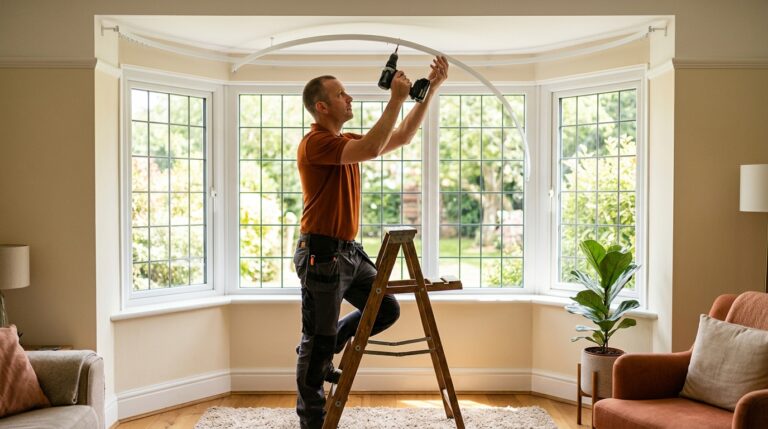
- Use sturdy hardware — Dense, sound-absorbing fabrics are heavy. Standard curtain rods may sag or pull away from the wall under the weight of lined or interlined drapery. Reinforce brackets and use rods rated for heavy fabric to ensure a secure, long-lasting installation.
- Professional installation matters — A treatment that’s mounted loosely, crooked, or with visible gaps won’t perform as well as one that’s precisely fitted. Professional installation ensures tight, gap-free mounting — which is especially important when noise reduction is the goal.
Noise-Reducing Window Treatment FAQs
How Much Noise Can Window Treatments Actually Block?
Realistically, a single quality treatment can reduce noise by 5 to 12 decibels. Layered treatments can achieve 10 to 20 decibels of reduction. For context, a 10-decibel reduction is perceived by most people as roughly cutting the noise level in half. This won’t eliminate construction or airport noise, but it meaningfully reduces traffic, street activity, neighborhood sounds, and the general urban hum that affects daily comfort, sleep quality, and concentration.
Do Blackout Curtains Also Block Noise?
Partially. Blackout curtains use denser, heavier fabrics than standard curtains, which gives them more mass to absorb sound. However, they’re designed primarily for light blocking, not sound absorption. A dedicated acoustic curtain or a custom drapery with interlining will outperform a basic blackout curtain for noise. That said, blackout curtains are still a meaningful upgrade over sheer or lightweight curtains — the added mass helps, especially in bedrooms where both darkness and quiet matter.
What’s the Best Window Treatment for a Bedroom on a Busy Street?
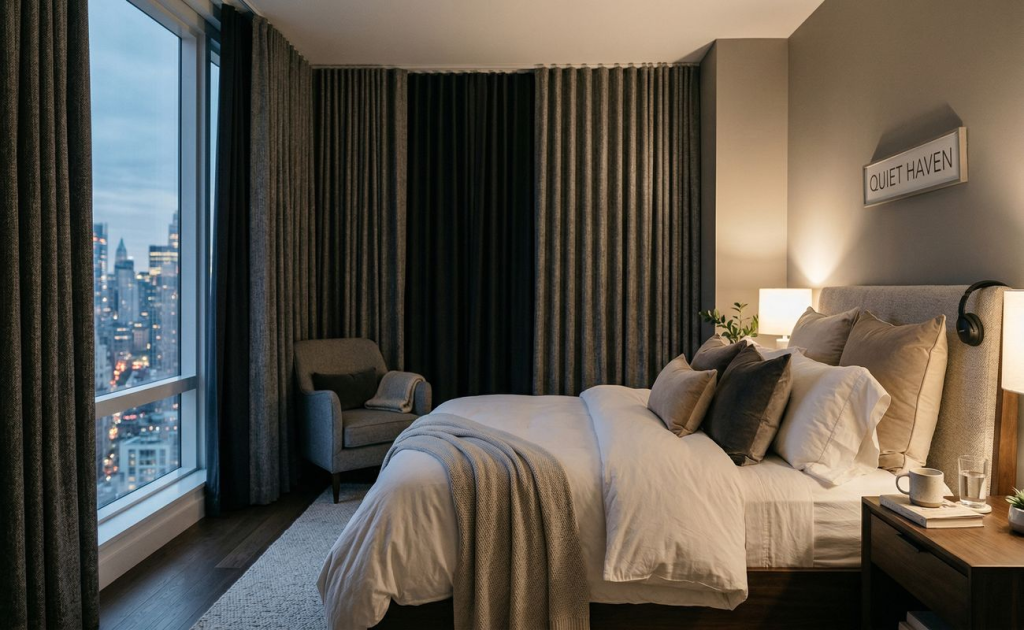
The layered approach delivers the strongest results: Duette® cellular shades in a double or triple cell, room-darkening configuration mounted inside the frame, plus heavy lined drapery panels (choose an interlined option for maximum mass) mounted on the wall with generous overlap. This combination provides the best noise reduction, complete blackout capability, and strong thermal insulation — addressing all three bedroom priorities in one installation. Adding weatherstripping to the window frame before installation completes the setup for the quietest possible result.
Create a Quieter Home With the Right Treatments
Outside noise is one of the most common comfort complaints homeowners have — and one of the most solvable. Cellular shades are the single best noise-reducing treatment thanks to their sound-trapping honeycomb construction. Heavy drapery absorbs sound through fabric mass. Shutters add a solid physical barrier. And layering any of these together produces results that are greater than the sum of their parts.
For NJ and NY homeowners near highways, busy streets, train lines, or dense neighborhoods, the right treatment combination can transform a noisy room into a comfortable, quiet retreat. At The Curtain, we offer free in-home consultations where we assess your noise situation, evaluate your windows, and recommend the most effective combination for each room. With 18+ years of experience and 300+ five-star reviews, we’ll help you find the quiet you deserve.
Ready for a quieter home?
Schedule your free in-home consultation: (201) 302-9111 or Request a Consultation
The Curtain | Good Choice, Good Life | Family-Owned Since 2007
Request Your Free In-Home Consultation