Table of Contents
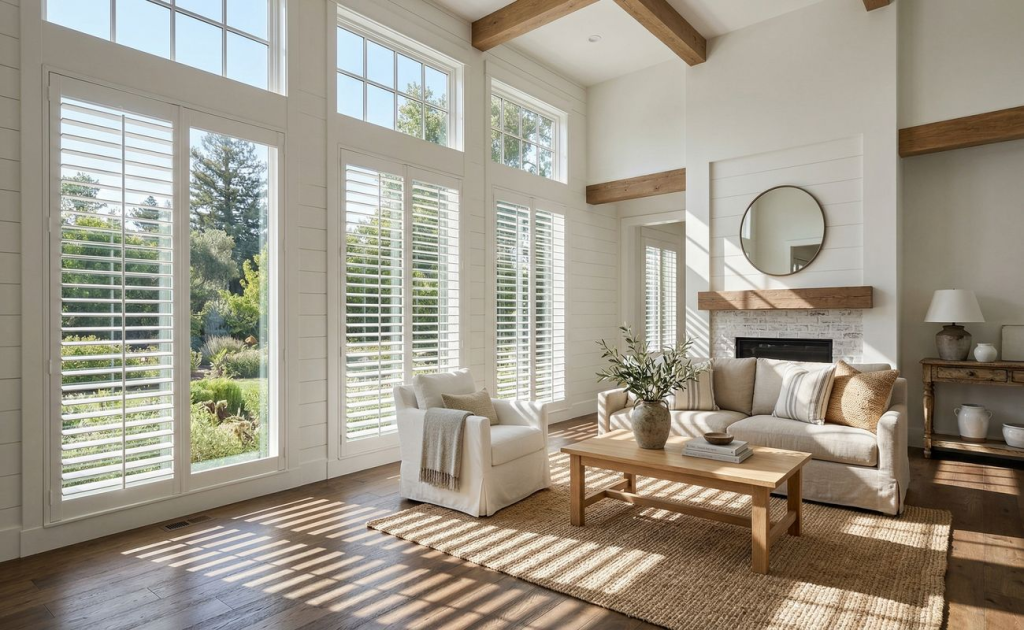
Plantation shutters have a reputation that few other window treatments can match. They’re the one option that homeowners, designers, and real estate agents consistently call “timeless.” And unlike many trends in home design, that label has held up for decades — shutters installed twenty years ago still look current today.
But shutters are also a bigger investment than blinds or shades, and the choices involved — material, louver size, configuration, and room placement — can feel overwhelming if you haven’t explored them before. This plantation shutters guide walks you through everything you need to know: the three main types, how they compare to other window treatments, what they cost, and which rooms they work best in. By the end, you’ll have a clear picture of whether shutters are the right fit for your home.
What Are Plantation Shutters?
Plantation shutters are interior window treatments made of solid panels with wide, adjustable louvers (slats) that tilt open and closed to control light, airflow, and privacy. Unlike blinds or shades that hang from a headrail, shutters are permanently mounted to the window frame — making them a built-in architectural feature rather than a removable accessory.
The wide louvers are what distinguish plantation shutters from traditional shutters with narrow slats. Louver widths typically range from 2½” to 4½”, giving the treatment an open, airy feel that works across a wide range of interior styles — from colonial and farmhouse to modern and transitional. Materials include genuine hardwood, composite blends, and polysatin vinyl, each with distinct advantages depending on the room and budget.
Because they’re permanently installed, shutters are considered a home fixture. They transfer with the property when you sell, and many buyers view them as a premium upgrade that adds both curb appeal and functional value.
Types of Shutters: Wood, Composite, and Polysatin Vinyl
Hunter Douglas offers three distinct shutter lines, each engineered for different needs and budgets. Here’s how they compare — and which rooms each one is best suited for. You can explore the full shutter collection on our product page for additional details.
Heritance® Hardwood Shutters — Premium Real Wood
Crafted from genuine hardwood sourced from responsibly managed forests, Heritance® shutters deliver the warmth, grain, and richness that only natural wood can provide. The Integra™ finish technology creates a lasting, durable surface, while TrueMill® dovetail construction ensures the joints hold strong year after year.
- Louver sizes: 2½”, 3½”, or 4½”
- Finish options: a wide selection of custom paints and stains to match any décor
- Optional: SoftClose™ louvers with Quick Align™ for one-touch closure
- Eco-conscious: each purchase supports the Arbor Day® Foundation
- Coordinates with the Whole House Solution® for a unified look across all windows
Best for: living rooms, dining rooms, bedrooms, and any dry, low-humidity space where you want the authentic beauty of natural wood.
Palm Beach™ Polysatin™ Shutters — Moisture-Proof and Guaranteed
Designed for environments where wood would struggle, Palm Beach™ shutters are constructed from a UV-resistant polysatin compound backed by the Palm Beach Promise™ — a guarantee that they won’t warp, crack, fade, chip, peel, or discolor over time. Internal aluminum supports and resin reinforcements give them structural strength that stands up to daily use and high humidity.
- Louver sizes: 2½”, 3½”, or 4½”
- Fully moisture-proof: ideal for bathrooms, kitchens, and laundry rooms
- Optional: Decorative Sill Cover to hide damaged windowsills or add a sill where needed
- Smart-home ready: available with PowerView® Automation for app, remote, or voice control
- Custom-fit for specialty shapes including arches, angles, and hexagonal windows
Best for: bathrooms, kitchens, laundry rooms, and any high-humidity or high-use area. Also the only Hunter Douglas shutter line with motorization.
NewStyle® Hybrid Shutters — The Best of Both Worlds
NewStyle® shutters combine the refined look of real wood with the strength and stability of composite construction. The Finetech® low-sheen coating creates an authentic painted finish, while TrueMill® dovetail joinery provides the same build quality found in the premium Heritance® line — at a more accessible price point.
- Louver sizes: 2½”, 3½”, or 4½”
- Optional: SoftClose™ louvers with Quick Align™ for smooth, one-touch closure
- Durable composite construction resists everyday wear
- Coordinates with Whole House Solution™ for a cohesive look throughout your home
Best for: any room in the house. NewStyle® shutters are a versatile, mid-range option that works equally well in living areas, bedrooms, and offices.
Shutter Comparison at a Glance
This table summarizes the key differences between the three Hunter Douglas shutter lines to help you narrow down the best fit for your home.
|
Feature |
Heritance® Hardwood |
Palm Beach™ Polysatin |
NewStyle® Composite |
|
Material |
Genuine hardwood |
Polysatin vinyl compound |
Wood + composite hybrid |
|
Moisture Resistance |
Low — avoid humid rooms |
Excellent — fully waterproof |
Moderate — better than wood |
|
Best Rooms |
Living, dining, bedroom |
Bathroom, kitchen, laundry |
Any room |
|
Louver Sizes |
2½”, 3½”, 4½” |
2½”, 3½”, 4½” |
2½”, 3½”, 4½” |
|
Construction |
TrueMill® dovetail |
Aluminum + resin reinforced |
TrueMill® dovetail |
|
Finish Technology |
Integra™ |
UV-resistant polysatin |
Finetech® low-sheen |
|
Motorization |
No |
Yes — PowerView® |
No |
|
SoftClose™ Option |
Yes |
No |
Yes |
|
Specialty Shapes |
Yes |
Yes |
Yes |
|
Price Range |
Higher |
Mid–Higher |
Mid-range |
|
Guarantee |
Limited lifetime |
Palm Beach Promise™ |
Limited lifetime |
Why Homeowners Choose Shutters Over Blinds or Shades
Shutters cost more upfront than most wood blinds or shades — so what makes them worth the investment? These five benefits explain why so many homeowners ultimately choose shutters for their most important rooms.
Durability and Longevity
High-quality shutters can last 25 years or more with basic care — far longer than blinds (which typically need replacing every 5–8 years) or fabric shades that can fade, fray, or lose their shape over time. Because shutters are permanently mounted to the frame with robust hinges, there are no cords to break, no slats to bend, and no mechanisms to jam. The result is a window treatment you install once and enjoy for decades.
Energy Efficiency
Shutters add a solid insulation layer at the window that reduces heat transfer in both directions. In summer, closed louvers deflect solar heat before it enters the room. In winter, the panel construction helps retain interior warmth. For homeowners in New Jersey and New York — where temperatures can swing from the teens to the nineties across the year — this translates to meaningful energy savings and more consistent indoor comfort.
Home Value and Curb Appeal
Because shutters are considered a permanent fixture rather than a removable accessory, they transfer with the home at sale. Industry estimates put the return on investment for shutters at approximately 75%, making them one of the few window treatments that actively contribute to resale value. From the street, shutters visible through the windows signal quality and care — a subtle but real factor in buyer perception and curb appeal.
Light Control and Privacy
Unlike shades that offer an “all or nothing” approach (fully open or fully closed), shutter louvers can be tilted to any angle. This means you can redirect sunlight toward the ceiling for ambient glow, angle louvers downward to block direct glare, or close them completely for total privacy. The solid frame construction also eliminates the light gaps that blinds sometimes leave at the edges — providing a more complete seal when privacy matters most.
Low Maintenance
Shutters are among the easiest window treatments to care for. There’s no fabric to stain, no cords to tangle, and no delicate mechanisms to clean around. Regular dusting with a dry cloth keeps them looking fresh, and a damp cloth handles any deeper cleaning. Unlike curtains, they never need laundering or professional cleaning, and unlike blinds, individual slats won’t bend or snap with normal use.
How to Choose the Right Louver Size
All three Hunter Douglas shutter lines offer the same three louver widths. The size you choose affects both the look and functionality of the shutters.
- 2½” louvers — The most traditional, classic proportion. These are ideal for smaller windows or homes with colonial, Cape Cod, or historical architectural styles. The narrower louvers create a more detailed, layered appearance.
- 3½” louvers — The most popular choice and the sweet spot for most homes. They offer balanced proportions that work on standard-size windows, provide good view-through when open, and complement both traditional and contemporary interiors.
- 4½” louvers — The widest and most modern option. Larger louvers maximize your view when tilted open and give the shutters a clean, contemporary feel. They work best on large windows, picture windows, and sliding glass doors where you want maximum light and sightline when the louvers are open.
A simple guideline: the larger your windows, the wider you can go with louver size. But personal style matters too — some homeowners prefer the traditional charm of narrower louvers on any window, while others want the modern, open feel of 4½” louvers throughout. During an in-home consultation, you can see all three sizes side by side on your actual windows to make the most confident choice.
What Rooms Are Best for Shutters?
Shutters work in nearly every room, but some spaces benefit more than others.
- Living rooms and family rooms — Shutters are a natural showpiece here. They’re visible from both inside and outside, elevating curb appeal while giving you precise control over light and privacy for daily living and entertaining.
- Bedrooms — Excellent light-blocking capability when closed, with the flexibility to tilt louvers for gentle morning light. Pair with room-darkening options for a primary suite.
- Bathrooms and kitchens — Use Palm Beach™ Polysatin™ shutters for full moisture resistance. Their solid, waterproof construction handles steam, splashes, and humidity without any risk of warping or damage.
- Dining rooms — Shutters create an elegant backdrop for meals and entertaining, and their adjustable louvers let you set the right mood for everything from weeknight dinners to holiday gatherings.
- Home offices — Control glare on screens by tilting louvers to redirect light, without darkening the room entirely. The clean aesthetic also makes for a polished video-call backdrop.
- Specialty-shaped windows — Arched, angled, circular, and other non-standard windows can be custom-fit with Hunter Douglas shutters. This is a major advantage over blinds and shades, which often can’t cover these shapes without leaving gaps.
Plantation Shutter FAQs
How Much Do Plantation Shutters Cost?
Plantation shutter pricing varies based on material, window size, and customization. Industry averages range from approximately $20 to $45 per square foot installed, with hardwood shutters at the higher end and composite or vinyl options more affordable. Custom shapes, oversized windows, and motorization can increase the cost. For a standard home with 8–15 windows, a full-house shutter installation typically falls between $2,500 and $8,000 depending on the material and complexity.
Rather than guessing, the most accurate way to understand pricing for your specific home is a free in-home estimate. The Curtain provides complimentary consultations across NJ and NY — we measure your windows, discuss your preferences, and provide a detailed quote with no obligation. Schedule a free consultation to get started.
Are Plantation Shutters Still in Style?
Shutters are one of the few window treatments that are genuinely timeless rather than trend-dependent. Their clean, architectural lines complement modern, traditional, coastal, farmhouse, and transitional interiors equally well. Because they’re a structural feature rather than a decorative accessory, they don’t cycle in and out of fashion the way certain curtain fabrics or blind styles do. Shutters installed a decade ago still look current today — and they’ll look just as relevant a decade from now.
Can Shutters Be Motorized?
Yes — Palm Beach™ Polysatin™ Shutters are available with Hunter Douglas PowerView® Automation, making them the only shutter line in the collection with smart-home integration. You can open and close the louvers with a remote, the PowerView app, or voice commands through Amazon Alexa or Google Assistant. Motorization is ideal for hard-to-reach windows, skylights, or homeowners who want to set automated daily schedules for light and privacy.
Do Shutters Help Block Noise?
Shutters won’t soundproof a room, but their solid panel construction and tight frame fit provide noticeably better sound dampening than blinds or shades. The thick material absorbs and blocks a portion of exterior noise — traffic, neighbors, lawnmowers — making them a practical upgrade for street-facing rooms or homes in busy NJ and NY neighborhoods.
Find the Right Shutters for Your Home
Plantation shutters are a long-term investment in your home’s style, comfort, energy efficiency, and resale value. Whether you’re drawn to the natural warmth of hardwood, the moisture-proof durability of polysatin vinyl, or the versatile balance of composite construction, there’s a shutter line that fits your rooms, your budget, and your taste.
At The Curtain, we carry all three Hunter Douglas shutter lines — Heritance®, Palm Beach™, and NewStyle® — and we handle everything from your initial consultation through installation and cleanup. We bring samples to your home so you can see louver sizes, finishes, and materials against your actual windows and décor. With 18+ years of experience and 300+ five-star reviews from homeowners across New Jersey and New York, we’re here to help you make the right choice with zero pressure.
Ready to see shutters in your home?
Schedule your free in-home consultation: (201) 302-9111 or Request a Consultation
The Curtain | Good Choice, Good Life | Family-Owned Since 2007