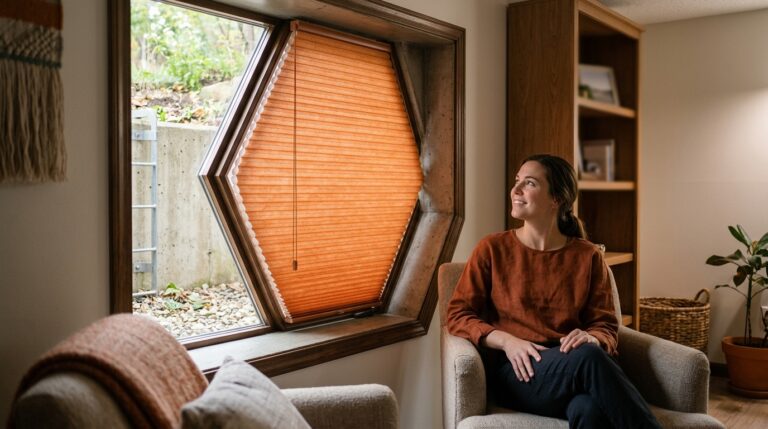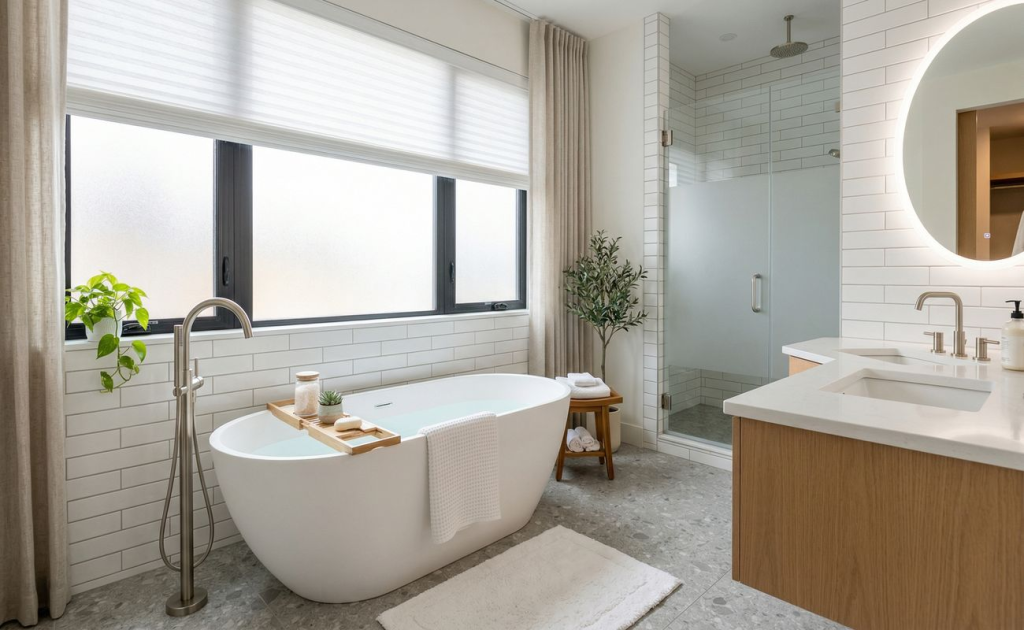
A bathroom window is the hardest window in the house to cover. Steam fills the room every morning, the glass often sits within arm’s reach of running water, and privacy is not optional. Good bathroom window treatments come down to one measurement most homeowners skip: how far the window sits from the shower, tub, or sink. Here is what to put on each of those windows, and what we fit in Bergen County bathrooms from our showroom in Palisades Park.
Why Bathrooms Are the Toughest Room to Dress
- Constant humidity. Materials that absorb moisture swell, warp, or grow mold.
- Direct water contact. Windows beside a shower, tub, or sink get splashed, and only waterproof materials survive that.
- Privacy you can count on. Gaps between slats, sheer fabric, and a shade cut half an inch narrow all fail here.
- Mildew risk. Fabric and natural wood trap moisture against the frame, which is the condition mold needs.
- Temperature swings. The room moves from shower heat to cool air several times a day, and materials that expand and contract show it first.
Proximity to water decides everything below. The closer the window sits to it, the harder the material has to be.
The Best Window Treatments for Bathrooms
Faux Wood Blinds, the All-Around Bathroom Champion
Composite slats give you the warm look of real wood without the humidity risk, so they will not warp, crack, or peel in a full bath used daily. Hunter Douglas EverWood Alternative Wood Blinds use a Performance Plus Shield that protects against discoloration, bowing, and fading. Tilt the slats closed for privacy during a shower, then angle them open for daylight after. Slats come in 2 inch and 2.5 inch sizes, and cleaning is a wipe with a damp cloth. Our faux wood vs. wood blinds comparison covers the trade-offs.
Composite Shutters, Timeless Style That Handles Steam
Hunter Douglas Palm Beach Polysatin Shutters use a UV-resistant polysatin compound that will not warp, crack, fade, chip, peel, or discolor, even next to a shower, and internal aluminum supports keep the panel straight. Louvers come in 2.5 inch, 3.5 inch, and 4.5 inch sizes, and solid panel construction closes the gaps blinds leave. They can be built for specialty shapes too, including arches. Browse the full window treatment range or our shutters guide.
Roller Shades, Sleek and Easy to Clean
A roller shade is one flat panel that rolls into a slim headrail. No slats, no folds, nothing for steam to settle into, which suits small bathrooms. Choose vinyl or a moisture-resistant performance fabric. Hunter Douglas Designer Roller Shades come in light-filtering fabrics that soften daylight while holding privacy, and in blackout fabrics for full coverage. A bathroom skylight takes a shade as well, and motorization matters more up there, because a hand pull is not realistic.
Cellular Shades, Insulation and Privacy in One
Honeycomb pockets trap air and insulate the glass, which you feel on a January morning in North Jersey. The feature that matters most here is the top-down/bottom-up design on Hunter Douglas Duette Honeycomb Shades: drop the shade from the top for daylight and ventilation while the bottom stays up for privacy at eye level. Where a primary bath opens onto a bedroom, LightLock blocks light at the edges. Cellular fabric wants airflow, so keep it out of splash zones and run the exhaust fan. See our cellular shades and the honeycomb buying guide.
Roman Shades, Elegance for Powder Rooms and Half Baths
Fabric folds add warmth against tile, porcelain, and stone. Roman shades are strongest in a powder room or half bath with no shower generating steam. Hunter Douglas Vignette Modern Roman Shades come in sheer, light-filtering, and room-darkening fabrics, with 4 inch full folds or 6 inch flat folds. In a guest bath, choose a moisture-resistant fabric or add a room-darkening liner. Provenance Woven Wood Shades work in a low-humidity bathroom with an independent liner, though read the pros and cons of woven wood shades first. See our Roman shade fold styles.
Bathroom Window Treatment Comparison at a Glance
| Treatment | Best bathroom spot | Moisture resistance | Cleaning |
|---|---|---|---|
| Faux wood blinds (EverWood) | Any bathroom, full baths included | Excellent | Wipe clean |
| Composite shutters (Palm Beach) | Beside the shower or tub | Excellent | Wipe clean |
| Roller shades (Designer Roller) | Narrow windows and skylights | Excellent in vinyl | Wipe clean |
| Cellular shades (Duette) | Vanity windows in ventilated baths | Good | Dust or vacuum |
| Roman shades (Vignette) | Powder rooms and half baths | Moderate | Spot clean |
How to Choose Bathroom Window Treatments by Bathroom Type
Full Bathroom with a Shower or Tub
The wettest case. Stay with hard-surface materials: faux wood blinds, composite shutters, or vinyl roller shades. Skip untreated natural wood and standard drapery fabric here.
Primary Bathroom with Several Windows
Windows sit at different distances from the shower, so mix treatments instead of one product everywhere. Shutters near the tub, cellular or Roman shades at the vanity. If the bath connects to the bedroom, a blackout shade keeps early light out of both rooms.
Powder Room or Half Bath
No shower means far less humidity, so the material list opens up: Roman shades, woven wood, cellular shades, and fabric curtains all work. Lead with pattern and texture here, because guests see this room and steam does not.
What we would put on the window
- Window inside the shower or over the tubPalm Beach polysatin shutters, or a vinyl roller shade on PowerView so nobody touches it with wet hands.
- Small window beside the vanityDesigner Roller Shade in a light-filtering fabric, inside mount to keep the profile tight.
- Primary bath that opens onto the bedroomDuette honeycomb, top-down/bottom-up, with LightLock where you want it fully dark.
- Standard double-hung in a family full bathEverWood faux wood blinds, 2 inch slats, tilted closed for privacy.
What About Windows Near the Shower or Above the Tub?
A window inside a shower enclosure or directly above a tub is the most demanding placement in the house. Three options hold up there: polysatin shutters, vinyl roller shades, and faux wood blinds. All three wipe dry and do not degrade from repeated contact with water and steam. Rule out real wood, which absorbs moisture in a steam-heavy room and eventually warps, cracks, or loses its finish.
Motorization earns its place here. It removes dangling cords near water, which also matters with small children in the house, and nobody stretches over a wet tub. Hunter Douglas PowerView Automation runs on a schedule, closing the shade at sunset and opening it in the morning, and it works with smart-home systems. See our comparison of automated blinds versus automated shades.
A top-down/bottom-up shade is the other smart move at a tub window. Keep the lower half covered for privacy and open the top so steam vents and daylight still gets in.
Bathroom Curtains: Where Fabric Still Works
Fabric is not banned from a bathroom, it is limited to the dry half of the room. Choose a washable fabric, since polyester and cotton blends launder better than silk or velvet. Keep the hem off the floor so it never sits in a puddle, which is why sill-length or apron-length panels beat floor-length ones here.
Handle privacy with the layer underneath rather than the fabric. A cafe curtain on the lower sash covers what needs covering while the top of the window stays clear for light, and a shade behind a panel does the same at night. We make custom drapery, so a bathroom panel gets cut to the exact sill height instead of hemmed down from a stock length.
Bathroom Window Treatment FAQs
Can You Use Real Wood Blinds in a Bathroom?
Not in a full bath with a shower or tub. Constant humidity eventually swells or warps even good hardwood and damages the finish. Faux wood blinds such as EverWood give the same look in materials engineered for moisture.
What Is the Best Window Treatment for Bathroom Privacy?
Composite shutters, because a closed solid panel leaves virtually no gaps. Faux wood blinds are close behind with the slats tilted shut. For privacy and daylight at once, cellular shades with top-down/bottom-up block the view at eye level and still open at the top. Our post on whether people can see through your blinds goes deeper.
Do Bathroom Window Treatments Need to Be Waterproof?
It depends on placement. A window in or beside a shower or tub needs a waterproof treatment. A window at a vanity only needs to be moisture-resistant, which opens up cellular shades, Roman shades in treated fabrics, and woven wood with a liner.
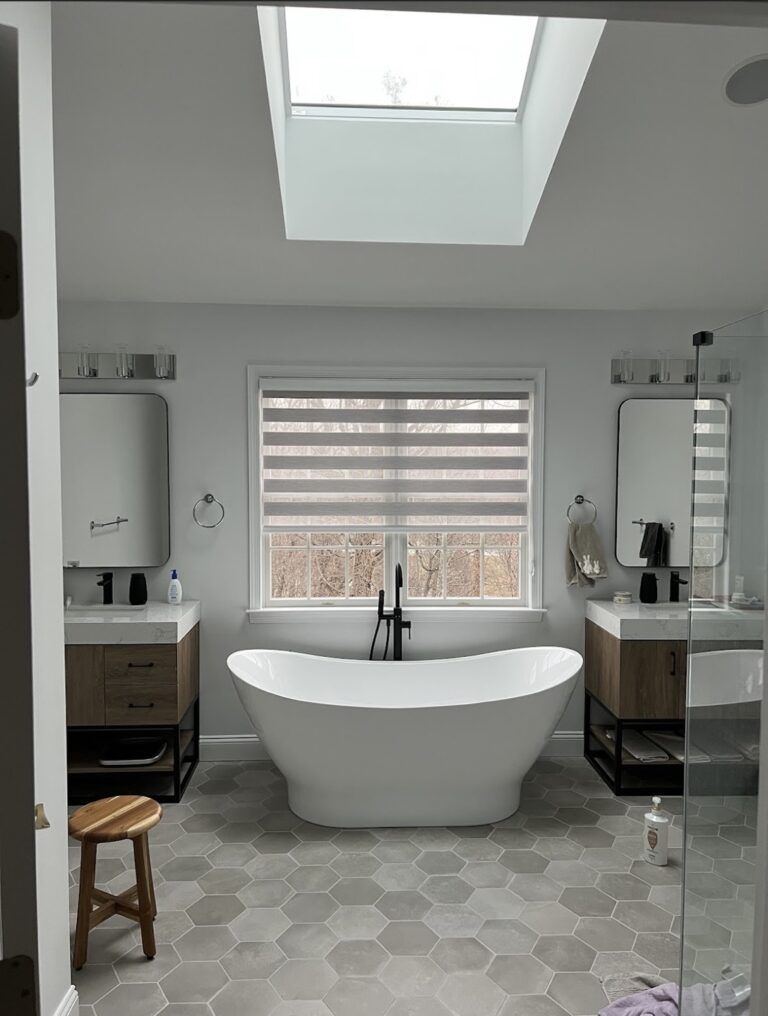
From our own installs in Bergen County

Find the Right Bathroom Window Treatments for Your Home
Identify the bathroom type, measure how far the window sits from the water, then choose the material that distance allows. Bathroom openings are rarely square once tile and trim are in, so measure width and height in three places and use the smallest width with the largest height for an inside mount. Our measuring guide walks through it.
The Curtain is a family-owned window treatment showroom at 545 Broad Ave in Palisades Park, in business since 2007 and serving Bergen County. Sejun Park is the owner and designer. We are a Hunter Douglas partner, we sell and install Hunter Douglas shades, blinds, and shutters, and we make custom drapery. If a shade still fits the opening but the lift mechanism has failed, ask about repair before replacing it.
Measurement in your home is free and the quote comes in writing. See finished rooms in the gallery, check the towns we serve, call (201) 302-9111, or book a free consultation.