Table of Contents
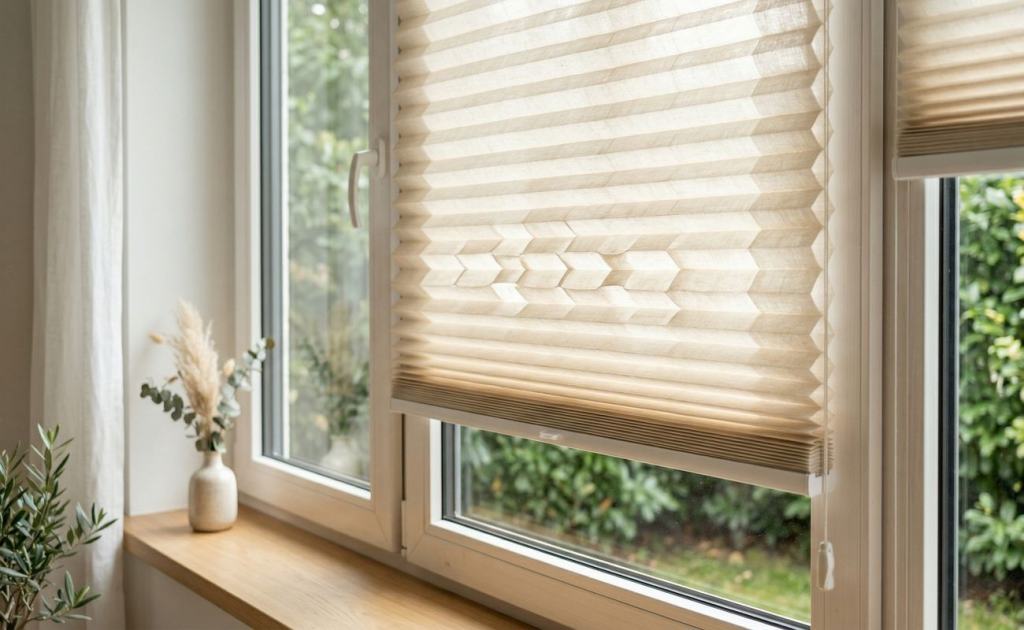
Cellular shades — also called honeycomb shades — are one of the most popular window treatments on the market, and for good reason. They’re the only shade type specifically engineered to insulate your windows, reducing heat loss in winter and blocking heat gain in summer. But beyond energy efficiency, they offer a depth of customization that can feel overwhelming when you’re trying to choose: single cell or double cell, three different pleat sizes, five opacity levels, and a lineup of specialty features that most other treatments can’t match.
This cellular shades buying guide cuts through the complexity. You’ll learn how cellular shades actually save energy, how to choose the right cell construction and pleat size for your windows, and how the two Hunter Douglas cellular shade lines — Duette® and Sonnette® — compare. By the end, you’ll know exactly what to look for and which options matter most for your home.
What Are Cellular Shades (and Are They the Same as Honeycomb Shades)?
Cellular shades are window coverings constructed with a distinctive honeycomb-shaped cell structure. When you look at the shade from the side, you can see the hexagonal cells that give the product its name. These cells trap air in pockets between the window and the room, creating a thermal barrier that insulates far more effectively than flat blinds, roller shades, or curtains.
If you’ve seen the terms “cellular shades” and “honeycomb shades” used interchangeably, that’s because they’re the same product — two names for one design. Hunter Douglas coined the term “Honeycomb Shades” for their Duette® line, which was the original cellular shade when it launched. The broader industry uses “cellular shades” as the standard category name.
Beyond insulation, cellular shades also absorb sound (reducing outside noise), block UV rays (protecting furniture and flooring from fading), and provide strong privacy in both light-filtering and room-darkening configurations. They’re available for virtually any window type — standard rectangles, arches, angles, skylights, and even doors.
How Cellular Shades Save Energy
The honeycomb air pockets are the key. They increase the window’s R-value — its resistance to heat flow — by adding an insulation layer that standard glass alone can’t provide. According to field studies conducted by the U.S. Department of Energy’s Building Technologies Office, cellular shades can reduce heating energy use by up to 20% and total energy use by up to 15%. Industry estimates go further, suggesting up to 40% reduction in winter heat loss and 60% reduction in unwanted summer heat gain compared to uncovered windows.
For homeowners in New Jersey and New York, where temperatures swing from the teens in January to the nineties in July, these savings are meaningful. Cellular shades work year-round: trapping warmth inside during cold months and reflecting solar heat back toward the window during summer. No other shade type provides this dual-season benefit at the same level. For a broader look at energy-saving window options, read our guide to energy-efficient window coverings.
Motorization amplifies the savings even further. With Hunter Douglas PowerView® Automation, you can schedule your cellular shades to lower during peak sun hours and raise when the temperature drops — optimizing insulation automatically without you needing to remember or be home to adjust them.
Understanding Cell Construction
Single Cell vs. Double Cell vs. Triple Cell
The number of cell layers directly affects how much insulation your shades provide. Here’s how the three options compare:
- Single cell — One layer of honeycomb cells. Provides good insulation with the slimmest profile. This is the most affordable option and works well in moderate climates or for homeowners who want energy improvement without the maximum investment.
- Double cell — Two connected layers of cells stacked together. Delivers enhanced insulation and better sound absorption while maintaining a relatively slim profile. Double cell is the most popular choice for homeowners who want strong energy performance without the premium price of triple cell.
- Triple cell (Architella®) — Hunter Douglas’s exclusive honeycomb-within-a-honeycomb design features three insulating pockets. This is the most energy-efficient cellular shade construction available anywhere. Duette Architella® Honeycomb Shades are rated highest on the AERC energy performance scale and are the best choice for homes in climates with extreme seasonal temperature swings.
General guidance: if energy efficiency is your top priority and you live in a region with harsh winters or hot summers (like the NJ/NY metro area), double or triple cell construction will deliver the most noticeable comfort and cost savings. Single cell is a solid option for milder conditions or tighter budgets.
Choosing the Right Pleat Size
Pleat size refers to the height of each individual cell. Hunter Douglas Duette® shades are available in three sizes:
- ⅞” (three-eighths inch) — The smallest, most compact pleat. Creates a finely textured, detailed appearance. Best suited for small or narrow windows where a larger pleat would look out of proportion.
- ¾” (three-quarters inch) — The mid-range option and the most popular choice. Offers balanced proportions that work on standard-size windows throughout the home. A versatile pick that complements most interior styles.
- 1¼” (one and a quarter inch) — The largest pleat. Creates a more contemporary, open feel with fewer visible folds. Works best on large windows, picture windows, or in modern interiors where clean, simple lines are the design priority.
A useful rule of thumb: scale the pleat size to the window. Smaller windows benefit from smaller pleats that maintain proportion, while larger windows can carry the visual weight of larger pleats. During an in-home consultation, you can see all three sizes on your actual windows — the difference is subtle but noticeable.
Cell Construction Comparison
Feature | Single Cell | Double Cell | Triple Cell (Architella®) |
Insulation Level | Good | Very Good | Excellent (highest rated) |
Sound Absorption | Moderate | Good | Very Good |
Profile Thickness | Slimmest | Slightly thicker | Thickest |
Price Range | Most affordable | Mid-range | Premium |
Best For | Moderate climates; budget priority | Strong year-round performance | Maximum efficiency; extreme climates |
Hunter Douglas Option | Duette® single cell | Duette® double cell | Duette Architella® |
Duette® vs. Sonnette® — Which Cellular Shade Is Right for You?
Hunter Douglas offers two distinct cellular shade lines. Both provide honeycomb insulation, but they differ in design, feature depth, and aesthetic. Here’s how to choose between them. Explore both options on our cellular shades product page.
Duette® Honeycomb Shades — The Original
Duette® is the shade that created the cellular category. It offers the widest range of customization of any shade type available — period. You can choose from single, double, or Architella® triple-cell construction; three pleat sizes; an extensive selection of fabrics and colors (including options made from over 50% recycled content); and light-filtering through complete blackout opacities.
What sets Duette® apart is its depth of features. Top-down/bottom-up lets you lower from the top for light while keeping the bottom raised for privacy. The Duolite® system pairs a light-filtering shade and a room-darkening shade on a single headrail. ClearView® sheers provide maximum view-through with minimal light filtering. And the LightLock® blackout system uses side channels to block light at the edges — the most complete room darkening available in any window treatment.
Duette® also handles specialty applications that most shades can’t: Vertiglide™ for French and patio doors, SkyLift™ for skylights, and TrackGlide™ for tilt-turn windows. Available with PowerView® motorization, cordless operation, cord loop, or retractable wand.
Best for: any room in the house. Duette® is the most versatile and feature-rich cellular shade available, making it the go-to choice for homeowners who want maximum customization.
Sonnette® Cellular Roller Shades — Cellular Meets Roller
Sonnette® combines the clean, simple operation of a roller shade with the insulating benefits of cellular construction. The 2” cell size creates gentle, dimensional curves that diffuse light into a soft, radial glow — a noticeably different light quality than the flat filtering of a standard roller shade.
The fabric rolls up neatly like a roller shade, giving it a slimmer stacking profile than Duette®. It’s available in semi-opaque and room-darkening opacities, with optional features including the Kickback™ privacy feature and front-rolling fabric for clearing door handles and window cranks. Control options include PowerView® motorization, cordless, beaded loop, and retractable wand.
Best for: homeowners who love the minimal aesthetic of roller shades but want the energy-saving insulation of a cellular design. Sonnette® is a strong choice for living rooms, bedrooms, and offices where you want both beauty and performance.
Duette® vs. Sonnette® at a Glance
Feature | Duette® Honeycomb Shades | Sonnette® Cellular Roller |
Cell Construction | Single, double, or Architella® triple | Single (2” cell) |
Pleat Sizes | ⅞”, ¾”, 1¼” | 2” (fixed) |
Opacities | Sheer, light-filtering, room-darkening, blackout | Semi-opaque, room-darkening |
Key Features | TDBU, Duolite®, LightLock®, ClearView®, Vertiglide™, SkyLift™ | Kickback™, front-rolling fabric |
Specialty Shapes | Arches, angles, circles, skylights, doors | Standard rectangles |
Fabric Selection | Widest range (incl. 50%+ recycled content) | Curated selection |
Design Profile | Dimensional, textured honeycomb | Smooth roller aesthetic with gentle curves |
Motorization | PowerView® | PowerView® |
Best For | Maximum customization; any room or window | Roller-shade lovers wanting insulation |
Choosing the Right Opacity for Each Room
Cellular shades are available in a wider range of opacities than most other treatment types. Matching the right opacity to each room is one of the most important decisions in your purchase.
Light-Filtering
Softly diffuses natural light while maintaining daytime privacy. The room stays bright and welcoming without harsh direct sun. Best for living rooms, kitchens, dining rooms, and any space where you want to preserve a naturally lit atmosphere.
Room-Darkening
Blocks most incoming light and provides stronger privacy than light-filtering options. Some light may still enter around the edges, but the room will be significantly darker. Best for bedrooms, nurseries, home theaters, and media rooms.
Blackout with LightLock®
The LightLock® system takes room darkening to another level. Side channels integrated into the shade’s frame block light at the edges — eliminating the glow that even standard blackout shades let through. This is the most complete blackout solution available in any window treatment. Best for primary bedrooms, nurseries, shift workers who sleep during the day, and anyone who requires total darkness.
Sheer (ClearView®)
Maintains your outside view with minimal light filtering. ClearView® sheer fabric provides UV protection and a degree of insulation without obscuring the scenery beyond the window. Best for rooms where the view is the priority — a living room facing a garden, a study overlooking trees, or any window where you want to see out while still gaining the thermal benefits of cellular construction.
Dual-Opacity (Duolite®)
The Duolite® system is the answer when one opacity isn’t enough. It pairs two fabrics — typically light-filtering on the front and room-darkening on the back — on a single headrail. Switch between the two depending on the time of day, activity, or mood. Best for bedrooms (light-filtering in the morning, room-darkening at night), home offices (glare control during work, darkness for presentations), and any multi-use room.
Special Features and Applications
One of the biggest advantages of cellular shades over other treatment types is the range of specialty features available. These expand where and how you can use them throughout your home.
- Top-down/bottom-up — Lower the shade from the top for natural light while keeping the bottom raised for privacy. Ideal for bathrooms, street-facing rooms, and any space where you want both light and coverage simultaneously.
- Vertiglide™ — A cordless system designed specifically for French doors, patio doors, and sliding glass doors. The shade glides sideways rather than up and down, staying completely out of the way when the door is in use.
- SkyLift™ — A skylight shade system that covers overhead windows with the same insulating cellular construction. Reduces heat gain from above and controls light in rooms with skylights.
- TrackGlide™ — Designed for tilt-turn windows, which are common in European-style homes and increasingly popular in NJ/NY renovations. The shade follows the window’s movement for seamless operation.
- PowerView® Automation — Schedule your shades to adjust throughout the day based on the sun’s position. Control via app, remote, or voice commands through Amazon Alexa or Google Assistant. Available on both Duette® and Sonnette®.
- Specialty shapes — Cellular shades can be custom-fabricated for arches, angles, circles, and other non-standard window shapes. This versatility makes them one of the few treatments that can cover virtually any window in your home.
How to Clean and Maintain Cellular Shades
Cellular shades are low-maintenance, but the honeycomb cells can collect dust over time if left unattended. A simple, regular routine keeps them looking and performing their best:
- Dust regularly — Use a feather duster or the soft brush attachment on your vacuum (set to the lowest suction level). Run it gently across the cells to remove surface dust before it bonds.
- Spot-clean stains — Dampen a clean cloth with warm water and a small amount of mild soap. Blot the stain gently — don’t rub, which can push the stain deeper into the fabric.
- Never submerge in water — The cell structure and fabric can be damaged by soaking. Avoid saturating the shade during cleaning.
- Mind the placement — Cellular shades work well in bathrooms with good ventilation, but shouldn’t be installed directly in splash zones (above showers or beside tubs where direct water contact is likely).
With proper care, quality cellular shades last seven to ten years or more. For a detailed step-by-step cleaning guide, read our post on how to clean cellular shades.
Cellular Shades FAQs
Are Cellular Shades Worth the Higher Price?
Yes. While cellular shades cost more upfront than standard blinds or roller shades, the energy savings — up to 20% on heating costs alone according to DOE research — can offset that investment over time. Beyond energy efficiency, you also get superior sound absorption, UV protection, and the widest range of opacity, feature, and specialty-shape options available in any shade type. For NJ and NY homeowners dealing with both freezing winters and humid summers, the year-round comfort improvement is substantial.
Can Cellular Shades Fit Skylights and Specialty Windows?
Yes — this is one of cellular shades’ biggest advantages. Duette® Honeycomb Shades can be custom-fabricated for arches, angles, circles, skylights (with the SkyLift™ system), and tilt-turn windows (with TrackGlide™). Most roller shades and blinds have very limited specialty-shape options. If you have non-standard windows, cellular shades are one of the few treatment types that can cover them properly.
What’s the Difference Between Cellular Shades and Roller Shades?
The fundamental difference is insulation. Cellular shades have a honeycomb structure that traps air for thermal insulation; standard roller shades use a flat, single-layer fabric that provides minimal insulation. Cellular shades also offer more feature options (top-down/bottom-up, Duolite®, LightLock®) and fit more window shapes. Roller shades counter with a flatter, more minimal aesthetic and simpler operation. If you want both, Sonnette® Cellular Roller Shades combine the roller shade look with cellular insulation — the best of both worlds.
Find the Right Cellular Shades for Your Home
Cellular shades are the most energy-efficient, feature-rich shade type you can install. Whether you choose the deep customization of Duette® or the roller-shade simplicity of Sonnette®, you’re getting year-round insulation, sound absorption, UV protection, and light control in one treatment. Match your cell construction to your climate, your pleat size to your windows, and your opacity to each room’s function — and you’ll have a shade that performs beautifully for years.
At The Curtain, we carry the full Duette® and Sonnette® lines with every cell size, pleat option, opacity, and feature available. We bring fabric samples to your home so you can see and feel the difference between single cell and Architella®, compare light-filtering and room-darkening side by side, and test top-down/bottom-up operation on your actual windows. With 18+ years of experience and 300+ five-star reviews from homeowners across New Jersey and New York, we’ll help you navigate the options and find the perfect fit.
Ready to explore cellular shades?
Schedule your free in-home consultation: (201) 302-9111 or Request a Consultation
The Curtain | Good Choice, Good Life | Family-Owned Since 2007