Bay windows are one of the most coveted architectural features in any home. They flood rooms with natural light, create a sense of depth and spaciousness, and offer panoramic views that flat walls simply can’t match. But when it comes to choosing window treatments, that same beautiful multi-panel structure becomes a genuine puzzle.
Standard treatments don’t fit the angles. Adjacent shades can bump into each other. Curtain rods need to bend to follow the bay’s shape. And if you have a window seat, your treatment length is limited in ways you might not expect. It’s no wonder bay window treatment ideas are one of the most-searched topics in home design.
This guide breaks down the challenge into clear, practical steps. You’ll learn the three main approaches to dressing a bay window, see which treatments work best for the structure, and get the tips that ensure your installation looks polished from both inside and outside your home.
What Makes Bay Windows Challenging to Dress
Before diving into treatment options, it helps to understand exactly why bay windows require more thought than a standard flat window.
- Multi-panel angles — A typical bay window has three or five panels set at varying angles to the wall. Each panel needs its own treatment, but all of them need to look like they belong together. Get the coordination wrong and the entire bay looks disjointed.
- Angle interference — Treatments on adjacent panels can physically collide at the corners where the angles meet. If a shade, blind, or shutter extends even slightly beyond its frame, it can block or bump against the neighboring treatment. Precise sizing is essential.
- Window seats and built-ins — Many bay windows include a built-in seat or bench. This limits your treatment options to sill-length coverings that don’t pool or drag on the seating surface. Floor-length curtains and drapery are off the table unless the bay has a clear floor.
- Large glass surface area — All those panels add up to a significant amount of glass, which means more heat loss in winter and more solar gain in summer. Energy-efficient treatments make a bigger difference on bay windows than almost anywhere else in the home.
- Curb appeal — Bay windows are visible from the street. Mismatched or poorly fitted treatments are noticeable from outside, while coordinated, well-installed coverings elevate your home’s exterior appearance.
The good news: once you understand these challenges, the solutions are straightforward. It starts with choosing the right approach.
The Three Approaches: One Unit, Individual Panels, or Layered
Every bay window treatment decision begins with a fundamental question: do you want to treat the bay as one large opening, dress each window panel individually, or layer both strategies together?
Treating the Bay as One Unit
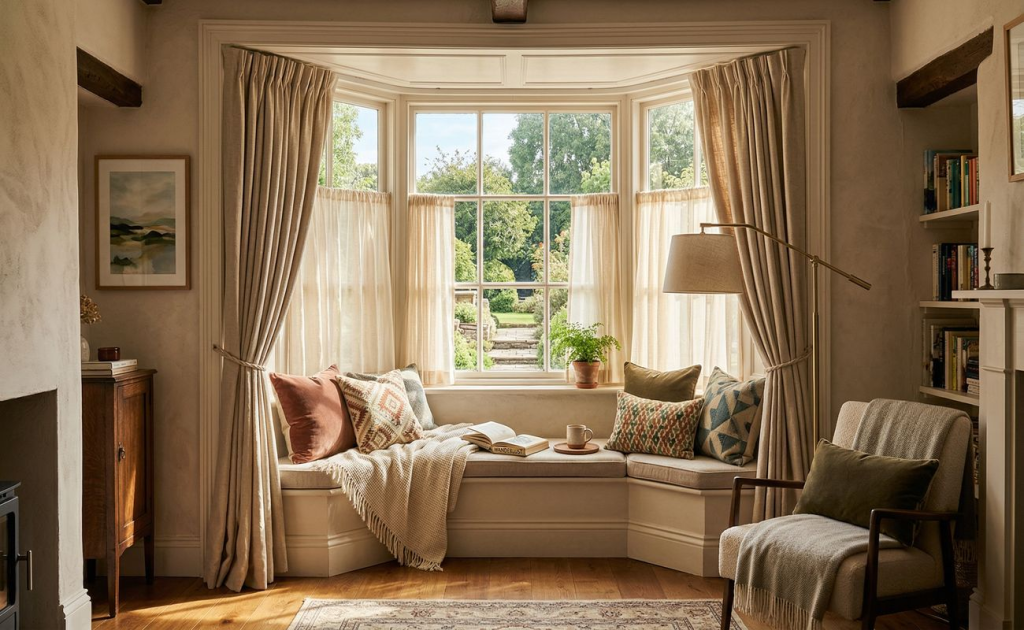
In this approach, curtains or drapery are mounted on a continuous rod or flexible track that wraps around the outside of the bay, above the window frames. When the panels are open, they frame the entire bay like a grand stage curtain. When closed, the bay becomes a cozy, private alcove.
This creates the most dramatic visual impact and works beautifully in living rooms, dining rooms, and primary bedrooms where design presence matters. You’ll need sufficient wall space above the bay for rod mounting and panels totaling two to two-and-a-half times the bay’s total width for proper fullness. Mount the rod four to six inches above the frame and extend it six to twelve inches beyond each outer edge so the panels stack cleanly to the sides when open.
Treating Each Window Individually
Here, each panel within the bay gets its own separate treatment — shutters, shades, or blinds mounted inside or just outside each individual frame. This approach highlights the bay’s architectural structure rather than concealing it, and it gives you independent control over each panel’s light and privacy.
The key is careful sizing. Each treatment must fit precisely within its panel without extending into the adjacent angle. A single decorative valance spanning all panels can unify the look and hide any hardware gaps at the corners. This approach works especially well for bays with window seats, functional spaces, or rooms where you want the clean, tailored look of individual treatments.
The Layered Approach — Best of Both Worlds
The layered approach is increasingly popular and solves the biggest limitations of the other two strategies. Mount functional treatments — roller shades, cellular shades, or Roman shades — inside each individual panel for daily light and privacy control. Then add decorative drapery panels on the walls flanking the bay’s outer edges for softness, framing, and design impact.
You get the precision and daily practicality of individual shades plus the grand, room-defining presence of drapery — without needing to run a curved rod across the bay’s angles. The side panels are purely decorative and never need to close across the windows, so they stay clean and simple. This is the approach most designers recommend when clients want both function and beauty from their bay windows.
Best Window Treatments for Bay Windows
These five treatment types are the strongest options for bay windows. Each one handles the angled structure differently, so the best choice depends on your room, your bay’s configuration, and your priorities.
Plantation Shutters — Architectural and Clean
Shutters are one of the most natural fits for bay windows. Each panel gets its own custom-fit shutter, mounted within the frame, creating a clean, architectural look that highlights the bay’s structure rather than hiding it. Because shutters sit flat within each frame, there’s virtually no risk of angle interference between adjacent panels.
The adjustable louvers give you independent light control on each panel — angle the side windows differently from the center for nuanced light throughout the day. From the outside, matching shutters across all panels create one of the most polished curb-appeal looks you can achieve. Explore our shutter collection to see Heritance® Hardwood, NewStyle® Composite, and Palm Beach™ Polysatin™ options — all available custom-sized for bay window configurations.
Roman Shades — Tailored Elegance
Roman shades bring softness and warmth to the bay’s hard angles — a quality that shutters and blinds can’t quite replicate. Individual shades on each panel create a cohesive, tailored effect, and the fabric folds add visual depth and texture to the window area.
Hunter Douglas Vignette® Modern Roman Shades are available in rolling or stacking styles with fold sizes of 4” (full fold) or 6” (flat fold), giving you control over how structured or relaxed the look feels. For bays with a window seat, inside-mount Roman shades in a sill-length configuration keep the fabric above the bench while adding elegance that bare windows or basic blinds can’t match.
Cellular Shades — Maximum Energy Efficiency
If your bay window faces harsh afternoon sun or cold winter winds, cellular shades should be at the top of your list. The honeycomb air pockets provide the best insulation of any window treatment type — and on a bay window with three to five large glass panels, that insulation adds up to real energy savings and noticeably better comfort.
Hunter Douglas Duette® Honeycomb Shades offer a top-down/bottom-up option that’s ideal for bays: maintain your view from the upper portion of each window while keeping the lower section covered for privacy. The low-profile design minimizes interference between angled panels, and multiple pleat sizes (⅞”, ¾”, and 1¼”) let you match the scale to your bay’s proportions. For the ultimate light control, add the LightLock® blackout system to block light at the edges.
Roller Shades — Modern and Minimal
Roller shades offer the slimmest, most unobtrusive profile of any treatment — making them ideal for bay windows where you want the architecture to remain the star. When raised, the fabric rolls into a headrail that virtually disappears. When lowered, the single flat panel provides clean, consistent coverage without the visual complexity of folds, slats, or louvers.
Designer Solar Shades are particularly effective on bay windows that face the sun. They reduce glare and block UV rays while maintaining your view through the glass — so you can enjoy the panoramic scenery your bay was designed to showcase. The low-profile design also means adjacent panels won’t interfere with each other at the angles, even on tight three-panel bays.
Custom Drapery — Grand and Dramatic
For bay windows in living rooms, dining rooms, and primary suites where design impact is the priority, custom drapery creates the most dramatic effect. Full-length panels in a rich fabric — velvet, linen, or silk — mounted on a flexible track or custom-bent rod that follows the bay’s exact angles transform the window into the room’s defining architectural feature.
Carole Fabrics Custom Drapes offer fashion-forward fabric collections, extensive hardware choices in custom finishes, and style options including pleated, non-pleated, and Ripplefold™ configurations. For the layered approach, pair wall-mounted side panels in a statement fabric with inside-mount roller or cellular shades on each panel — this combination gives you both the visual drama and the day-to-day functionality.
Bay Window Treatment Comparison at a Glance
Use this table to compare how each option handles the unique demands of bay windows.
|
Treatment |
Bay Compatibility |
Angle Interference |
Energy Efficiency |
Curb Appeal |
Best For |
|
Plantation Shutters |
Excellent — custom-fit each panel |
None — sits within frame |
Very good (solid panel) |
Excellent — polished, uniform |
Architectural emphasis; any room |
|
Roman Shades |
Very good — individual panels |
Minimal — inside mount |
Good (fabric insulation) |
Good — consistent fabric look |
Tailored elegance; bays with seats |
|
Cellular Shades |
Excellent — low-profile |
Minimal — slim design |
Excellent (honeycomb) |
Good — clean, uniform |
Energy efficiency; sun-facing bays |
|
Roller Shades |
Excellent — slimmest profile |
None — flush fit |
Good (solar option) |
Good — minimal, modern |
Modern interiors; view preservation |
|
Custom Drapery |
Good — flexible track/rod needed |
N/A — wall-mounted |
Good (layered) |
Dramatic — statement from outside |
Design-impact rooms; layered approach |
Tips for Getting Bay Window Treatments Right
Beyond choosing the right treatment type, these practical details make the difference between a bay window that looks professionally finished and one that feels slightly off.
- Measure each panel separately — Bay windows are rarely perfectly square. Measure the width and height of each individual panel at the top, middle, and bottom, and use the most precise measurements for ordering. Even a quarter-inch variance matters on angled installations.
- Consider the view from the street — Consistent treatments across all panels create a polished exterior look. If you mix treatment types (shades on side panels, drapery in the center), make sure they coordinate in color and style so the bay reads as a cohesive unit from outside.
- Account for window seats — If your bay has a built-in bench or seat, use sill-length treatments that stop at or just above the seat surface. Roman shades, shutters, cellular shades, and café curtains all work well. Avoid floor-length panels that would drape onto the bench.
- Use motorization for hard-to-reach panels — Side panels in deep bays can be awkward to reach, especially if furniture or a window seat is in the way. Hunter Douglas PowerView® Automation lets you control all panels from a single app, remote, or voice command — raising and lowering each one independently or all at once.
- Coordinate across the room — Your bay window doesn’t exist in isolation. If the same room has other windows, coordinate the treatments for a unified look. Hunter Douglas Whole House Solution™ makes it easy to match styles across different window types and sizes throughout your home.
Bay Window Treatment FAQs
How Do You Hang Curtains on a Bay Window?
The most effective method is a flexible curtain track or custom-bent rod that follows your bay’s exact angles. Mount it four to six inches above the window frame to create the illusion of height, and extend it six to twelve inches past the outer edges so panels can stack fully to the sides when open. For proper fullness, use panels totaling two to two-and-a-half times the bay’s total width. If a custom track exceeds your budget, you can mount individual straight rods on each flat section and use corner connectors to join them — then hang a continuous set of panels for a similar seamless effect.
What Is the Best Window Treatment for a Bay Window With a Window Seat?
Sill-length treatments are the way to go. Roman shades, plantation shutters, cellular shades, and café curtains all stop at or above the seat surface without draping onto the bench. Inside-mount installations create the cleanest look because the treatment sits flush within each window frame, leaving the seat fully accessible. If you want the softness of drapery, use the layered approach: mount functional shades inside each panel and add decorative side panels on the walls flanking the bay — the curtains frame the bay without ever touching the seat.
Are Bay Windows Hard to Insulate?
Bay windows present a larger total glass surface area than a single flat window, and the multiple angles create more seams where air can transfer. This makes them more prone to heat loss in winter and heat gain in summer. Cellular shades (Duette®) provide the best insulation of any treatment type thanks to their honeycomb air-pocket construction. For maximum efficiency, layer cellular shades with drapery panels — the combination creates two barriers against temperature transfer. Shutters also add a solid insulation layer, particularly when the louvers are fully closed.
Find the Right Treatment for Your Bay Windows
Bay windows deserve treatments that match their beauty and architectural character. Start by choosing your approach — one unit, individual panels, or the layered combination — then select the treatment type that fits your room, your style, and how the bay is used day to day. Shutters highlight the structure. Roman shades add softness. Cellular shades deliver insulation. Roller shades keep things minimal. And custom drapery creates drama.
At The Curtain, bay window installations are one of our specialties. The angled panels require precise, panel-by-panel measuring that off-the-shelf solutions simply can’t accommodate — and getting the measurements right is the single most important factor in a bay window treatment looking professional. We bring samples to your home, measure each panel on-site, and handle the full installation. With 18+ years of experience and 300+ five-star reviews from homeowners across New Jersey and New York, we’ll make your bay windows the showpiece they were designed to be.
Ready to dress your bay windows?
Schedule your free in-home consultation: (201) 302-9111 or Request a Consultation
The Curtain | Good Choice, Good Life | Family-Owned Since 2007
Request Your Free In-Home Consultation