Sheer Curtains
A sheer is the only treatment that covers the glass and keeps the daylight. It is also the only one that stops working the moment you turn on a lamp, and that is the part nobody explains before you order.
 ★★★★★ 4.9 · 314 reviews (314)
 Partner
~2 weeks to install~2 wks
Partner
~2 weeks to install~2 wks
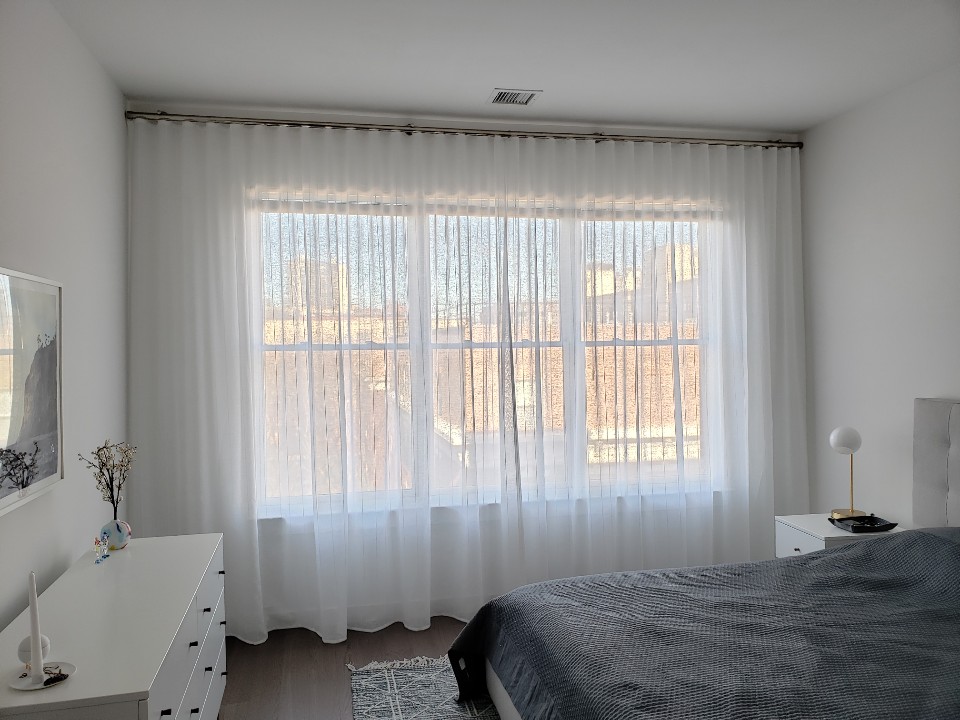
Daytime privacy, and nothing after dark
A sheer works on the brightness difference between the two sides of the glass. That is the whole mechanism, and it is why the same panel behaves in opposite ways at two in the afternoon and nine at night.
By day the outside is far brighter than the room. Light scatters off the face of the weave before it gets past, so from the street a sheer reads as a soft bright wall and the room behind it disappears. From inside you look straight through, because your eye follows the light. It is not a coating or a finish. It is brightness, doing all the work.
After sunset it reverses. Turn on a lamp and the room becomes the bright side. The weave that hid you at noon now backlights you, and from across the street someone sees shapes, movement, and enough detail to count the people in the room. Most people learn this at night, standing on their own sidewalk, with the panels already hung.
We would rather say it before you order. If a window has to be private in the evening, a sheer is one layer of the answer and not the whole of it, and the second layer has to be planned while the hardware is still a drawing. Decided afterwards, it means drilling a rod into a wall that has already been patched and painted.
- Daytime privacy. Real, and better than people expect. Lit from behind by the sky, a sheer is close to opaque from outside.
- Night privacy. None, once a lamp is on. This is the fact the rest of the page is built around.
- Glare. Softened, not solved. A sheer spreads direct sun into an even light, which is genuinely pleasant, but a low west sun still finds you.
- Heat and UV. Barely touched. An open weave is not a barrier, so a hot room needs something at the glass — usually a solar shade behind the panels.
How much fullness a sheer actually needs
Fullness is how much fabric width goes on the rod compared with the width of the rod itself. On a lined drape it is a matter of taste. On a sheer it decides whether the panel reads as drapery or as a stretched sheet, because there is nothing else there for the eye to hold on to.
Two times: the floor, not the target
Twice the track width is the standard multiple across drapery, and it is the floor for a sheer rather than the target. You get folds, the panel reads as fabric rather than a screen, and the stack stays tight against the wall.
The trouble is that you see through the flat part of every fold. At 2x the rod, the wall and the frame show through, and the fabric looks pulled rather than gathered. It is the right call behind a drapery panel that carries the look, or on a run wide enough that stack-back decides everything.
Best for sheers hidden behind an outer panel, and wide runs where stack space decides it.
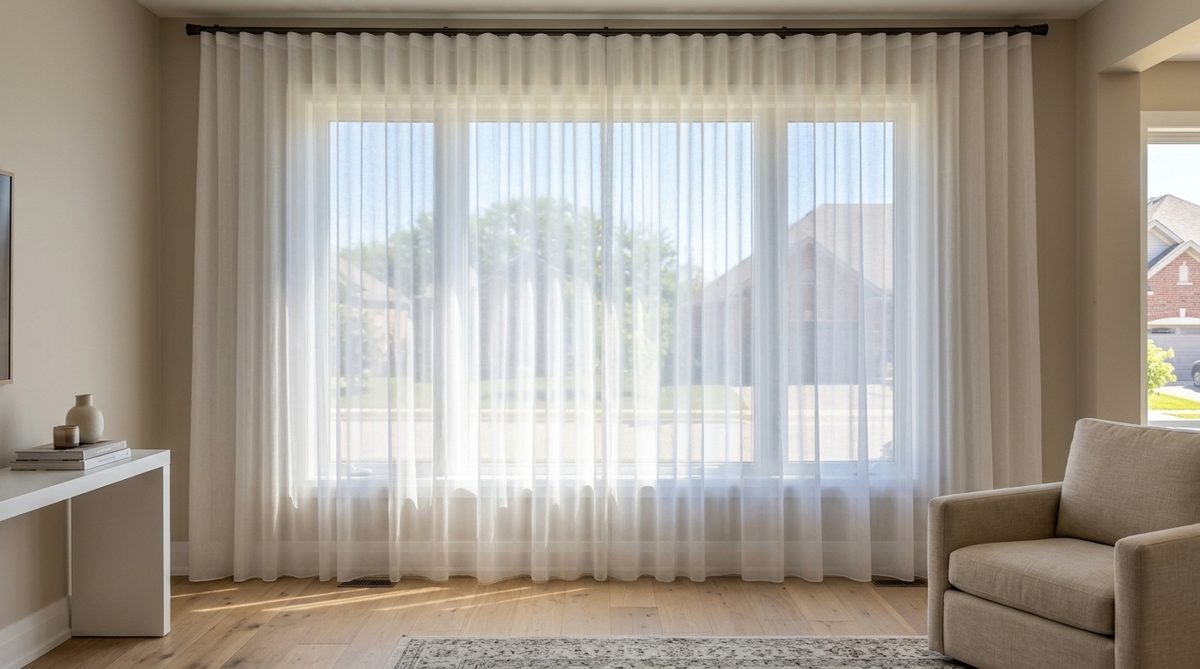
Two and a half: where most sheers land
The one to ask for unless there is a reason not to. There is enough fabric for the folds to close on themselves, so the panel holds an even wave instead of flattening into a sheet. Daytime privacy improves as a side effect, because the doubled-over part of a fold is where the fabric is genuinely dense.
The extra fabric costs real money but little against the whole job, and the stack grows by about the same proportion. On a normal window that is a couple of inches a side.
Best for most living rooms, bedrooms and dining rooms.
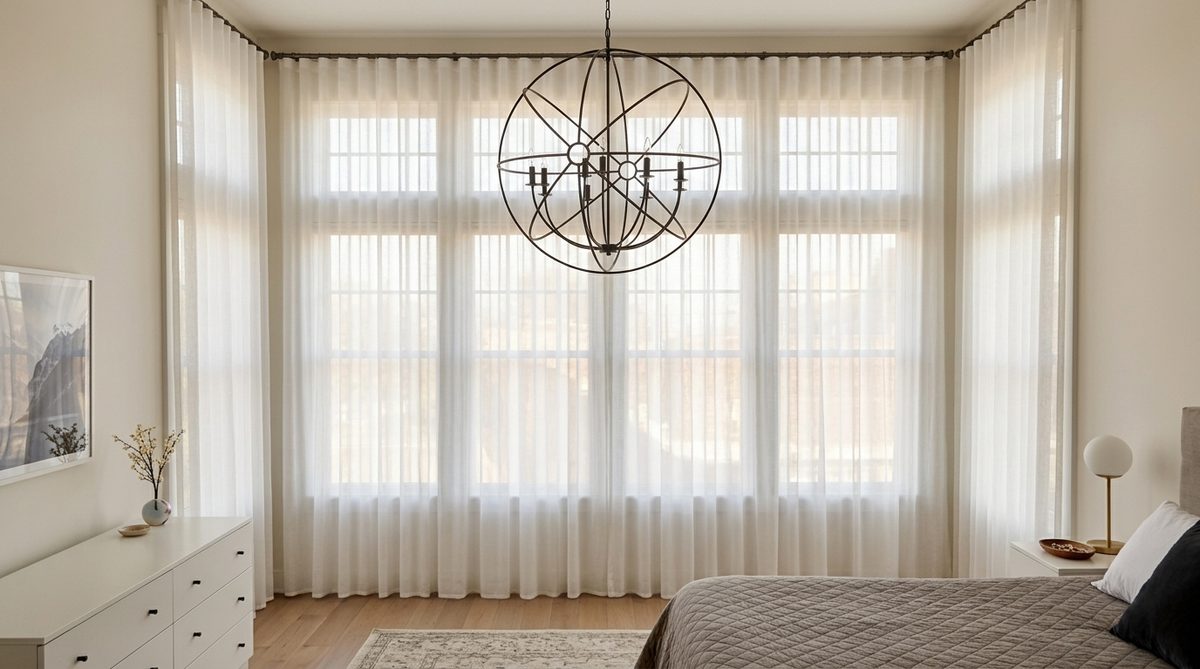
Three times: when the sheer is the whole treatment
When nothing else is on the window and the window is why the room works, 3x is what makes it look like the photographs people have in mind when they call. The folds are deep enough to hold their own shadow, and the panel keeps its shape drawn across or pushed back.
You pay for it twice, in fabric and in wall. Half again as much fabric as 2x, and enough stacked width to sit over a foot of glass a side unless the rod runs well past the frame. On a wall that cannot take a wider rod, 3x is the wrong answer however good it looks.
Best for tall windows, rooms where the sheer is the only layer, ripplefold on a long run.
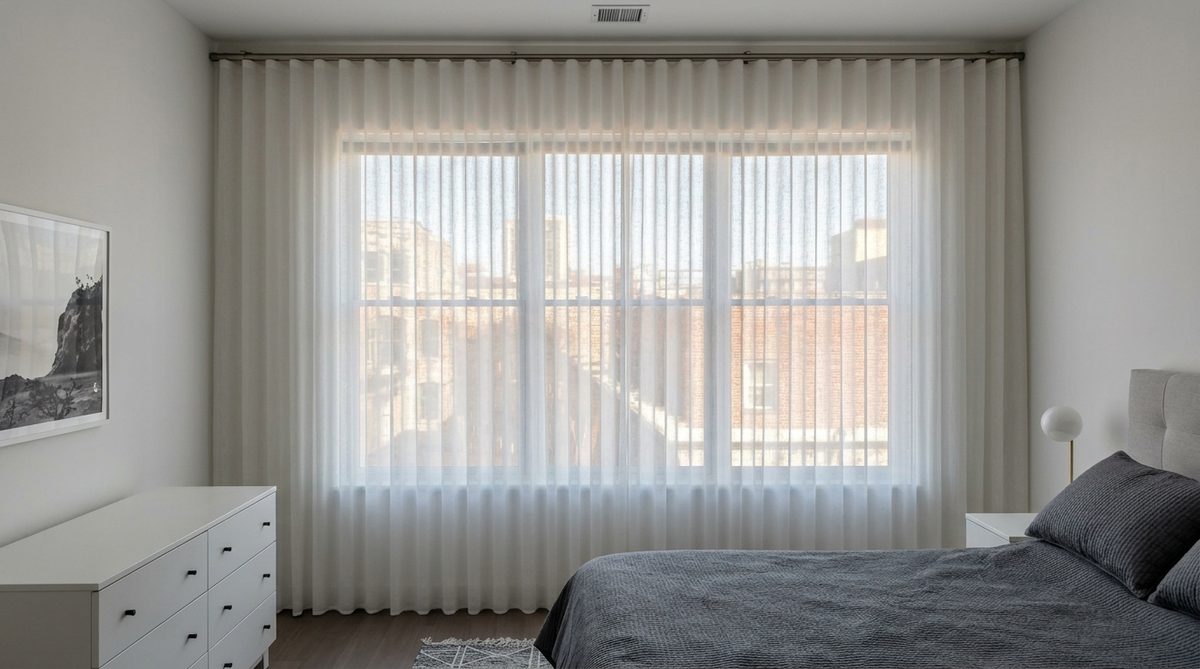
Layering sheers with drapes
The standard fix for the night problem, and the reason most of the sheers we make are half of a pair. It is a hardware decision before it is a fabric one.
The order does not vary. Sheer closest to the glass, heavier panel outside it. The sheer is the layer you move daily; the outer panel closes at night and otherwise sits stacked against the wall framing the window, which is exactly what it should be doing.
Two ways to hang it. A double rod puts the layers on separate brackets a few inches apart, which is simple and right when the two treatments want different lengths or the outer panel is heavy. One track carrying two rows of carriers keeps the top of the window clean and suits a modern room, but whether the wall or ceiling can take the weight has to be settled before anything is cut.
The number that catches people out is stack-back. Two layers park beside each other, not on top of each other, so the wall you need next to the window is roughly double. On a picture window with eight inches of wall to one side, layering will cover glass. That is not a reason to skip the second layer. It is a reason to measure the wall before choosing the treatment.
- Sheer inside, panel outside. Always. The layer you touch daily belongs closest to the light.
- Hardware first. Double rod, or one track with two rows of carriers. Adding the second rod later means drilling a finished wall.
- Double the stack. Two layers need roughly twice the wall beside the window, or the panels sit on the glass.
- One panel that does both. Soft fabric vanes hung between two sheers give you the sheer look and a closed position on a single track. Hunter Douglas calls theirs Luminette, and it is the answer when the wall only takes one track.
Sheer panels for sliding doors
The widest opening in most houses, the one people walk through, and the one where a wrong decision shows. Three ways to do it in sheer, with the same stack-back problem sitting under all three.
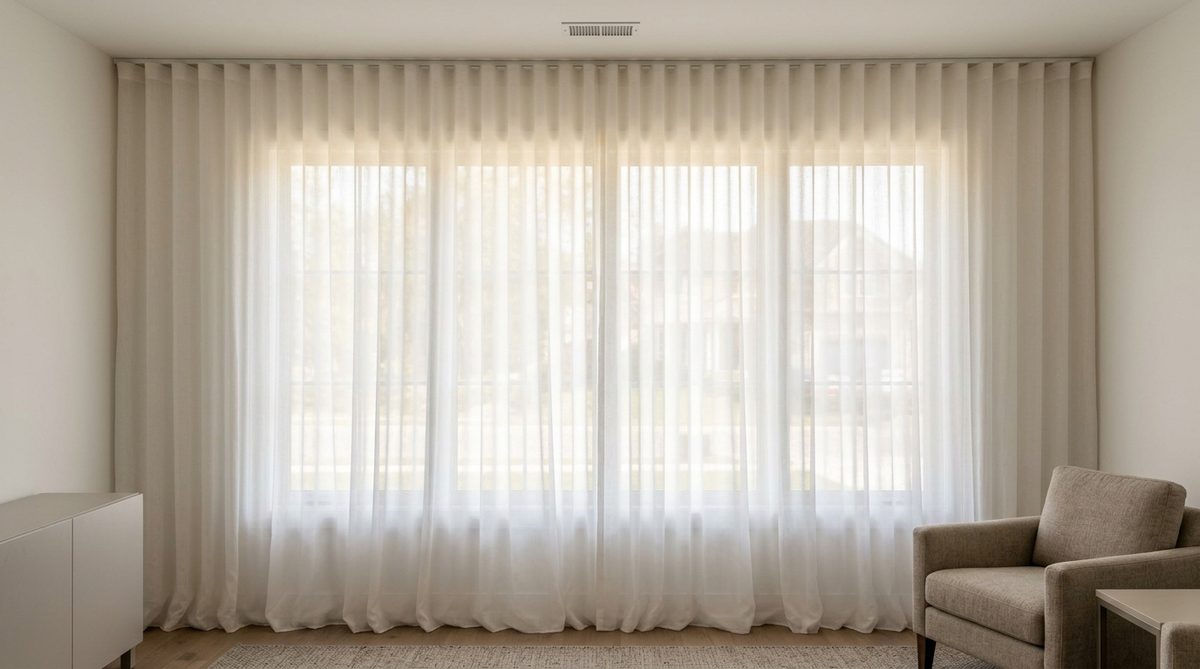
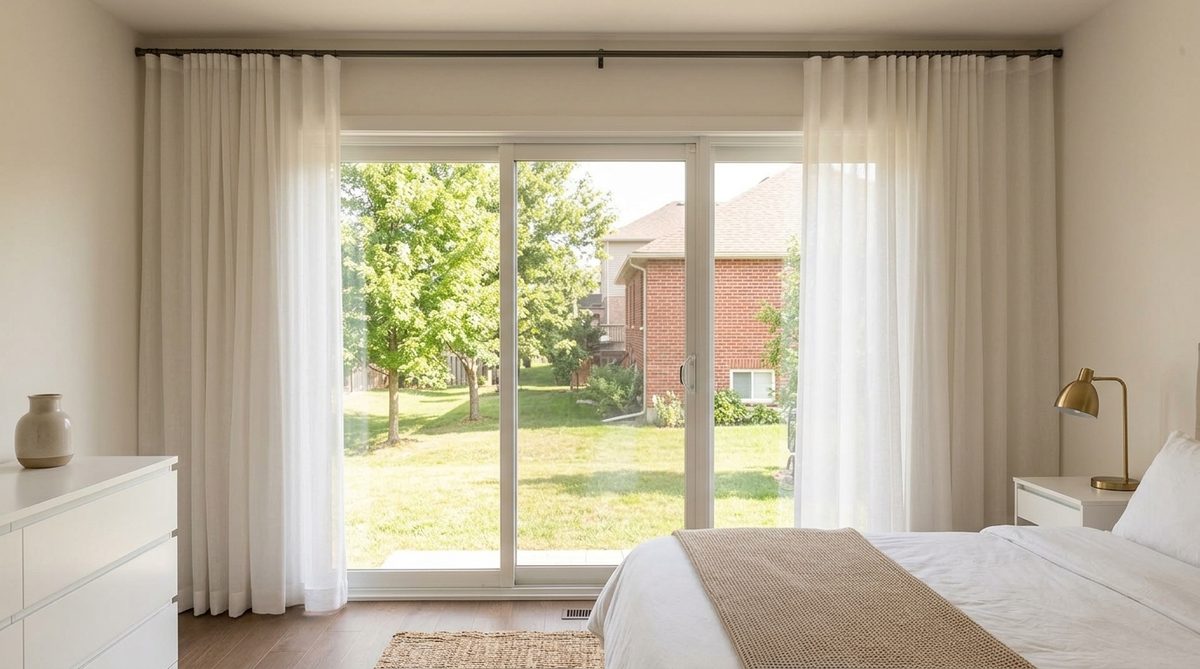
A sheer on its own across the door
The lightest-looking way to cover a slider and the easiest to walk through. The panel splits in the middle or draws one way, and you push it aside to use the door. Facing a garden rather than a street, it is often all the door needs.
The catch is the one at the top of this page, only bigger. A slider is usually the largest piece of glass in the house, and often the one facing the part of the yard the neighbors can see. At night, with the kitchen lights on, it shows the room clearly.
Best for doors onto private gardens, upper-floor balconies, rooms that go dark in the evening.
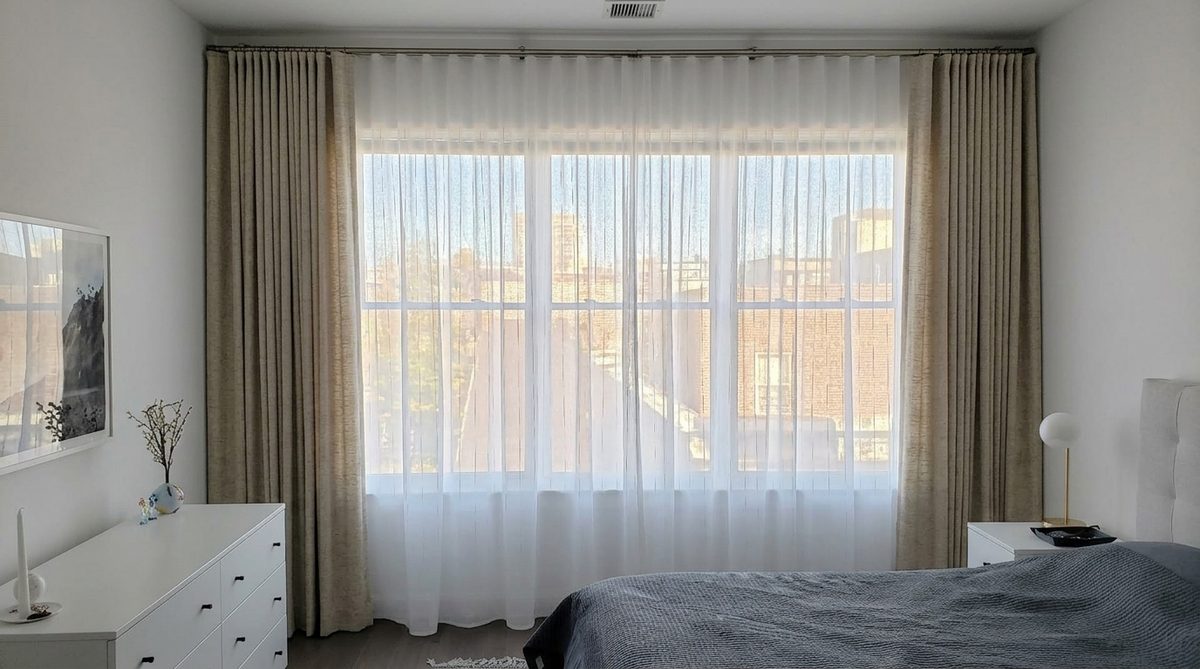
Sheer with a drapery panel over it
The usual answer, and the one that treats a slider properly. Sheer drawn by day so the room keeps its light and the glass is still covered, drapery closed in the evening once the sheer has stopped doing anything.
Stack-back is the design problem. Two layers across a nine-foot opening park in a lot of wall, and with no wall beside the door they park on the glass and you lose part of the doorway. A one-way draw sends everything to the side that has the wall, and running the track past the frame buys back the rest. Both are decided with a tape measure in the room, not from a catalog.
Best for most sliders, particularly living rooms and kitchens used after dark.
Fabric vanes between two sheers
One panel with soft vertical vanes hung between two layers of sheer. Open, it looks and behaves like a sheer. Rotate the vanes and the same panel closes the room, so a single track does both jobs.
It suits a slider better than almost anything, because the stack is one layer instead of two and the vanes rotate rather than having to be drawn clear of the glass. It costs more than a plain sheer panel, and it is a manufactured system rather than a made-to-order fabric panel, so treat it as a question for the consultation rather than a default.
Best for wide sliders with no wall to stack into, where one track has to do everything.
Sliders have a page of their own with every option on them, sheer and otherwise — see window treatments for sliding doors if the door is the reason you are here.
How the panel is headed, and how you will draw it
The heading shows more on a sheer than on any other panel, because light comes through the top of the fabric and puts the construction on display.
Ripplefold
Snap carriers on a track hold the fabric in one continuous even wave, with no pleats at all. The cleanest look on a sheer and the most forgiving over a long run. Fullness here is quoted as a percentage of the track rather than a multiple, so ask which percentage you are being priced at before comparing quotes.
Long runs and slidersPinch pleat
Pleats formed by hand and sewn into a stiffened band at the header. On a sheer that band shows as a denser strip across the top, which some people like and some do not. Hold a sample up to the light first.
Traditional roomsGrommet and rod pocket
Both put the fabric straight onto a rod. Simple, informal, drawn by hand every time. On a wide sheer the fabric drags across the rod more than people expect, so they suit narrower windows.
Narrow windowsMotorized track
A sheer gets moved more often than anything else hanging in the house, which makes it a better candidate for a motor than heavy drapery. On a stair landing or a two-story window it decides whether the panel gets used at all.
Tall and out-of-reach glassHems and weights
Sheer fabric has almost no weight of its own, so the hem does the hanging. A doubled hem gives the panel something to fall against, and on a wide sheer a chain weight along the bottom stops it lifting every time a door opens.
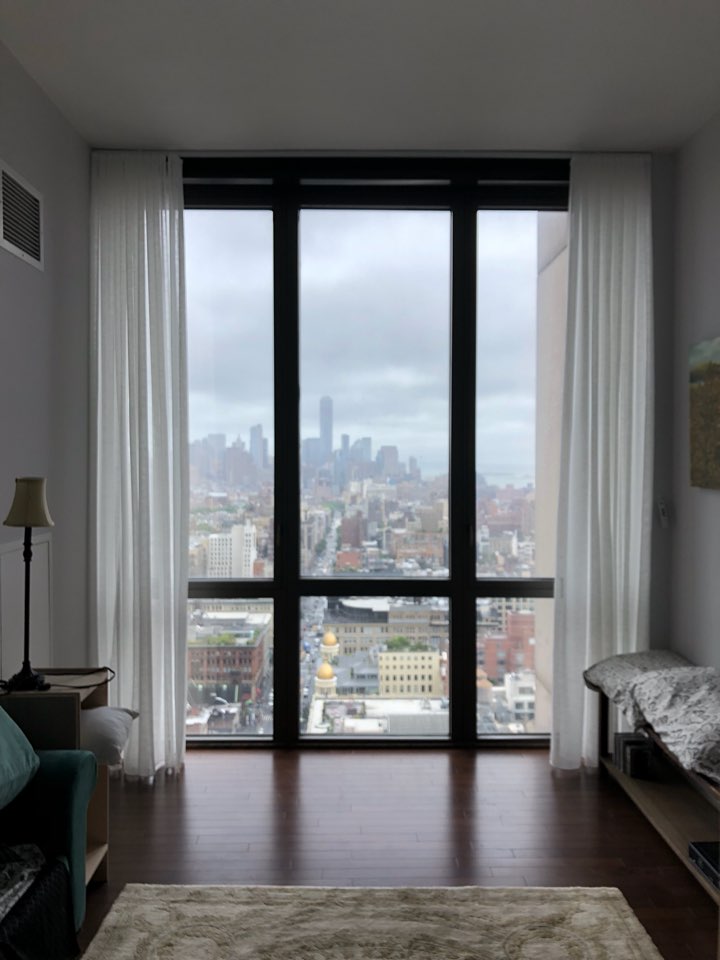
Why some sheers hang badlySheer curtains we have made and hung
No stock photography, no showroom staging — homes and offices across Bergen County and the Tri-State.

What actually drives the price
Sheers are priced by the fabric that ends up on the rod rather than by the size of the window. Those sound like the same thing and they are not, which is why two windows of identical size can come back at different numbers.
01Fullness
The biggest lever on this page. A panel at 3x uses half again as much fabric as the same panel at 2x, and the header takes proportionally longer to make. It is also where the look comes from, so it is the number to discuss openly rather than the one to trim quietly.
02Fabric width and where the seams fall
Sheer fabric is often woven extra wide and then used sideways, so a tall window can be made with no vertical seams at all. It costs more per yard and saves labor, and on a sheer it is frequently worth it outright: a seam that disappears inside a lined drape shows as a dark line through a sheer whenever the sun is behind it.
03Heading and workroom time
A ripplefold header on snap tape and a hand-formed pinch pleat are different amounts of work. Sheer fabric is also slower to handle than any other drapery fabric. It moves under the needle, it shows every stitch from both sides, and hems are doubled so the two layers read as one density.
04Hardware, and how far it runs
Track and rod are priced by length, and a sheer wants a rod that runs well past the frame so the panel can clear the glass. Layering doubles that, as a second rod or a track carrying two rows of carriers. Ceiling mounts and returns add again.
05Motorization
A motor and power per track. It earns its cost more often on sheers than on heavy drapery, because a sheer is moved daily rather than seasonally, and because these are often the tall windows nobody wants to reach.
Why we don't publish a price list. Two windows in the same room can price differently once you account for size, fabric and mount. We measure and quote every window during the free consultation, so you see the number before anything is ordered. Book one here.
Measured to hung in about two weeks
Free consultation
We come to you, so you're judging the room in the light the shade will actually live in.
Measure & design
Every window measured to the sixteenth, with a designer's eye on mount, stack and fabric.
Made for your window
Hunter Douglas or our own Korean workroom — built to your opening, never trimmed from stock.
Installed & tidy
Professionally hung, tested, and the packaging leaves with us. Usually a single visit.
Sheer curtain questions we get asked
Can people see through sheer curtains at night?
Yes. A sheer works on the brightness difference between the two sides of the glass, so once the room is the brighter side the effect reverses. With a lamp on, someone outside sees shapes, movement and more than people expect. If the window needs privacy in the evening, plan a second layer — a drapery panel over the sheer, or a blackout shade behind it.
Do sheer curtains give any privacy at all?
During the day, yes, and more than people expect. The outside is brighter, so light scatters off the face of the fabric and the room behind it disappears from the street while you still see out. The privacy is one directional, and it lasts exactly as long as the outside stays the brighter side.
How much fullness do sheer curtains need?
Two and a half times the track width for most rooms. 2x is the minimum and it works behind an outer panel or where stack space is tight, but on its own a sheer at 2x looks stretched and the rod shows through the flat parts of the folds. 3x is for tall windows and rooms where the sheer is the only treatment. More fullness means more fabric, more cost and a wider stack when the panel is pushed back.
How do you layer sheers with drapes?
Sheer closest to the glass, heavier panel outside it, on either a double rod or one track carrying two rows of carriers. Decide which before ordering — retrofitting a second rod means drilling a wall that has already been finished. Check the wall beside the window first: two layers stack side by side, so they need roughly twice the wall a single sheer does, or the panels cover glass.
Do sheer curtains block heat or UV?
Barely. An open weave spreads direct sun into a softer, more even light, which helps with glare, but it is not a barrier and it does little about heat or fading. If the room gets hot or the floor is fading, the fix belongs at the glass — usually a solar shade behind the panels.
Will sheer curtains work on a sliding glass door?
Yes, and it is one of the places they look best — but the stack matters more than the fabric. Panels have to park somewhere when the door is in use, and on a wide opening with no wall beside it they park on the glass. A one-way draw stacks everything to the side that has wall, and running the track past the frame buys back the rest. Fabric vanes hung between two sheers are the other answer, since they rotate closed instead of being drawn clear.
How long should sheer curtains be?
Floor length, finishing about half an inch above the floor. A sheer shows an uneven hem more than heavy fabric does, and it is light enough that a panel resting on the floor catches and hangs crooked. Puddling photographs well and collects dust in practice, so it is worth deciding on purpose rather than by default. Sill length suits kitchen and bathroom windows where a full-length panel would be in the way.
How long do custom sheer curtains take?
Usually about two weeks from approval to installation. Layered jobs and anything on a motorized track can run longer, because there is hardware to coordinate as well as fabric. We tell you the timeline before you order rather than after.
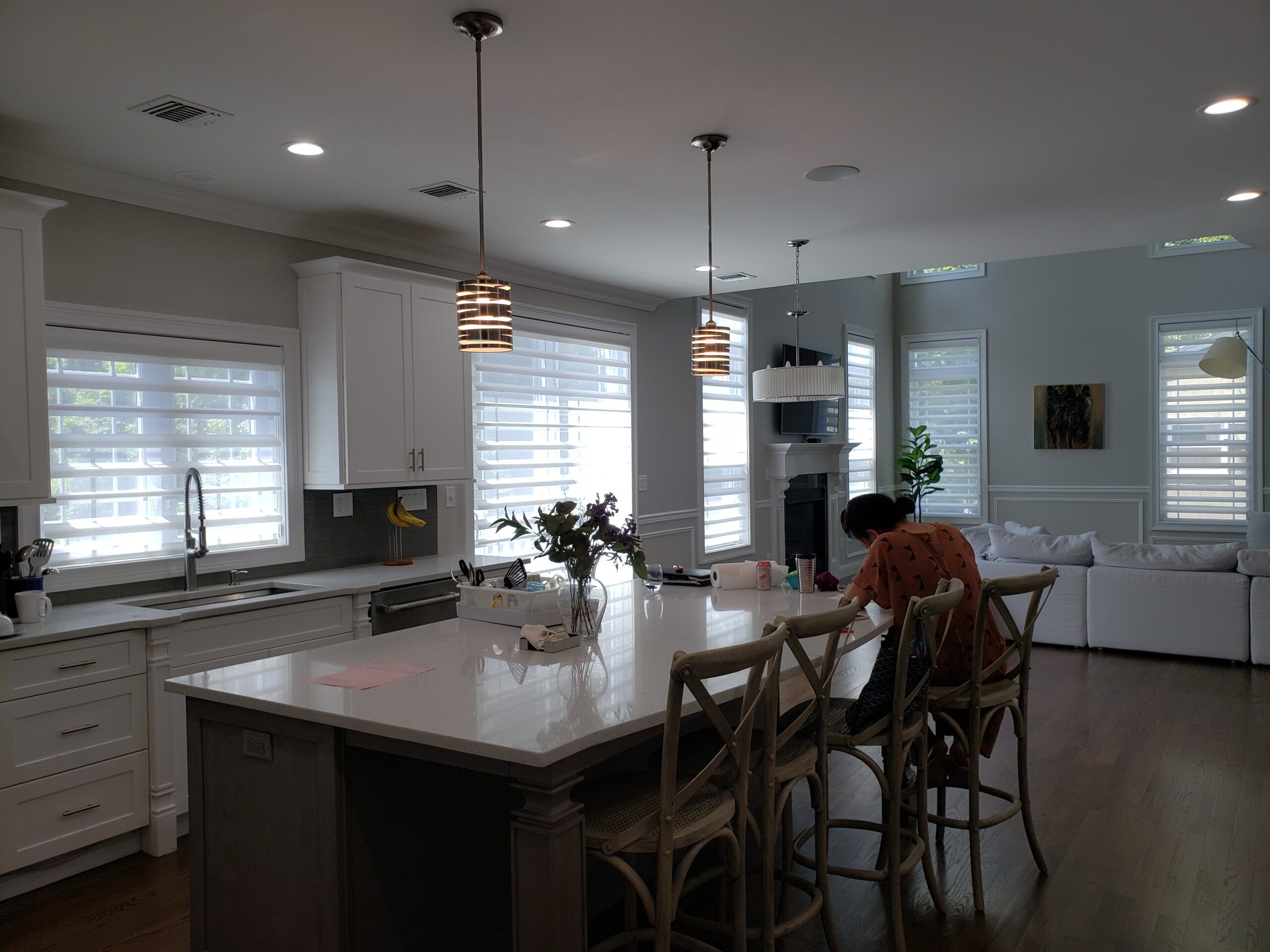 ShadesRoller, solar, zebra, cellular and more
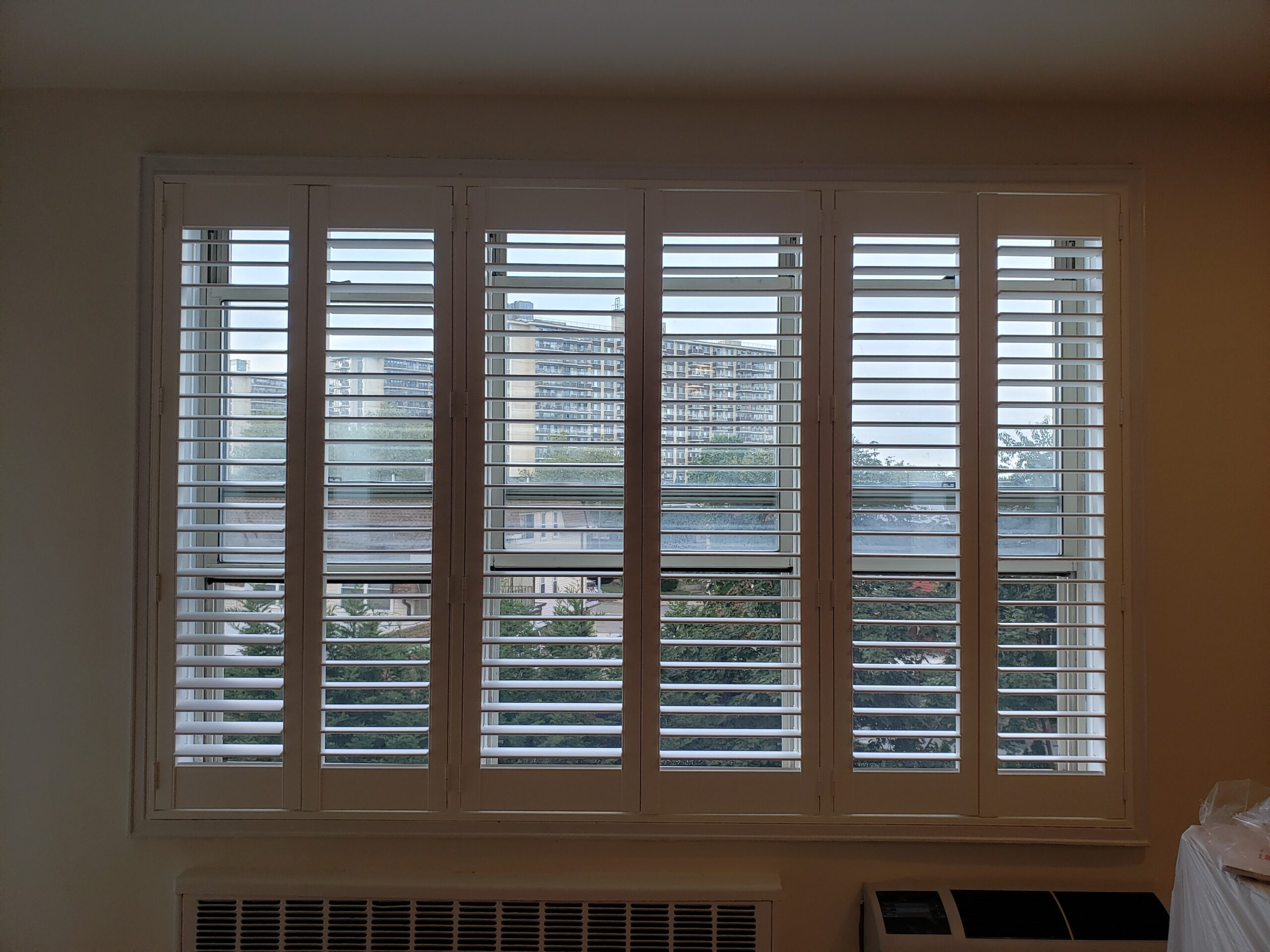 Plantation ShuttersBuilt into the frame, never raised
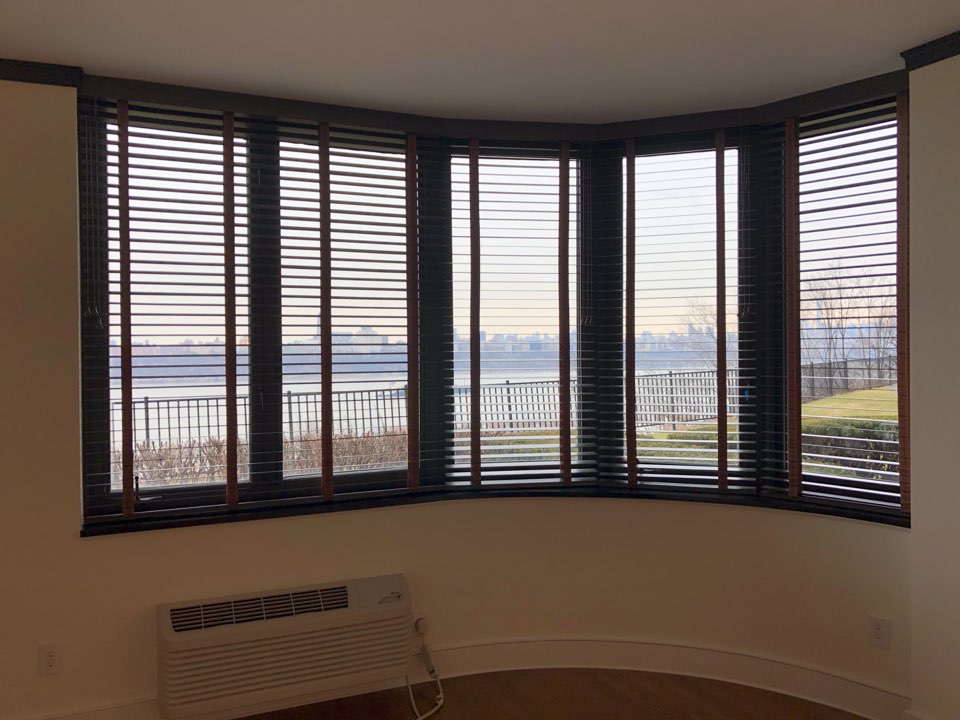 BlindsWood, faux wood and vertical
4.9 across 314 Google reviews
“Highly recommend this place for window treatment for the quality of the product and reasonable price. Jason Park is very nice and professional. He did both my blackout roller shade for the bedroom and the living room curtains. I am very satisfied with the result.”
★★★★★ a year ago
“We had a wonderful experience with The Curtain. Especially the manager, Jason, went above and beyond our expectations, so professional and attentive throughout the entire process. We ordered zebra blinds, and everything from the initial quote to installation went incredibly smoothly. The blinds look beautiful.”
★★★★★ 6 months ago
“Jay must have come to our house between four and six times, as we went back and forth on zebra shades or roller shades, and samples after samples. We chose the Korean manufacturer with Tide White as our color. Shades arrived within two weeks and installation took under two hours.”
★★★★★ a year ago
Visit the showroom
Prefer to see things in person before we come to you? We're on Broad Avenue in Palisades Park, a few minutes from Fort Lee and the GWB.
- 547 Broad AvenuePalisades Park, NJ 07650
- Mon–Fri 10–7 · Sat 10–5Closed Sunday
- (201) 302-9111We usually pick up on the first ring