Vertical Blinds
Vanes that hang from a track, tilt for the light, then draw sideways and park off the glass. On a sliding door that pairing still has no real rival — which is why verticals outlasted the decade that gave them their reputation.
 ★★★★★ 4.9 · 314 reviews (314)
 Partner
~2 weeks to install~2 wks
Partner
~2 weeks to install~2 wks
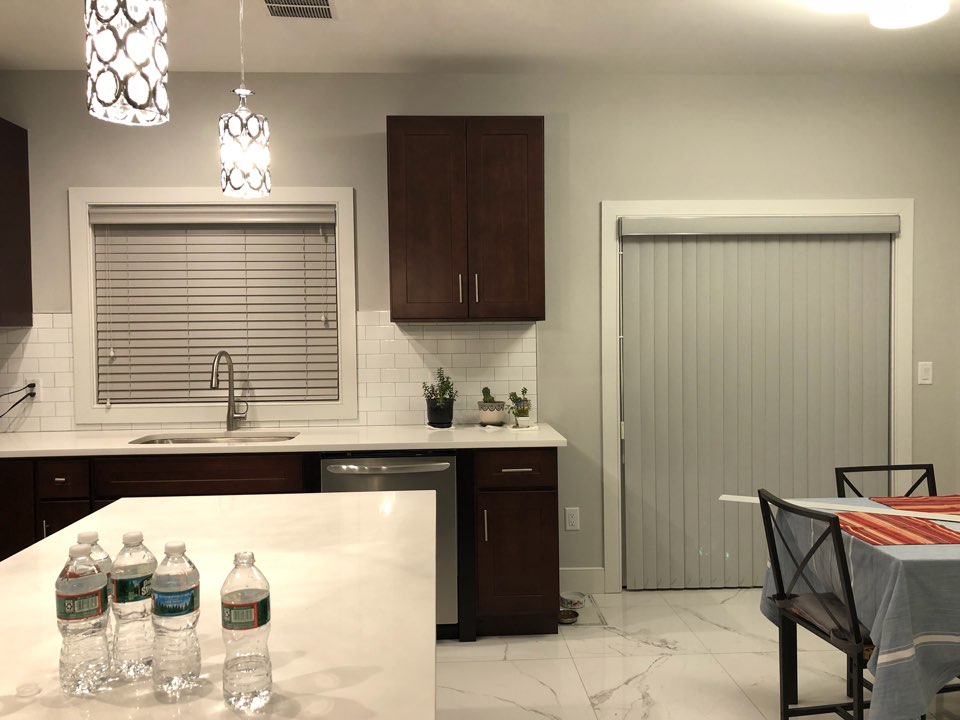
What a vertical blind actually does
Two jobs on one track. The vanes rotate to aim the daylight, and the whole set draws sideways to give you the opening back.
Inside the headrail is a row of carriers on a track, one vane each, all geared to the same tilt rod — so one twist of the wand rotates thirty vanes together. A separate control slides the carriers along and bunches them at one end. Tilt and traverse.
Width is the underrated part. A ten-foot horizontal blind is a ten-foot beam holding itself straight, which is why wide horizontals get split into two or three sections on a shared headrail. A ten-foot vertical is thirty small pieces hanging independently.
- Tilt and draw are separate. Rotate the vanes for light without moving them, or pull the set aside for a clear opening.
- Width costs you nothing. Thirty independent vanes rather than one long slat, so a twelve-foot run behaves like a four-foot one.
- A single vane is replaceable. If one cracks it unclips from its carrier and a new one goes on. You are not replacing the blind.
- It will never be dark. Closed vanes overlap, but there is a seam down every join. Privacy and glare, not blackout.
Vertical blinds for sliding doors and patio doors
This is the opening the product was built around. Four cases we get asked about, including the ones where the answer is no.
Sliding glass doors: the reason this product exists
A slider is six to twelve feet of glass with a working door in the middle of it. Cover it with anything that lifts and you raise the whole treatment every time someone carries a tray out to the deck.
The detail worth getting right is which end the stack lands on. Draw the blind so it parks over the fixed panel and the panel you slide stays clear. Backwards, and you are moving the blind to open the door anyway.
Best for six to twelve foot sliders, and any glass door you walk through daily.
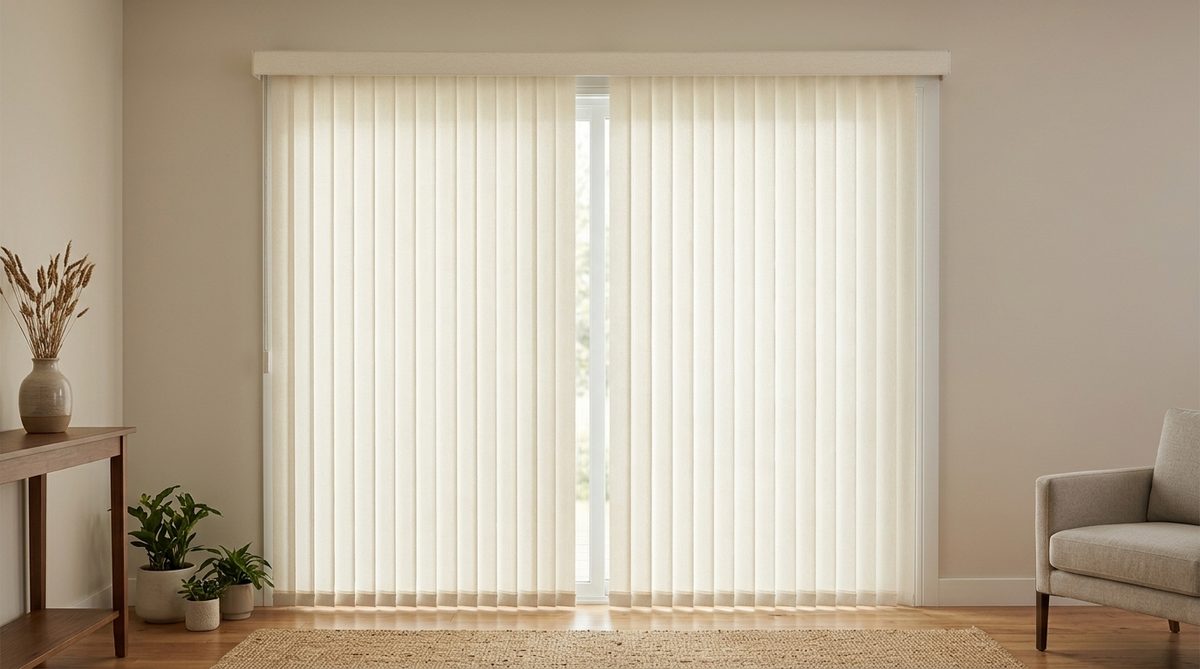
Patio doors: mind the handle and the floor
Patio door blinds live or die on clearance. A slider handle stands proud of the glass, and vanes hung flat to the frame will catch it. Extension brackets hold the track far enough off the wall for the vanes to swing past the hardware.
The floor is the other one. Vanes hang about half an inch clear so they do not drag, measured from the highest point along the run — a tile step at a threshold changes the finished length, and that length is cut before the vanes arrive.
Best for sliding patio doors, atrium doors, anything with hardware standing out from the glass.
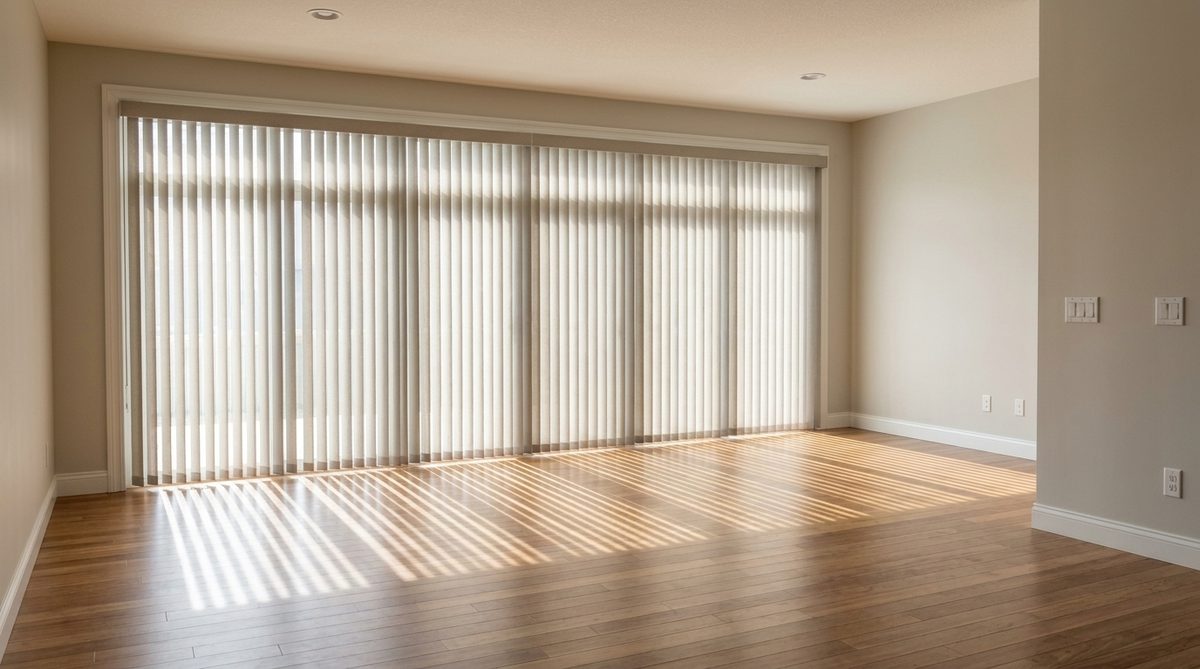
Window walls: verticals scale where other blinds stop
On a long run of glass with no door in it, a vertical is still often the practical answer. It covers the span as one uninterrupted surface with no split down the middle, and it weighs almost nothing at the bracket.
Be honest about why, though. If the only reason is width, and you never walk through that glass, a wide roller or a panel track may look better. The sideways draw is what you are paying for.
Best for runs past eight feet, and openings a horizontal blind would have to be split across.
The openings where we steer you elsewhere
French doors that swing inward. A vertical hangs in the arc of the door, so the only way to use it is to move the blind first, which defeats the point.
Small windows, too: a vertical on a thirty-inch bedroom window is technically fine and looks like a waiting room, because your eye reads the proportion of vane to opening. And no vertical in any material will make a room dark.
Best for none of these. If your window is on this list, we will bring different samples.
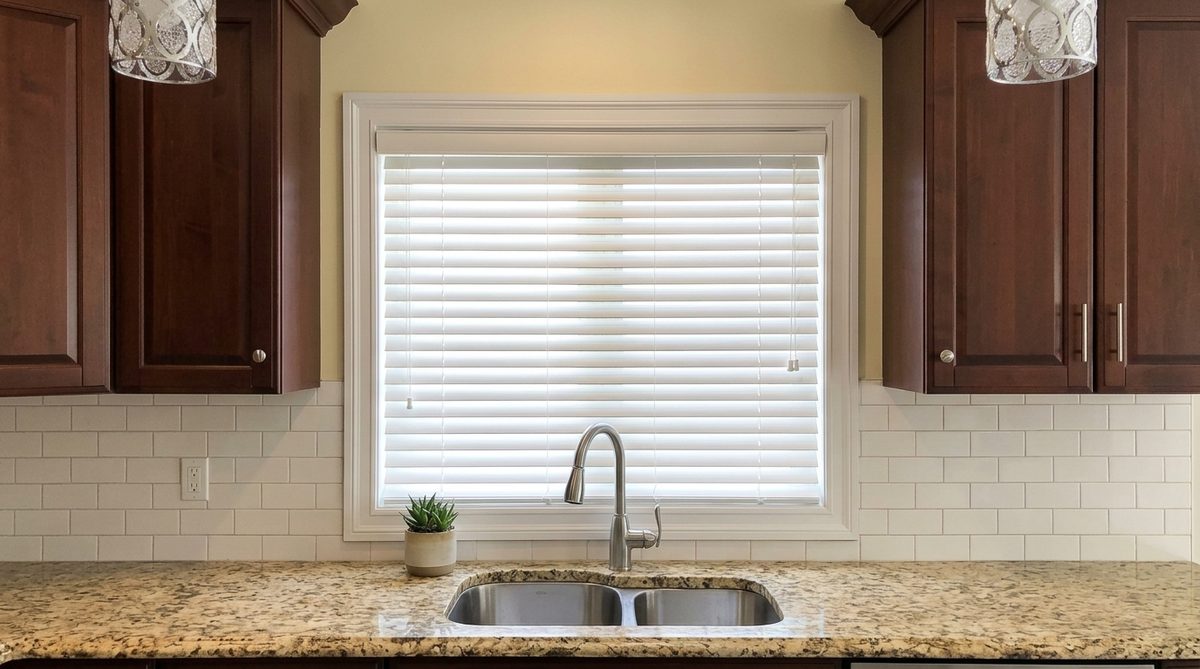
Stack back is the measurement nobody asks about
The most common regret on a vertical blind is not the colour or the material. It is how much glass the vanes still cover when the blind is open.
Stack back is the width the bundled vanes take up when the blind is drawn fully aside. A wide slider carries thirty-odd vanes, each bunching to roughly half an inch, so well over a foot of track is occupied before you have opened anything. If that foot sits in front of the glass, it is view you paid for and cannot see through.
The fix is in the mounting, not the blind. Where there is wall beside the opening we run the track past the frame so the stack parks on plaster; where there is not, we decide where it does least damage. It is the honest reason we measure in the room — handle position, which panel is fixed and how the traffic flows all feed one decision, and once the track is cut none of it can be revisited.
- One-way draw. Everything stacks at one end. Right when only one side of the opening has wall to park against.
- Split draw. The stack divides and the opening parts in the middle. Halves the width at each end.
- Stack off the glass. Run the track past the frame and an open blind covers plaster instead of view. Costs almost nothing.
- Ceiling or wall mount. A ceiling track buys full-height drop. A wall mount is easier to level when the ceiling is not.
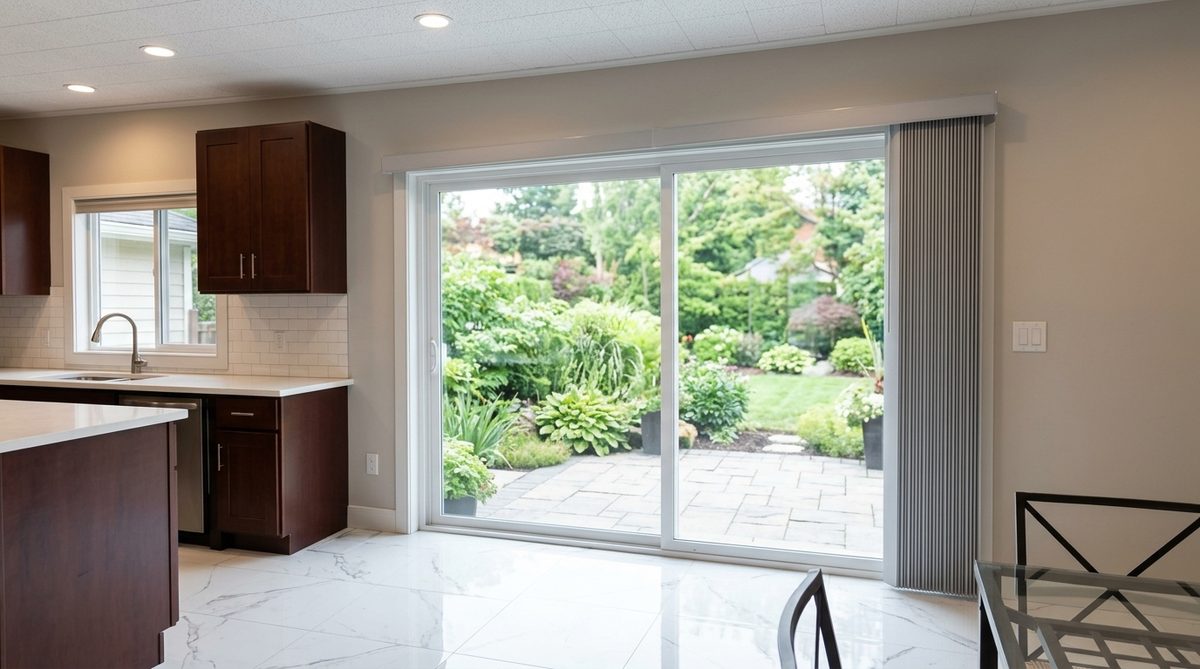
The dated reputation, and what actually fixed it
Verticals earned that reputation honestly, some time around 1994. Most of what made them look cheap has since been designed out.
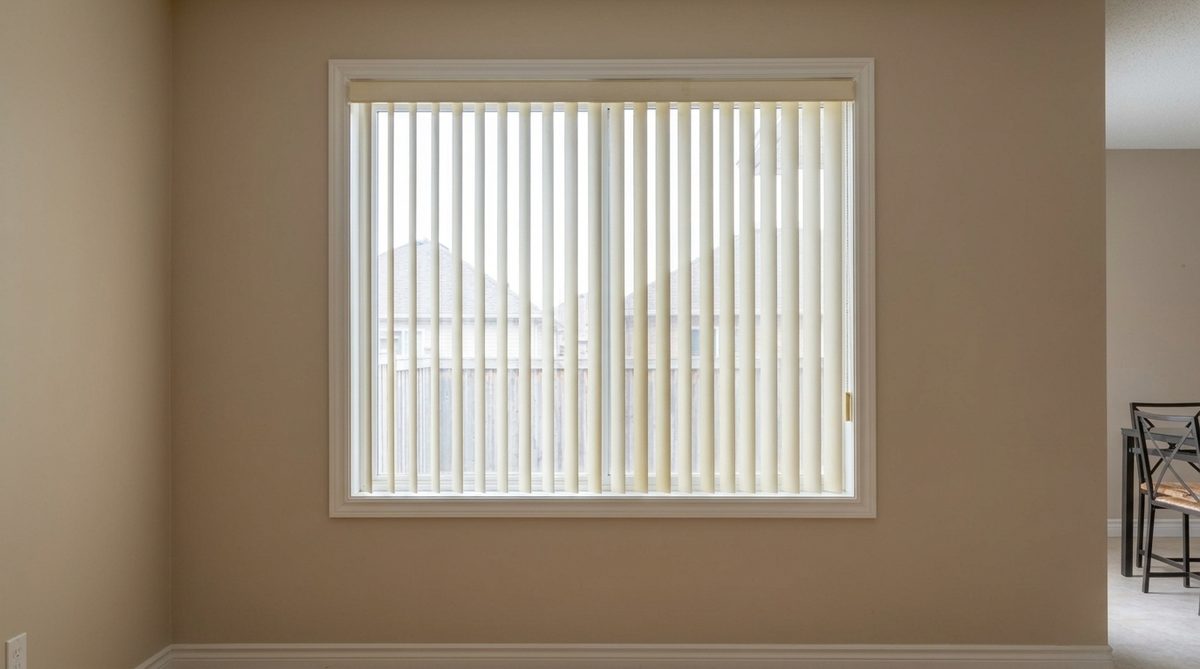
What people are actually picturing
A flat white PVC vane, thin enough to bow in the sun. A chain along the hem that clicked whenever the heat came on. Yellowing at the top, and one vane always cracked through the punch hole it hung from.
Every item on that list is a specification, not a mechanism. The track, the carriers and the tilt gear were never the problem, and they are the parts that have not changed.
Best for nothing. This is the version we are trying to talk you out of.
Fabric vanes: the single biggest change
A fabric vane hangs like a narrow drapery panel. It has drape, it moves when the room moves, and it absorbs sound rather than clicking. What reads as commercial is the hard flat edge, not the fact that the thing is vertical.
The trade is upkeep. Fabric holds dust and shows a mark where vinyl wipes clean, and a free-hanging vane swings in a draft — charming in a living room, irritating beside a door that is open all summer.
Best for living rooms, dining rooms, bedrooms, and any door you look at all evening.
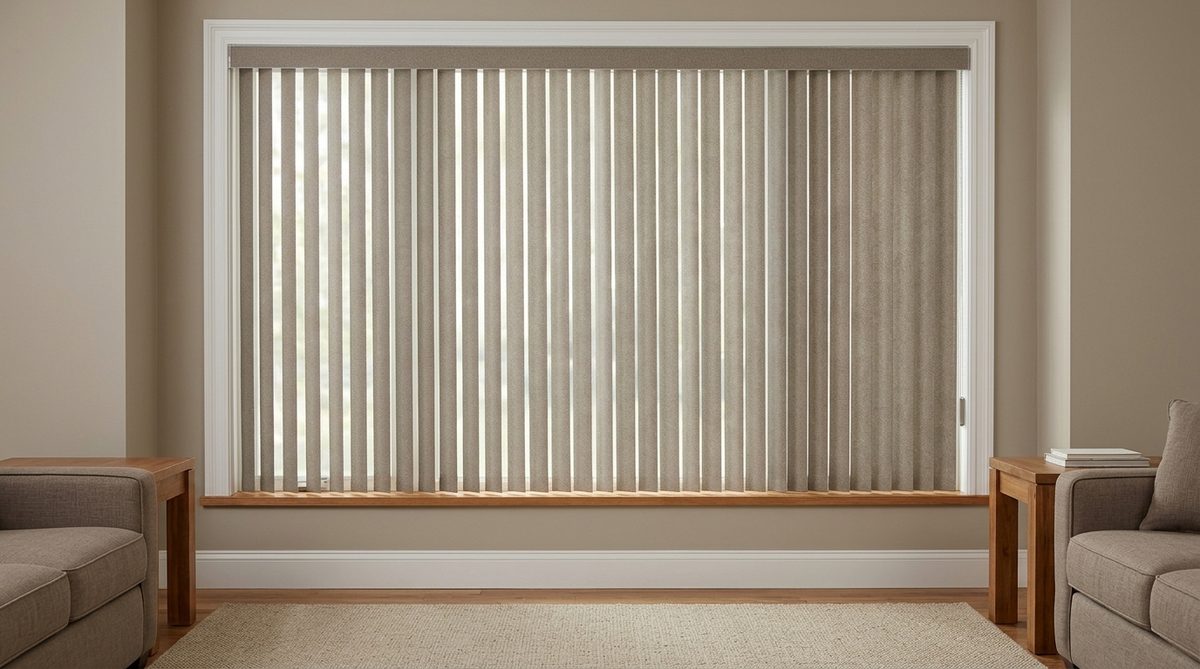
S-curve vinyl: the practical upgrade
The vane is extruded with a gentle S profile rather than pressed flat. It holds its shape instead of bowing, it overlaps its neighbour more completely when closed, and the curve catches light, so the run reads as a ribbed surface instead of a row of blades.
It also wipes down, which is why it goes on the kitchen slider and the basement door. Current vinyl is textured and colour-matched rather than the gloss white everyone remembers.
Best for kitchens, basements, rentals, and anywhere the blind gets touched.
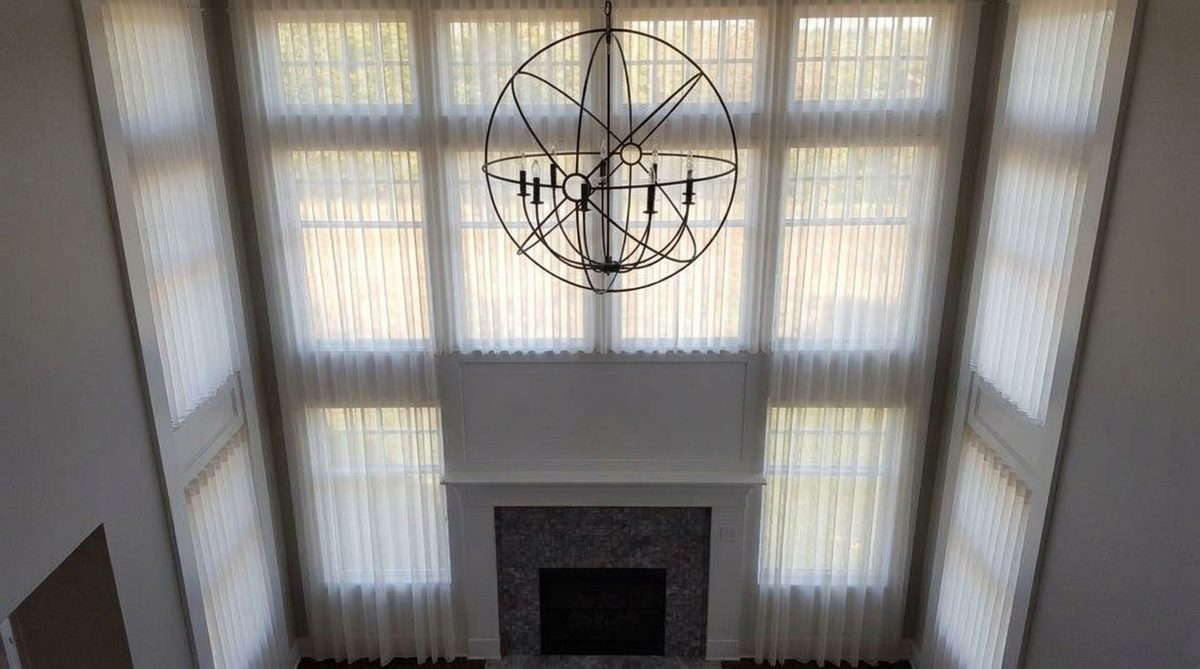
Vertical sheers: a vertical that reads as drapery
Fabric vanes suspended between two layers of sheer. They rotate and draw exactly like a vertical blind, so the control is identical, but from across the room you see a sheer rather than a track of vanes. Hunter Douglas calls this Luminette.
It costs considerably more and performs the same two jobs, so the decision is about the room rather than the window. On a living room window wall we think it earns the difference. On the basement slider it plainly does not.
Best for living rooms, window walls, and any door in the middle of a room you use.
Vertical blind alternatives worth seeing first
Drawing sideways is not the same thing as a vertical blind, and on some openings it is not the best version of the idea.
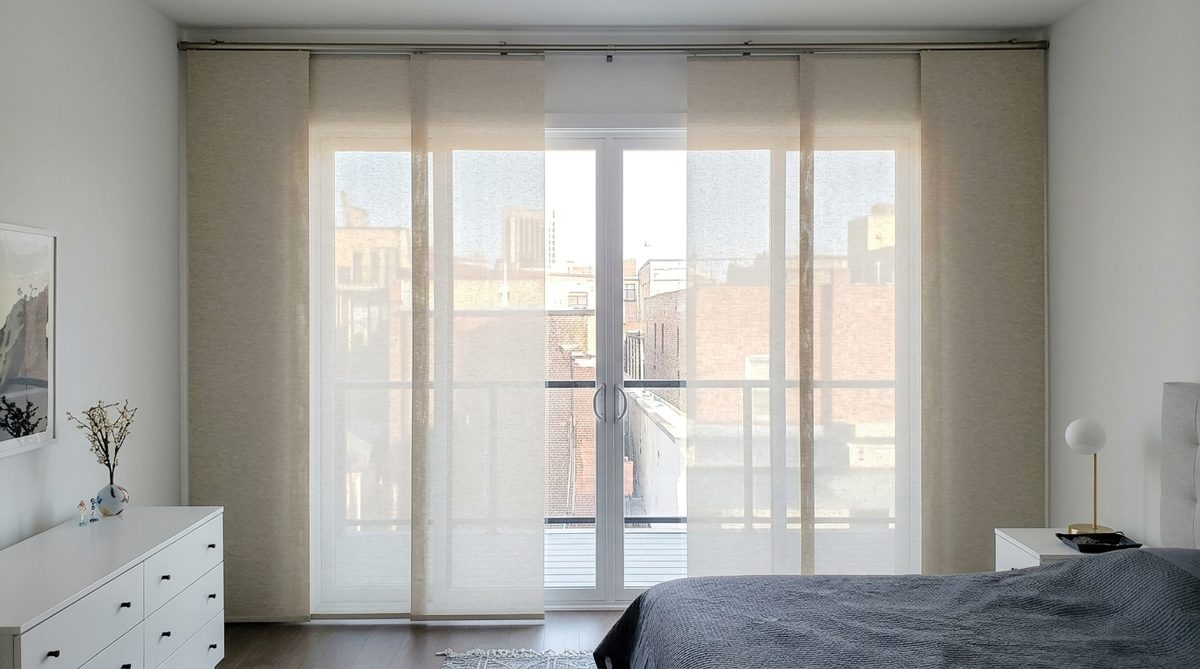
A panel track is the closest relative. Instead of thirty vanes it hangs three or four wide flat panels, each roughly a foot and a half to two feet across, sliding behind one another on a multi-channel track. On a very wide opening it is the calmest thing you can put up.
What you give up is control. Panels slide, they do not rotate, so you get covered, part-covered or open and cannot aim daylight at the ceiling. On a west-facing slider where glare is the complaint, that is a real loss. On a mudroom doorway, a panel track is the better-looking answer and we will tell you so.
- Panel track. Fewer, wider planes on a multi-channel track. Best on very wide openings and doors you want reading as architecture.
- Vertical sheers. The same mechanism in fabric and sheer. Costs more, tilts identically, stops the wall looking commercial.
- Wide roller shade. No stack across the wall, and the only one of these that will make the room dark. Best where the door rarely opens.
- Drapery on a traverse rod. Draws sideways and stacks off the glass. No tilt, so it is open or closed, but it is fabric floor to ceiling.
How you will tilt them and draw them
A vertical has two movements where most blinds have one, and the control sits at head height beside a door people walk through.
Wand and cord
Twist the wand to tilt, pull the cord to draw. Precise, inexpensive, and there is a cord beside the door.
The defaultWand only
One wand does both: twist to tilt, then push or pull the wand itself to move the vanes along the track. Nothing hangs.
Best around kidsMotorized
Tilt and traverse from a remote, an app or a schedule — PowerView on the Hunter Douglas side. Strongest case is glass too wide to walk twice a day.
Wide runs and window wallsBottom chain or free hang
A chain linking the hems keeps vanes aligned and stops them swinging. It is also the most dated-looking part of an old vertical.
Ask about the doorwayVertical blinds we have installed
No stock photography, no showroom staging — homes and offices across Bergen County and the Tri-State.

What actually drives the price
Vertical blinds are priced by the opening rather than by the vane, and they remain one of the least expensive ways to cover a very wide span. Five things move the number.
01The size of the opening
Width does the heavy lifting, because it sets the vane count and the track length. Height only adds material to vanes you were paying for anyway — the opposite of a roller shade, where height is what hurts.
02What the vane is made of
The biggest single lever. Flat vinyl at the bottom, textured and S-curve vinyl above it, fabric above that, a vertical sheer well above all of them. The gap between the cheapest and dearest vane on one track is wider than the gap between a small opening and a large one.
03How the blind draws
A straight one-way track is the simplest thing we make. A split draw adds hardware. A track that turns a corner into a bay is fabricated to your room, and it changes where the stack goes.
04Mounting and clearance
Extension brackets to clear a door handle, a ceiling mount instead of a wall mount, a valance over the headrail. Small numbers individually, and the difference between a finished door and a track screwed to a wall.
05The control
Motorization adds a motor and power per track, and on a very wide run it is what keeps the blind getting used.
Why we don't publish a price list. Two windows in the same room can price differently once you account for size, fabric and mount. We measure and quote every window during the free consultation, so you see the number before anything is ordered. Book one here.
Measured to installed in about two weeks
Free consultation
We come to you, so you're judging the room in the light the shade will actually live in.
Measure & design
Every window measured to the sixteenth, with a designer's eye on mount, stack and fabric.
Made for your window
Hunter Douglas or our own Korean workroom — built to your opening, never trimmed from stock.
Installed & tidy
Professionally hung, tested, and the packaging leaves with us. Usually a single visit.
Vertical blind questions we get asked
Are vertical blinds outdated?
The mechanism is not, and never was. What dates is the vane — the picture in your head is a flat white PVC vane from a 1990s rental, chain along the hem, yellowed at the top. Fabric vanes, S-curve vinyl and vertical sheers each fix a different part of that. If you still dislike it after seeing current samples, a panel track is what we would show you next.
What are the best blinds for a sliding glass door?
Something that draws sideways: vertical blinds, vertical sheers, a panel track, or drapery. Anything that lifts has to be raised in full every time you use the door. Verticals are the most economical of the four and the only one that also tilts. Our sliding and patio door page compares them on one opening.
How much stack back do vertical blinds need?
Enough to matter. The figure depends on the vane count and the material, so we work it out per opening rather than quote a formula. For scale: each vane bunches to roughly half an inch, so a wide slider with thirty vanes has well over a foot of stack. Where there is wall beside the opening we run the track past the frame; where there is not, a split draw halves it at each end.
Can vertical blinds open from the middle?
Yes. That is a split draw, sometimes called a centre open, decided when the blind is ordered rather than changed later. The vanes divide and stack half to each side, so the opening parts like a pair of curtains. It halves the stack at each end, which is usually the better reason to choose it.
Do vertical blinds work on regular windows, or only doors?
They work on windows, and they are very good on a wide one that a horizontal blind would have to be split across. They look wrong on a small window, because your eye reads the proportion of a three and a half inch vane to a thirty inch opening. Deep sills are the other case: the vanes hang past the sill, so you lose the shelf.
What are the alternatives to vertical blinds?
Panel track blinds, vertical sheers, a wide roller shade, or drapery on a traverse rod. A panel track slides three or four wide flat panels behind one another — calmer on a wide opening, but it cannot tilt. A wide roller shade is the only one that will make a room dark, and drapery draws sideways with no tilt at all.
If one vane breaks, does the whole blind have to be replaced?
No. Each vane hangs from its own carrier, so a cracked vane is swapped rather than the blind rebuilt — a real advantage over anything with slats on a ladder tape. It does depend on the vane still being available years later, which is why we suggest keeping a spare on a door that sees pets or heavy traffic.
Can vertical blinds be motorized?
Yes — tilt, traverse, or both, from a remote, an app or a schedule. On Hunter Douglas that is PowerView. It earns its cost on a very wide run or a window wall, where the alternative is walking the length of the glass twice a day. On a single door you pass constantly, it usually does not.
Other ways to cover the same opening
 ShadesRoller, solar, zebra, cellular and more
 Plantation ShuttersBuilt into the frame, never raised
 BlindsWood, faux wood and vertical
 Drapery & CurtainsFabric, fullness and a proper track
4.9 across 314 Google reviews
“The owner was so kind and helpful. I slept so well last night after installing the blinds. Now that I have the blinds installed, I feel much more at ease and at peace. I really like it.”
★★★★★ 4 months ago
“Installation of Hunter Douglas Duette Honeycomb Blackout Shades. They arrived on time, were professional, and answered all our questions. Customer service was responsive. Overall, we are pleased with their service and recommend them.”
★★★★★ 2 years ago
“My experience with The Curtain for Hunter Douglas Honeycomb Applause installation was outstanding. The initial consultation was thorough, and they offered a wide range of options to suit our needs. Installation was completed efficiently in just a couple of hours for 15 large windows. This was the best home improvement experience I have had.”
★★★★★ a year ago
Visit the showroom
Prefer to see things in person before we come to you? We're on Broad Avenue in Palisades Park, a few minutes from Fort Lee and the GWB.
- 545 Broad AvenuePalisades Park, NJ 07650
- Mon–Fri 10–7 · Sat 10–5Closed Sunday
- (201) 302-9111We usually pick up on the first ring