Basement bedrooms and lower-level living spaces often come with a code-required egress window. Figuring out how to dress one without sacrificing light, privacy, or that all-important quick-exit clearance isn’t always obvious. You need egress window covers that look intentional, not like an afterthought bolted onto a safety feature. The right pairing depends on the window’s shape, how much privacy you need, and whether anyone in the house should be able to open it in seconds. We’ll walk through what actually works, and what to avoid, so you can choose with confidence in 2026.
What Egress Window Covers Are and Why Basements Need Them
Egress wells vs. egress window glass vs. interior coverings
An egress well is the excavated pocket outside a below-grade window that gives someone room to climb out in an emergency. The cover that sits over that well is a separate piece of hardware entirely: a dome or flat panel that keeps leaves, rain, and stray footsteps out while staying removable from the inside. It’s not decorative. It’s not glass. Think of it as a hard hat for the hole in your yard, not an accessory for the window itself.
Then there’s the window glass, governed by building code for size and opening clearance. And there’s the interior covering, governed by nothing but your taste and comfort needs. These three layers — well cover, glass, interior treatment — don’t overlap in function. A homeowner who confuses them often ends up shopping for the wrong product, like asking a blind company to fix a cracked basement pane. That’s glass repair, and it’s not something a window treatment business performs; a glazier handles that side.
Material options and what they mean for sunlight, weight, and snow
Polycarbonate covers let daylight reach the window below, which matters if that basement room doubles as a bedroom or office. Metal grates, by contrast, block almost no view but offer limited weather protection and need a solid locking mechanism to stay code-legal. Domed shapes shed snow and rain better than flat covers. They’re rated in pounds per square foot to handle foot traffic or accumulated snow load, often somewhere between 50 and 400 psf depending on the product.
These choices affect how much natural light actually makes it to the glass, which matters once you start thinking about interior treatments. A heavily tinted or opaque cover means less daylight reaching your basement window, so your interior shade choice has less to compensate for. Fire safety groups have documented how basement and below-grade openings factor into escape planning, and reviewing research on “Window Falls In The Home” is a useful reality check before you finalize any below-grade window plan.
Where this article picks up: the inside of the window
Once the well is covered and the glass meets code, the remaining question is simple: what goes on the inside? That’s the part homeowners actually live with every day — privacy, light control, insulation, the works. Basement rooms used as guest suites, home gyms, or playrooms all need something softer than bare glass. That’s where interior window treatments take over.
From here on, this guide stays focused on that interior layer: cellular shades, wooden or metal blinds, Roman shades, and similar options sized for the smaller, often oddly placed windows common in basements. If you’ve got young kids or pets using that lower level, it’s worth glancing at pet friendly window treatment options while you’re planning, since basement fabrics take a different kind of wear than upstairs rooms. The well cover and the glass are settled matters by this point. What you hang inside is the fun part.
Matching Cover Types to Common Well Shapes and Sizes
Why cover shape must match the well model, not just the window
A lot of homeowners shop by window size and stop there. Wrong move. The cover has to fit the well itself, and wells come in dozens of brand shapes with different lip widths, curves, and mounting edges. A cover sized for a round corrugated well won’t seat right on a square modular one, no matter how close the width measurement looks on paper.
Cover types compared
Below is a quick rundown of the most common well families and the cover style that typically suits each one. Treat it as a starting point, not a final spec sheet.
| Well Style | Common Models | Best Cover Type | Typical Weight Rating | Main Advantage |
|---|---|---|---|---|
| Corrugated steel, round or square | Easy Well, Stif Back II | Grate-style, walk-on | Up to ~400 lbs | Airflow plus foot traffic strength |
| Modular polymer panels | Quarry View style | Dome or hinged thermal | 250–400 lbs | Insulation, sheds snow |
| Stone-textured composite | StoneWall, Stonewall | Flat plastic | 100–250 lbs | Budget-friendly, lightweight |
| Rock-face molded | Rhino, ScapeWEL | Flat plastic or low dome | 150–300 lbs | Easy install, decent UV resistance |
| Custom or oversized masonry | Site-built wells | Custom-cut acrylic or polycarbonate | Varies by fabricator | Exact fit for odd dimensions |
Grate-style covers win when you need people walking over the well, since the open slats let air circulate while still holding weight. Dome and hinged thermal covers do more for insulation and winter snow shedding, which matters if your well sits under a roofline drip line. Flat plastic covers are the budget pick for StoneWall, Rhino, and ScapeWEL style wells, though cheaper ones degrade faster under constant sun. Look for UV-stable resin; that one detail is the difference between a cover lasting five years or fifteen. Before you order anything, measure well width, projection, and shape (square, round, custom) twice. Returns on oddly shaped covers are a hassle nobody enjoys. And if your well surrounds an arched or angled basement window, a specialty window covering approach on the interior side will matter just as much as the exterior cover choice.
Choosing an Interior Window Covering for the Basement Window Itself
Why basement glass still needs interior coverage even with a well cover
A well cover handles what’s happening outside. It keeps leaves and rain out, maybe deters a critter or two. But it does nothing for the glass itself. Anyone walking past at night can still see straight into that room if the window’s bare, and come afternoon, sunlight can blast through a clear dome cover with surprising intensity. You still need an interior treatment for privacy, light control, and keeping the space comfortable.
Temperature is the bigger issue most homeowners overlook. Below-grade glass is often older, sometimes single-pane, and sits close to ground that stays cold well into spring. Cellular shades add an insulating cell structure that traps air and helps reduce the temperature swings that make basement rooms feel clammy in winter and stuffy in summer. It’s a simple layer, but it works harder than it looks like it should.
Think about what the room’s actually used for, too. A home gym or playroom needs different light control than a wine cellar or a guest bedroom. Light-filtering roller shades or sheer shades soften harsh glare when sun hits through a well dome cover, without blacking out the room entirely. That balance matters more in basements than anywhere else in the house, since natural light is already limited.
Measuring odd or angled basement windows for a proper fit
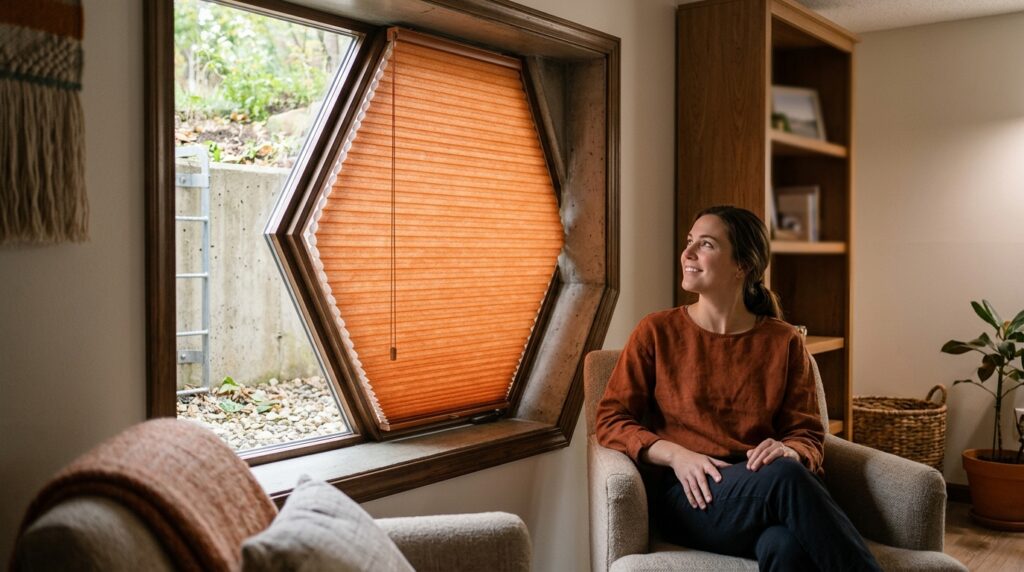
Basement windows rarely play by the rules. They’re often shorter, narrower, or set at odd angles compared to windows upstairs, and plenty of them are hoppers or sliders that don’t match standard sizing charts. Specialty shaped treatments are built to handle angled, narrow, or oddly proportioned openings that off-the-shelf blinds simply don’t fit. Trying to force a standard-width blind onto a 22-inch basement window usually ends in gapping, light leaks, or a crooked install.
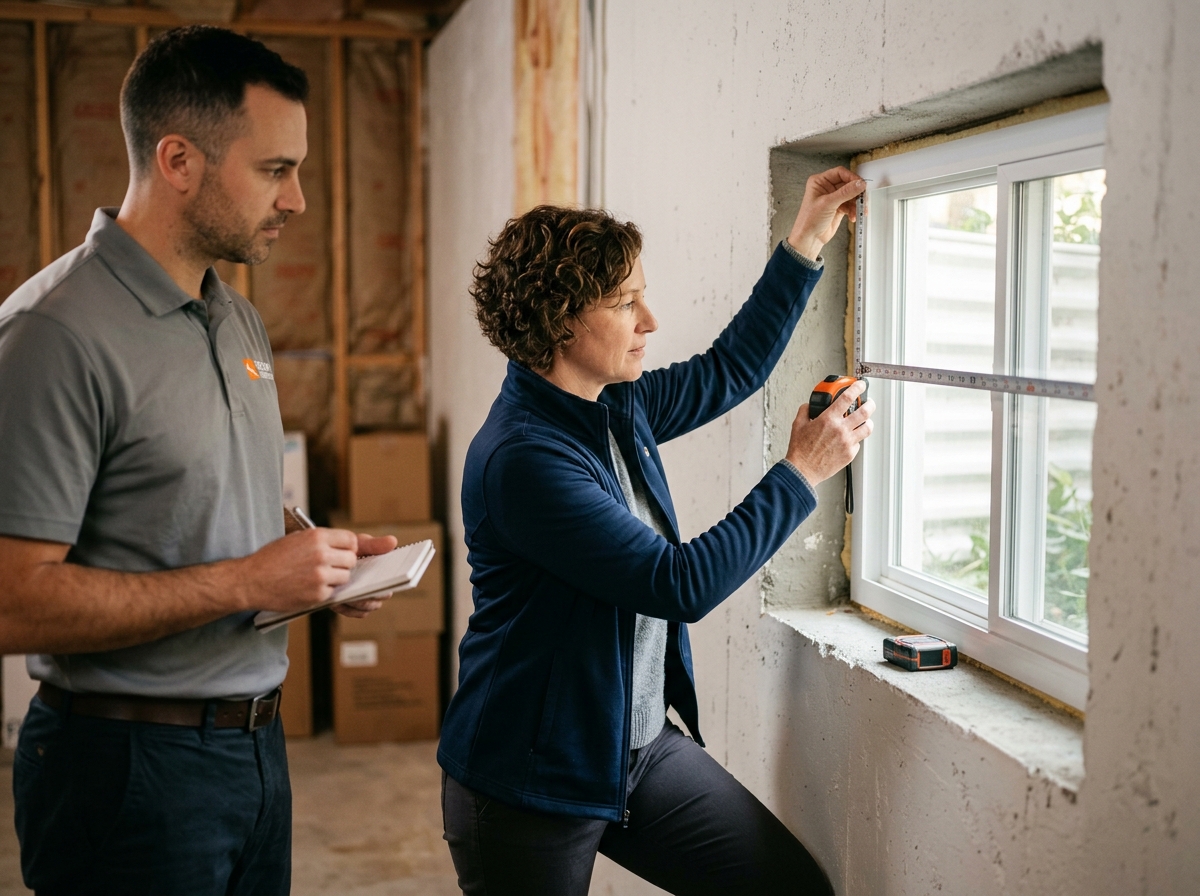
Getting an accurate measurement on these windows is trickier than it sounds. Depth, frame material, and obstructions like pipes or sill height all affect what will actually mount cleanly. A free in-home design consultation gives someone trained eyes on the window itself, so they can measure the opening correctly and suggest a fabric or shade type suited to a lower-light room, rather than guessing from a tape measure and a hope. That’s worth more than it sounds like on paper.
If you’re weighing motorized options for a hard-to-reach basement window, it helps to first spend time comparing how automated blinds and shades actually differ, since the mechanics and fabrics behind each affect how well they’ll perform near the floor-level glare these windows let in. Some owners pair that research with PowerView automation for a window that’s awkward to reach by hand. Others stick with a manual lift and call it done. Either way, get the measurement right first; everything else follows from that.
Comfort Problems Below Grade: Noise, Temperature, and UV
How insulating shades support a more stable basement temperature
Basements have a noise problem most people don’t think about until they’re down there trying to sleep, work, or watch TV. Thin glass, low ceilings, and proximity to the street or a furnace all team up to amplify sound in a way upstairs rooms rarely experience. Below-grade glass carries noise differently than a second-floor bedroom window, and the standard fix upstairs doesn’t always translate below ground.
A few specific issues tend to show up together in these rooms, and they’re worth naming so you know what you’re actually solving for:
- Street traffic, HVAC equipment, or a neighbor’s generator can bounce off thin basement glass and feel louder than it would on an upper floor.
- Denser fabrics or layered shades placed over the window add mass that helps dampen some of that sound transfer before it fills the room.
- Older or poorly sealed basement frames let in drafts, and cellular shades trap a layer of air in their honeycomb pockets to cut that cold, drafty feel.
- Sunlight hitting a basement window for even a few hours a day can fade furniture, flooring, or boxes of stored items sitting nearby.
- Light-filtering or solar-style roller shades block a meaningful share of that UV exposure while still letting usable daylight into the space.
There’s also a permanent option worth mentioning: window film applied directly to the glass. It’s a fine product, but it’s fixed in place. Once it’s on, you’re stuck with whatever light level it gives you. Shades do the same UV job while staying adjustable day to day, which is why insulating cellular shades and solar roller shades get recommended over film for basement windows. Pairing fabric choice with privacy needs matters too, and reviewing privacy curtains options for ground-level rooms can help you balance light control with the fact that basement windows sit closer to eye level outside.
Interior Treatment Options Compared
Picking a treatment based on window shape and room use
Not every basement window needs the same fix. A small awning-style egress window near a laundry area has different demands than a sliding glass door leading to a walkout basement patio. The table below lines up the main options so you can match the treatment to the room’s actual job, not just its looks.
| Treatment | Best For | Insulation Value | Notes |
|---|---|---|---|
| Cellular shades | Below-grade rooms, cordless safety | Highest (honeycomb air pockets) | Top pick for temperature swings near egress wells |
| Roller shades | Small or narrow basement windows | Low to moderate | Slim profile, wide range of fabric opacity |
| Roman & woven shades | Finished lower levels | Moderate | Adds texture; less practical in utility basements |
| Plantation shutters | Light control and privacy | Moderate | Interior only, not a storm or security product |
| Vertical blinds | Sliding glass doors, walkouts | Low | Wrong fit for small awning-style egress windows |
Cellular shades still win on raw insulation, and cordless versions keep dangling pulls away from kids near window wells. Roller shades make sense where space is tight; they won’t stack up thick like a cellular cell does. If you’ve got a finished rec room downstairs, roman or woven shades bring warmth that a bare utility window doesn’t need. For sliding doors specifically, reviewing a practical guide to vertical blinds for sliding glass doors helps before you commit to a track system. And for windows that are awkward to reach, PowerView automation lets you schedule shades open and closed without a step stool.
Safety, Security, and Where Interior Treatments Stop
When the problem is the glass, not the covering
Let’s be blunt about something first: a shade is a shade. It controls light. It doesn’t control weather, and it definitely doesn’t stop an intruder. If you’re shopping for interior covers and someone tells you they’re also protective, walk away. Interior treatments and safety hardware solve different problems, and mixing them up leaves a real gap in your home’s defenses.
A basement window well sits close to the ground, often below a deck or near a walkway, which is exactly where safety questions tend to pile up. Before you pick fabric or slat style, it helps to sort out which concerns actually belong to the glass and frame, and which ones belong to the covering you hang in front of them. Here’s how that usually breaks down:
- Interior shutters and blinds are not rated for storm, wind, or security protection, so they should never stand in for impact-rated exterior products installed by a licensed contractor.
- If dangling cords near a basement window well worry you with kids or pets around, cordless lift systems and app-driven motorized shades remove that hazard entirely.
- A failing, drafty, or single-pane basement window frame needs a contractor’s eye before any interior shade goes up, since fabric manages comfort but can’t fix a broken seal.
- Security bars or window guards for break-in concerns live in a separate exterior security category entirely, not something a shade or shutter can substitute for.
- Cracked glass, fogging between panes, or seal failure calls for a glazier, not a new window treatment, since no interior product fixes what’s wrong inside the glass itself.
- Once the glass and frame are sound, that’s when an interior shade or cellular treatment earns its keep, handling daily light and privacy with no structural pretensions.
Getting that order right matters more than people think. One useful overview on egress windows and their role in basement safety lays out why structural issues need to be settled first. Decide on the hardware, then the look — not the other way around. For the look itself, comparing fabric panels against slatted options is worth doing early; a primer on blinds vs curtains choosing the right window treatment is a reasonable place to start that comparison before you shop.
Planning an Egress Window Covers Project From Outside In
A basement egress project has two halves that don’t talk to each other: what’s happening outside in the window well, and what’s happening on the glass itself. Mixing up the order wastes time and money. Here’s a sequence that actually works.
A simple order of operations for basement window upgrades
Start outside. Pick a well cover sized and rated for your specific well, whether it’s a grate, dome, or flat style, and check that it meets local egress code before you buy anything. Then look at the frame. Drafts, cracks, or a failed seal need attention before interior treatments go up, since fabric won’t fix a leaky frame. From there, the project moves indoors, where light control and comfort take over.
| Step | Focus | Typical Timing |
|---|---|---|
| 1. Well cover selection | Sizing, material, code compliance | Before interior work begins |
| 2. Frame and seal check | Drafts, cracks, glazing condition | Immediately after well cover |
| 3. Interior consultation | Measurements, fabric opacity, light levels | Once frame is sound |
| 4. Operation decision | Manual vs. motorized control | During consultation |
| 5. Budget split | Separate costs for well cover and interior treatment | Planned early, paid in stages |
Notice step three doesn’t happen until the frame’s been cleared. A free in-home consultation is the right time to talk opacity, measure the actual opening, and get a few options suited to rooms that don’t get much natural light. If the window sits low, behind a sofa, or somewhere you’d rather not crouch to adjust twice a day, that’s also when to weigh manual control against PowerView motorization. Keep your budgets separate, too. The well cover and the interior treatment come from different suppliers and solve entirely different problems, so don’t expect one quote to cover both.
Who to call for each part of the project
Exterior well covers and code questions belong to well-cover manufacturers or a local contractor familiar with egress rules. Frame cracks, drafts, or seal failures call for a window contractor or glazier, not a shade company. For the glass that’s healthy, learning how window screenings affect indoor thermal comfort can help explain why basement rooms feel different once the right shade is installed. Once the exterior well cover is handled and the frame checks out, a local specialist can take the interior side from there. For many homeowners, the number worth having on hand is (201) 302-9111.
Keep in mind that window treatments are a visible upgrade, too. If resale value factors into your renovation math, it’s worth understanding whether window treatments increase home value before you finalize a fabric or finish. Basement rooms often get overlooked in that conversation, but a finished, code-compliant egress window with a thoughtful interior pairing reads as a real room, not an afterthought.
Before deciding, it helps to ask what you’re actually trying to solve: glare and heat inside a room call for a different fix than drafts from an aging window, and safety concerns around cords are different still from wanting a finished, custom look. A quick walkthrough with someone who can talk through fabric, light control, and motorization options tends to clarify which problems a window treatment can realistically solve and which ones genuinely need a contractor’s attention first. Getting that distinction right upfront saves time and money either way.