That awkward bathroom window, a narrow hallway pane, or a bedroom cutout barely wide enough for a hanger — standard panels just weren’t made for spaces like these. You’ve probably wondered whether small window curtains can even work, or if you’re stuck settling for something that hangs wrong or blocks light unevenly. They can work. But only when you know the tricks. This guide breaks down exactly when off-the-shelf curtains hold up, and when custom shades are worth the investment instead.
Why Small Windows Are Harder to Dress Than People Expect
Common small-window trouble spots: kitchens, bathrooms, basements
Retail curtain panels are cut for a handful of standard widths, usually 40 to 54 inches. That’s fine for a living room picture window. It’s a mess over a 22-inch bathroom window or a narrow basement casement, where the fabric either bunches into thick, overwhelming folds or leaves daylight gaps at both sides. Fit is the whole problem, and off-the-shelf sizing just wasn’t built to solve it.
Kitchen windows bring their own headache. They’re often set above a sink, flanked by cabinets, or interrupted by a faucet arm, leaving an odd, shallow opening that no standard panel length was designed for. Short curtains in these spots tend to pool oddly on the counter or stop well above the sill, which only draws the eye to the very proportions you were hoping to smooth over. Basements add moisture and low light to the mix, so fabric choice matters as much as size.
A kitchen with three or four small windows over an addition, a laundry nook, or a garden window makes things worse. Each opening might be a slightly different width, and matching pre-cut retail panels across all of them rarely produces a clean, unified look. That’s a common trouble spot for anyone trying to keep a consistent style through a whole room.
Short curtain panels can pool awkwardly or hover above the sill, drawing attention to the exact proportions homeowners want to soften
Here’s the irony: curtains meant to soften a window’s hard edges often end up highlighting them. A panel that’s an inch too long pools on the sill or the floor in a way that looks accidental rather than intentional. One that’s an inch too short leaves a gap that makes the window look smaller and the wall look unfinished. On a small window, there’s no room for that margin of error to hide.
Some homeowners try to compensate with wider rods or extra-long panels to create the illusion of a bigger window. That trick works on paper. In practice, it often just crowds a tight wall and makes the room feel busier, not larger. If you’ve hung a curtain and stood back thinking something’s still off, it’s usually proportion, not style, that’s the culprit.
Rooms with multiple small windows (kitchens, laundry rooms, additions) need a consistent look across different sizes, which is difficult with pre-cut retail panels
Multiple small windows in one room raise the difficulty further. A laundry room with a window above the machine and another beside the door rarely shares the exact same dimensions, even if they look similar at a glance. Retail panels come in fixed sizes, so you’re stuck choosing between a slightly-too-big and a slightly-too-small option for at least one of them, which breaks the visual rhythm across the wall.
This is where custom-measured shades and blinds earn their keep. Built to the precise width and height of each opening, they eliminate the guessing that dogs pre-cut panels, and they can be ordered in a matching fabric or finish across every window in the room. For anyone weighing shape-specific challenges too, learning how to hang curtains on an arched window shows just how far off standard hardware assumptions can be once a window strays from a plain rectangle. The takeaway is simple: consistency across odd sizes is a measuring problem, not a styling one, and it’s solved before the fabric ever gets ordered.
Small Window Curtains: Styles, Fit Rules, and When to Choose Something Else
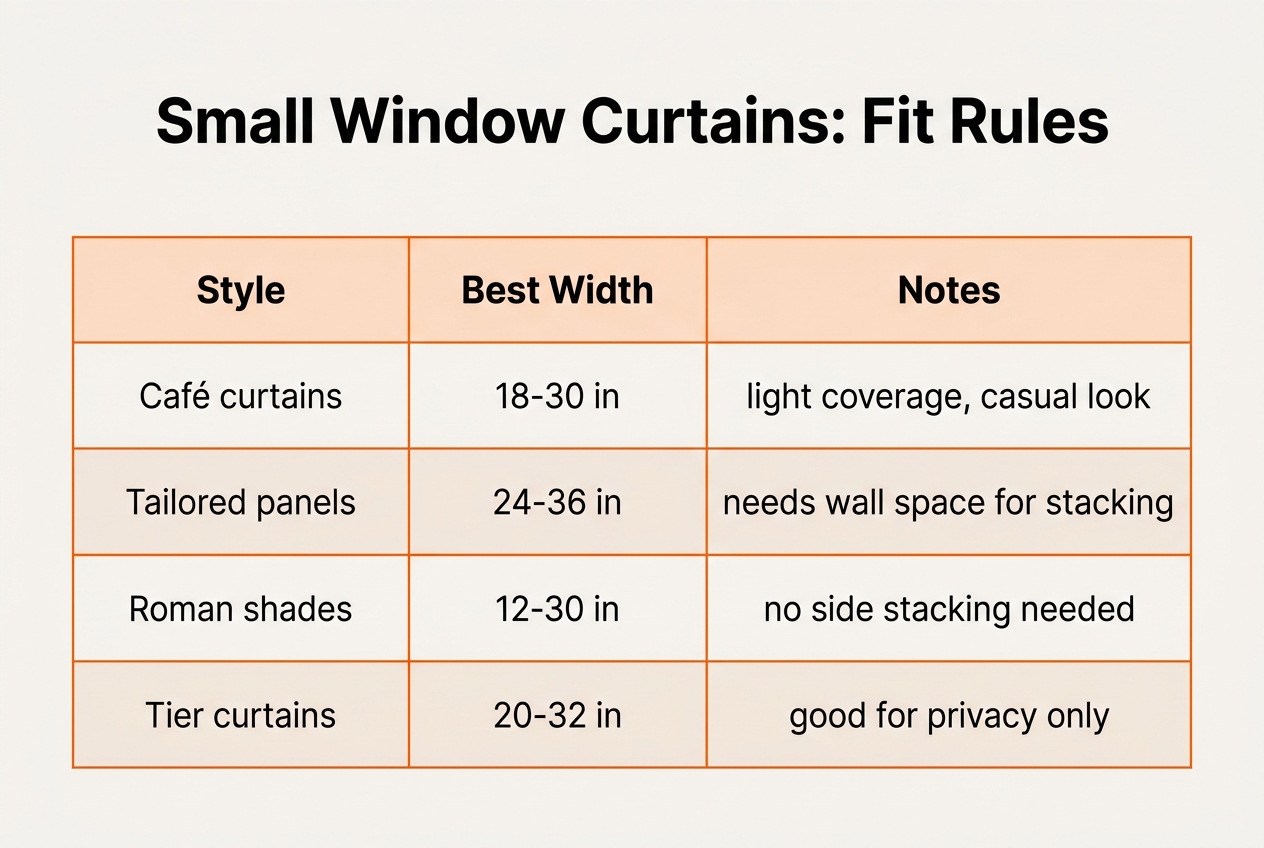
Search trends and showroom requests both point to the same three styles for compact windows: cafe curtains, tier curtains, and short blackout panels. Cafe curtains cover just the bottom half of the window, leaving the top open for light and privacy at the same time. Tiers do something similar but come in pairs that stack, which works well over a kitchen sink. Short blackout panels are the go-to when a small bedroom or nursery window needs real light control without full-length drapery. All three lean into cottage and farmhouse looks, and honestly, that’s part of why they’re so popular right now.
Sizing and hanging rules for a polished look
Bad proportions are the number one reason small window curtains look cheap, even when the fabric is nice. There’s a simple fix. Follow a few rules and the window instantly looks more finished:
- Mount the rod so it extends 3 to 6 inches beyond the window frame on each side, which makes the glass look wider and lets the panels clear the frame when opened.
- Let the curtain length clear the sill by at least half an inch, since anything shorter reads as a chopped-off, unfinished hem.
- Hang the rod closer to the ceiling than the frame when the wall space allows it, adding visual height to a squat window.
- Choose lightweight linen or sheer fabric for tiers over a sink or stovetop, where airflow and easy laundering matter more than blocking every ray of light.
- Skip heavy blackout panels on very narrow windows, since bunched fabric on a short rod tends to overwhelm the frame instead of framing it.
If you want a deeper breakdown of proportions for petite frames, a short curtains guide walks through hem lengths and rod placement in more detail.
When fabric panels stop being the right tool
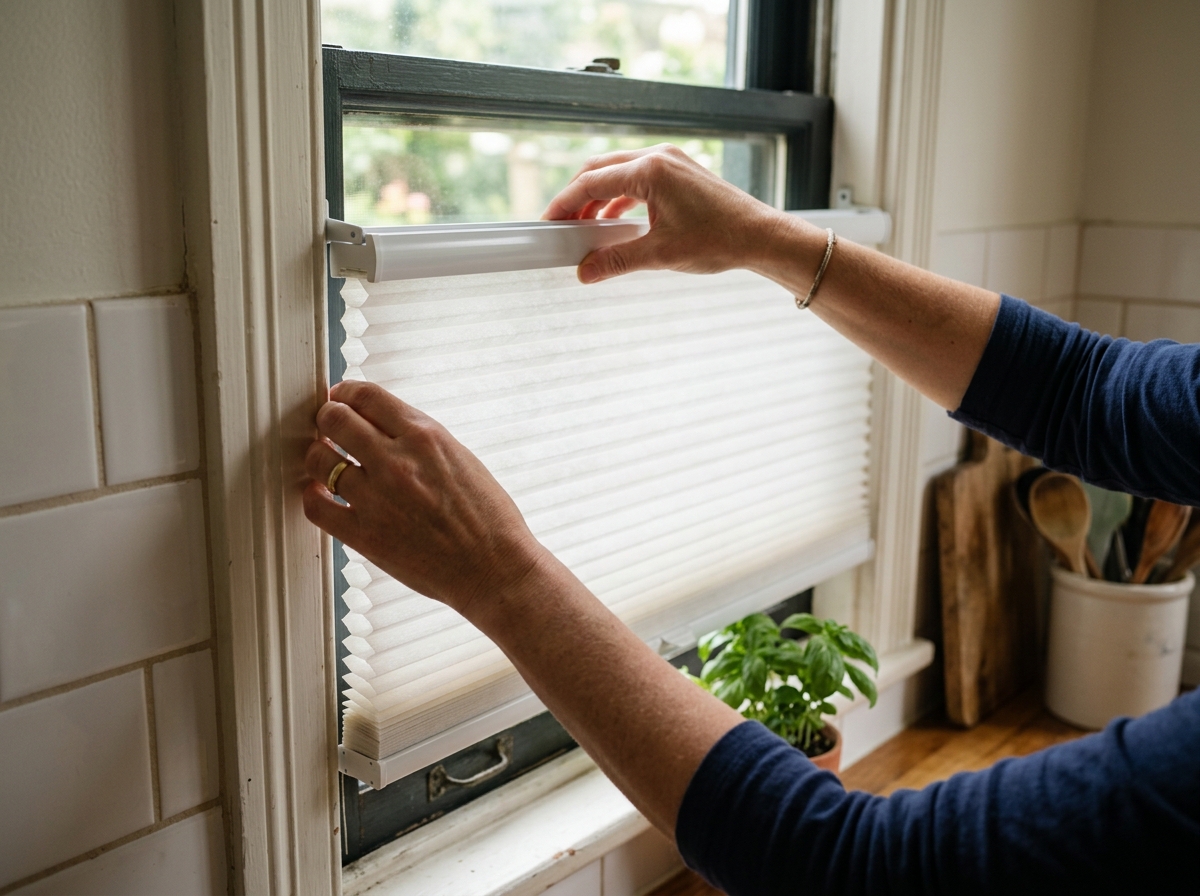
Curtains have real limits. On very small or oddly shaped windows, panels alone rarely deliver accurate light control or meaningful insulation, no matter how heavy the fabric claims to be. That’s exactly where cellular shades or Roman shades start to outperform them, especially in a drafty bathroom or an attic-style window with an odd angle. Fabric choice still matters even when you do go the curtain route; comparing weights and textures through a guide to linen curtains helps clarify why some fabrics drape well but insulate poorly. For a completely tailored, no-gap fit with no rod at all, custom Roman shades or cellular shades mounted inside the frame give a cleaner, built-in look that short panels just can’t match. Curtains are charming. They’re not always the right tool for the job.
Curtains vs. Custom Shades vs. Blinds for Small Windows
Four contenders, one small opening. Curtains bring the biggest style range but the sloppiest fit, since they’re built to a standard width and then hemmed to fit your gap. If you want proof that fabric alone can carry a small window, learning what actually works in curtains for small windows will save you a few trial-and-error purchases. Cellular shades flip that weakness into a strength: made to your exact inch, with a honeycomb structure that traps air and pulls double duty as insulation.
Roller shades sit in between. They’re the cleanest, most minimal option, and they’re hard to beat for glare and UV control on a sunny kitchen window. Wooden or metal blinds give you slat-by-slat control over light and privacy, which curtains and shades can’t quite match, but they collect dust fast and need regular wiping. Here’s how the four stack up on the things that actually matter for a small window.
| Treatment | Fit Accuracy | Light & Insulation | Maintenance |
|---|---|---|---|
| Curtains | Least precise; needs hemming or a shorter rod | Minimal insulation unless lined; style over function | Occasional washing or dry cleaning |
| Cellular shades | Exact custom fit | Strong; honeycomb cells resist heat loss | Low; occasional dusting |
| Roller shades | Precise, made-to-window | Excellent glare and UV control | Very low; wipe clean |
| Wooden/metal blinds | Precise, made-to-window | Tunable light and privacy via slats | Higher; slats need regular dusting |
So which one wins? Depends on the room, honestly. A kitchen window over the sink takes a beating from grease and steam, so easy-clean roller or woven shades make more sense than fabric that traps odor. A bedroom leans the other way: cellular or Roman shades give you the insulation and blackout that help you actually sleep. If privacy from a neighbor’s window is the driving concern rather than temperature, it’s worth reading up on privacy curtains before you commit to a harder-sided shade. There’s no single best answer here, just the right tool for the window in front of you.

Solving Heat, Glare, and UV Fade on Small Windows
UV protection without altering the glass
Small windows in kitchens, stairwells, and sunrooms take a beating from direct sun. A stairwell window facing west can pour hard light onto a wood floor for two or three hours a day, and that’s enough to fade a finish or bleach a rug over a year or two. Furniture nearby, cabinet fronts, even framed photos, all take the hit. Because these windows are often awkward shapes or hard to reach, homeowners tend to ignore them until the fading is obvious.
Window film is one option people consider elsewhere, and it does block UV. But it bonds directly to the glass, and once it’s on, it’s on. Adjusting or removing it means calling in a professional, and it can’t flex with the seasons. Light-filtering roller shades and cellular shades block that same UV range while staying completely adjustable, so you can dial in more light on a gray February morning and cut it back hard in July. Reading up on the tradeoffs in something like a comparison of blinds, curtains, and other coverings makes the flexibility argument pretty clear.
Insulating cellular shades add another layer of value here. Their honeycomb pockets trap air, which cuts drafts and smooths out temperature swings near a small window, sometimes the most exposed spot in a room. It’s a far cheaper first move than replacing the window. That said, if a window has failed seals or single-pane glass and drafts persist even with insulating shades installed, no shade fixes that. At that point, you need a window replacement contractor, not another layer of fabric. A free in-home consultation can measure actual light exposure and match fabric opacity to each room, which beats guessing off a swatch card at a store.
Matching Small Window Treatments to the Room
Not every small window wants the same treatment. The room around it decides what actually holds up day to day. Get this wrong and you’re rehanging curtains in a year.
Kitchens and bathrooms
Kitchens throw grease and steam at fabric constantly. Long curtain panels near a stove or sink soak that up and hold onto it. Bathrooms have the same humidity problem, plus condensation that warps anything wood. A few swaps solve most of this:
- Woven wood shades resist grease splatter far better than flowing fabric panels, and they wipe clean instead of needing a wash.
- Roller shades work the same way in a kitchen, with a flat surface that doesn’t trap cooking odors the way pleated fabric does.
- Cordless lift options keep the area near a sink or stove clear of dangling cords that snag on faucets or pot handles.
- Cellular shades hold up to bathroom humidity better than most curtain fabrics, since the cell structure doesn’t sag or mildew the way cotton can.
- Faux-wood blinds handle steam and splash without warping, unlike real wood, which can crack or discolor in a damp bathroom over time.
Bedrooms and specialty shapes
Small bedroom windows have a light problem: you want the room dark, but stock curtains on a short rod rarely block much. Layering solves it. A blackout Roman shade mounted inside the frame handles the actual light control, while a sheer curtain layered over it softens the look and keeps the window from feeling stark. It’s a small-footprint fix that does two jobs at once.
Sliding glass doors paired with a small adjacent window need a different kind of matching. Vertical blinds on the door, paired with a cellular or roller shade on the window beside it, keep the wall looking intentional instead of mismatched; if you want more on how that pairing works in practice, it helps to review vertical blinds for sliding glass doors before choosing fabrics. Specialty shapes are their own category entirely. Arched transoms, angled attic windows, and odd trapezoids can’t take a stock curtain rod at all — they need treatments built to the exact angle, which is really a measuring and fabrication question more than a style one. Insulating performance matters here too, and looking into energy efficient window coverings alongside broader building standards like ac installation for new construction shows how window coverings fit into a home’s overall temperature control, not just its looks.
Motorization and Child Safety for Compact Windows
Small windows show up in the wrong places all the time. Above a crib. Behind a changing table. Right next to a low play mat where a toddler can reach up and grab whatever’s hanging down. That’s exactly where dangling cords become a real hazard, not just a nuisance. Cordless lift systems solve this by removing the pull cord entirely, so there’s nothing for small hands to find. PowerView automation goes a step further, letting you raise or lower a shade with an app, a remote, or a schedule you set once and forget.
It’s worth being clear about what PowerView actually does, though. It’s built to control shades, not your whole house. If a room has a small window over a crib and a bigger one nearby, you can group them into a single scene so one tap adjusts both at the exact same time, no fumbling with two separate remotes at 2am. That’s genuinely useful for nurseries with multiple windows. What it won’t do is run your lights, thermostat, or locks. For that, exploring smart curtains and home automation options is a good starting point, but wiring a full smart home is a job for a dedicated AV integrator, not a shade specialist.
One more distinction, and it’s an important one. Security bars and window guards address break-in prevention elsewhere. That’s a locksmith’s or security contractor’s territory, completely separate from cords and lift systems. Don’t confuse the two. A cordless shade keeps a curious toddler safe from a dangling cord; it does nothing to stop someone climbing through the glass.
Getting the Fit Right: Measuring, Ordering, and Caring for Small Window Treatments
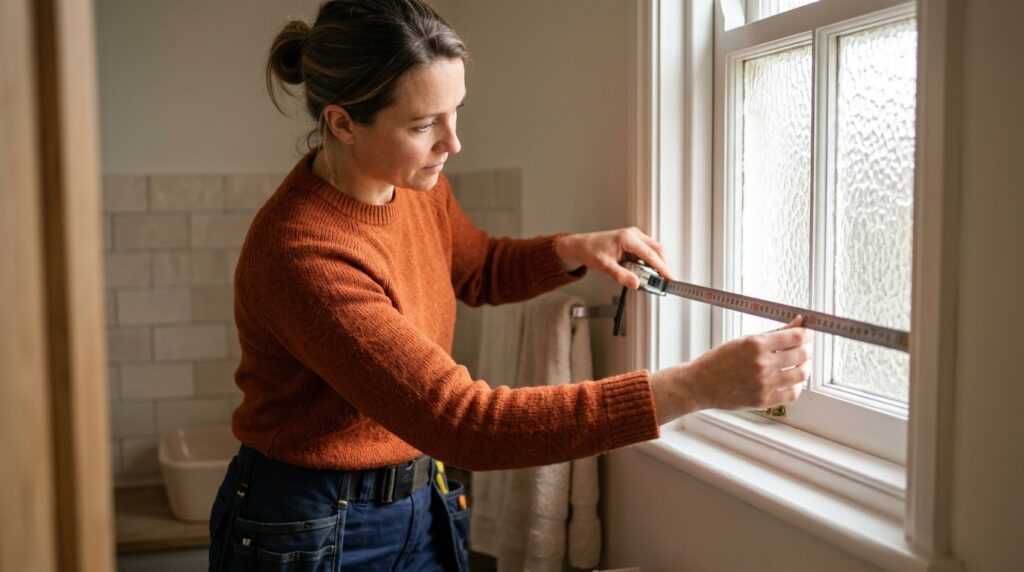
Small windows punish sloppy measuring more than big ones. An inch off on a picture window barely registers. An inch off on a 20-inch-wide bathroom window looks like a mistake every time you walk past it. So slow down and get the numbers right before you order anything.
Step-by-step measuring guide
The table below walks through the process in order. Follow it top to bottom, and don’t skip the “why it matters” column — that’s usually where people cut corners and regret it later.
| Step | What to do | Why it matters |
|---|---|---|
| 1. Measure width | Measure at the top, middle, and bottom of the frame; use the narrowest number for inside-mount shades | Frames settle and warp over years, so one width reading almost always lies |
| 2. Measure height | Measure at both sides and the center of the opening | Small windows are rarely perfectly square; a shade cut to one height can bind or gap |
| 3. Pick your mount | Choose inside mount for a clean, recessed look or outside mount to make the window read larger | Mount type changes both the measurements you need and the finished appearance |
| 4. Choose the material | Match fabric or material to room humidity and sun exposure, not just color | Faux wood handles steam; certain fabrics fade or warp fast in direct sun |
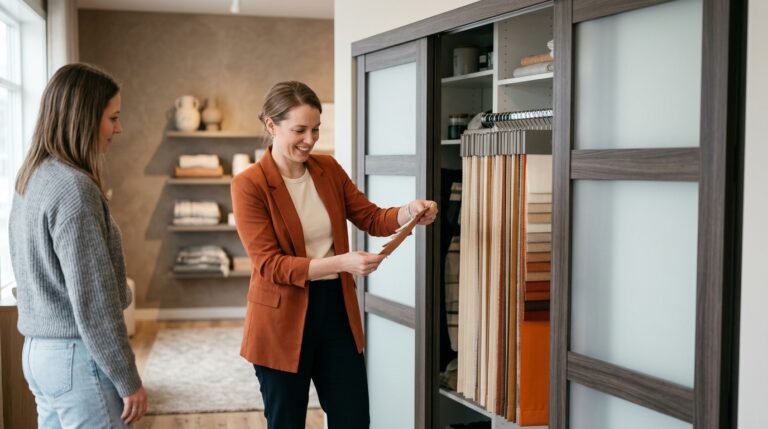
| 5. Confirm with a pro | Book a free in-home design consultation for precise measurements and fabric samples in real light | A designer catches out-of-square frames and light conditions a tape measure alone won’t show you |
Notice that step five isn’t optional padding. A consultation is where a trained eye reconciles the three width readings and the three height readings into one workable number, and where you actually see how a swatch looks against your wall’s real light instead of a store’s fluorescent bulbs. If you want a fuller sense of what that visit involves, the design process of custom window treatments is worth understanding before you commit to a fabric.
When to repair vs. when to clean
Once the treatment is installed, most problems fall into one of two buckets, and mixing them up wastes time. A stuck lift cord, a slat that won’t tilt, or a headrail that’s pulled loose from the wall is a hardware failure. That’s a repair job, plain and simple, and it usually takes less effort to fix than people assume.
Ground-in fabric stains or a musty smell are a different animal entirely. No amount of mechanical adjustment fixes a dirty fabric shade. That calls for a dedicated curtain or drapery cleaning service built for fabric, not a repair technician. Confusing the two just means paying twice: once for a repair that solves nothing, and again for the cleaning you needed from the start.
Before settling on any fix, it helps to be honest about what’s actually causing the discomfort in the room—is it glare and heat coming through the glass, or is the window itself past its prime and letting air in around the frame? Adjustable options like insulating cellular shades or solar roller shades can make a noticeable difference day to day and cost far less than a bigger project, but they won’t correct a failing seal or a single-pane window that’s simply worn out. Weighing the size of the problem against the size of the fix usually points to the right next step, and sometimes that means pairing a window treatment with a conversation with a contractor rather than choosing one over the other.