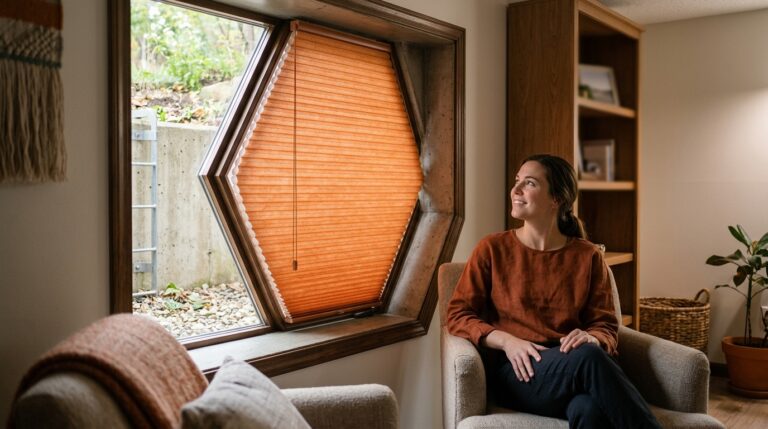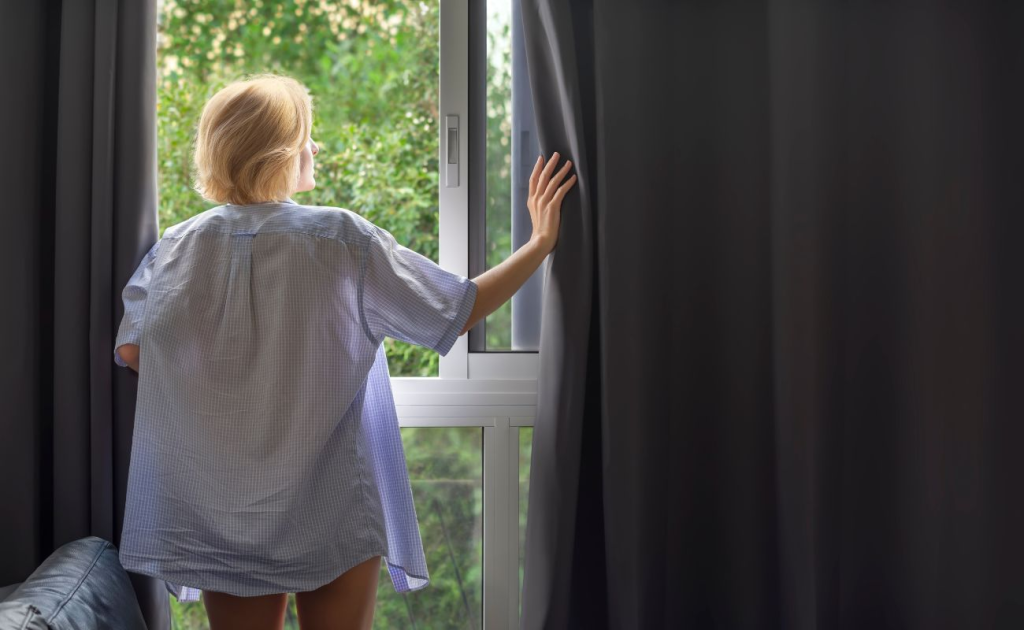
Streetlight at 11 p.m., sun on your face at 5:40 in June. If that is your bedroom, blackout curtains are the first thing most people shop for, and they do work. They are not the only way to get a dark room, though, and on some windows they are not the easiest way. Here is how we sort it out for homeowners around Bergen County: what blackout actually means, when a lined drapery panel is the right call, and when a blackout roller or cellular shade does the same job with less fabric on the wall.
Blackout is a performance level, not a style. You can reach it with a lined drapery panel, a roller shade, or a honeycomb cell. Which one belongs on your window depends on the opening, the wall around it, and who sleeps in the room.
What Blackout Curtains Actually Block
True blackout curtains block 99 to 100 percent of incoming light when they are installed correctly. Room darkening panels block roughly 60 to 85 percent, which dims a room without emptying it of light. The two labels get used loosely on store shelves, so read the construction rather than the tag.
The light blocking comes from one of three builds:
- Tightly woven fabric. Multiple layers of densely woven yarn form an opaque barrier on their own.
- Foam backed lining. An acrylic foam layer bonded to the back of a decorative face fabric.
- Separate blackout lining. A liner sewn in behind the panel, or added to drapery you already own.
For bedrooms, nurseries and media rooms, go for true blackout. Room darkening is usually enough in a living room, where you want glare control and not a cave. If you are still deciding on the room itself rather than the fabric, our guide to choosing bedroom curtains covers the style side.
Blackout Drapery, Blackout Roller, or Blackout Cellular
The light that wakes you up almost never comes through the middle of the treatment. It comes in at the edges. That single fact is what separates the three options, because a drapery panel hangs in front of the opening and can cover wall on all four sides, while a shade sits inside or just over the opening and has to be sized to beat the gap.
| Option | Best for | What to watch |
|---|---|---|
| Custom drapery with blackout lining | Bedrooms where you want fabric, softness and a little sound absorption | Has to be mounted high and wide, or light rides in along the sides |
| Blackout roller shade | Tight sills, clean modern windows, rooms you want clear glass in by day | A narrow light gap at each side is normal on an inside mount |
| Blackout cellular shade | Nurseries, cold rooms, windows sitting above a radiator or a deep sill | Order a cordless lift for a child’s room, and expect the cell to add insulation |
| Shade under a drapery panel | Street facing bedrooms and primary suites that need to be truly dark | Two treatments per window, and enough wall for the panel to stack off the glass |
We sell and install Hunter Douglas shades, and their cellular and roller shades come in room darkening and blackout fabrics, so you can stay with one look across a room and still change how dark each window goes. We also make custom drapery, which is the route to take when you want a specific fabric, a specific pleat, or a panel long enough to reach the floor on a window that no stock size fits. Compare the fabric families on our blackout shades page and the full window treatments range.
What we would put on the window
- Bedroom facing a lit streetBlackout roller in the opening with a blackout lined drapery panel over it.
- Nursery where naps happen at noonCordless blackout cellular shade, outside mounted so it runs past the frame.
- Bedroom window over a radiator or deep sillBlackout cellular shade inside the opening, no fabric hanging into the heat.
- Guest room that doubles as an officeRoom darkening roller for glare control, not full blackout.
Where the Light Gets In
Good fabric installed badly still leaks. These are the details that decide whether a room reads dark at 7 a.m. in July.
- Mount high and wide. Set the rod 4 to 6 inches above the window frame and run it 3 to 4 inches past each side.
- Use a wraparound rod. French return and wraparound rods curve back to the wall, which closes the side gap where most light comes through.
- Add a cornice or valance. A top treatment stops light from spilling over the rod and down the wall.
- Consider a ceiling mounted track. Mounting at the ceiling removes the gap between rod and ceiling entirely, which helps in rooms with short headers.
- Overlap the panels. On a two panel setup, the panels have to meet and overlap in the center when closed, not just touch.
- Outside mount your shades. If a shade is doing the blackout work by itself, mounting it on the wall past the opening beats an inside mount every time.
Measuring is where most of this is won or lost. If you are pricing shades yourself, read how to measure for blinds first, or let us do it in your home so the numbers are ours to get right.
What Blackout Buys You Besides Sleep
Sleep is the reason most people call, and it holds up. Your body produces melatonin in response to darkness, and even a small amount of light can suppress it and pull your circadian rhythm off schedule. Shift workers, light sensitive sleepers and anyone on a bright street feel the difference fastest. The other benefits come along with the same fabric:
- Lower energy bills. According to the U.S. Department of Energy, blackout curtains can reduce heat gain through windows by up to 33 percent in summer and reduce heat loss by up to 10 percent in winter. Our thermal curtains guide goes deeper on lining choices.
- Less noise. Dense multi layer fabric absorbs sound. It will not soundproof a room, but it takes the edge off street noise. More on that in our noise reducing window treatments guide.
- UV protection. Sun through glass fades hardwood, artwork and upholstery. Blocking it protects what is already in the room.
- Privacy day and night. Nothing shows through a blackout panel, which matters on ground floor bedrooms. If you are weighing this against blinds, see whether people can see through your blinds.
- A usable media room. Killing screen glare is the whole point of blackout in a den or theater room.
- Longer naps. Blackout in a nursery keeps a 5:45 a.m. sunrise from ending the night early.
How to Choose Blackout Curtains Without Ending Up With a Gap
Four things decide whether you are happy a year from now.
Construction. Look for multiple layers, a foam or rubber backing, or a real sewn in blackout liner. Thin single layer panels sold as blackout rarely deliver true darkness.
Size and fullness. Panels should extend at least 3 to 4 inches past the window on each side and hang long enough to reach the floor. For drapery, plan on roughly twice the window width in fabric so the panels still cover when they are stacked and gathered. Skimpy panels are the most common reason a blackout curtain disappoints.
Color. Blackout does not mean black. The blocking comes from the lining and the weave, so white, cream, pastel and patterned faces all work. A darker room facing color simply reads cozier.
Heading and hardware. Grommet and ring top panels slide easily and suit a modern room. Pinch pleat reads more tailored and holds a cleaner fold. In a child’s room, choose cordless lifts and keep any cords out of reach. Our notes on child safe window treatments cover the rest.
Questions We Get at the Showroom
Do blackout curtains make a room hotter?
A dark panel in direct sun will absorb heat at the glass. Overall, though, the thermal barrier keeps the room cooler because it stops solar gain from entering. Choose a light color or a white backed lining if the window bakes in the afternoon.
Can I wash them?
Many blackout panels are machine washable on a gentle cold cycle, but check the care label. Foam backed fabrics often need dry cleaning, and bleach or high heat will damage the light blocking layer.
How long do they last?
Quality blackout curtains hold up for years with normal care. Replace them when the backing starts to peel or crack, when the panel stops darkening the room the way it used to, or when the face fabric has faded along the fold lines.
From our own installs in Bergen County
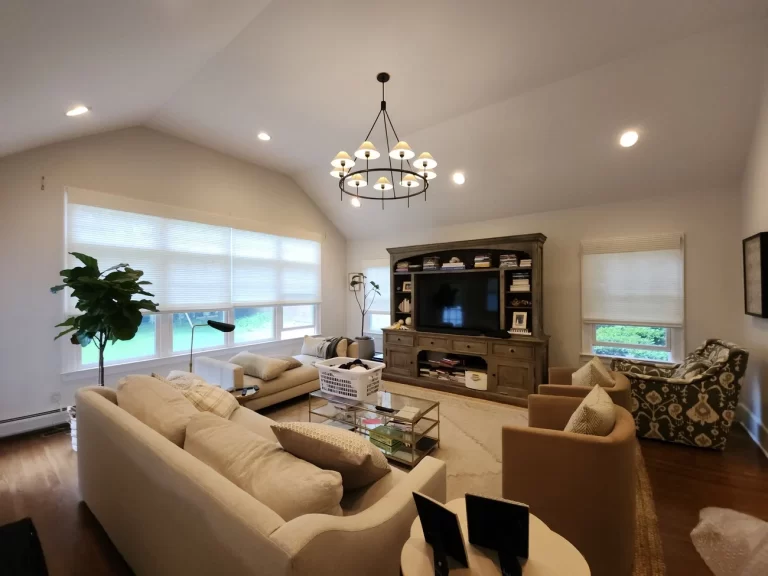

See the Fabric Before You Commit, in Palisades Park
The Curtain is a family owned window treatment showroom at 545 Broad Ave in Palisades Park, New Jersey, in business since 2007 and serving Bergen County. Owner and designer Sejun Park can put a blackout lining next to a room darkening one in daylight, so you see the difference instead of guessing from a product photo. We are a Hunter Douglas partner, we sell and install their shades, blinds and shutters, and we also make custom drapery.
Measuring is free. We come to the house, measure the opening, look at where the light actually enters, and give you a written quote. Call (201) 302-9111, book a free consultation, or see finished rooms in our gallery. Here is the full list of towns we serve.