You get one shot at a made-to-measure blind. Once the slats or vanes are cut, that is the size forever, so the tape work matters more than the swatch. This guide covers how to measure for blinds the way we do it in Bergen County homes, inside mount versus outside mount, plus how to measure for vertical blinds inside mount on a window or a sliding door. About five minutes a window, and one tool you already own.
Short answer
Measure the window opening in three places and always write it width first, then height, to the nearest 1/8 inch. For an inside mount, use the narrowest width and the tallest height and take no deductions of your own, because the factory allowance is already built in. For an outside mount, forget the opening and measure the area you want covered instead, adding roughly 3 inches past the opening on each side.
Inside mount vs. outside mount
Everything else follows from this one decision, so make it before you pick up the tape.
- Inside mount sits inside the window frame for a clean, built-in look. It needs enough depth in the frame for the headrail to fit. Best when you have a deep frame and trim worth showing off.
- Outside mount is installed on the wall or on the trim above and around the window. It makes a window look larger, hides a frame that is out of square, blocks more light at the edges, and works when the frame is too shallow for an inside mount.
The two are measured in opposite directions. Inside mount measures the opening. Outside mount measures the area you want to cover. Mixing that up is how a blind ends up floating in the middle of a window.
What you need before you measure
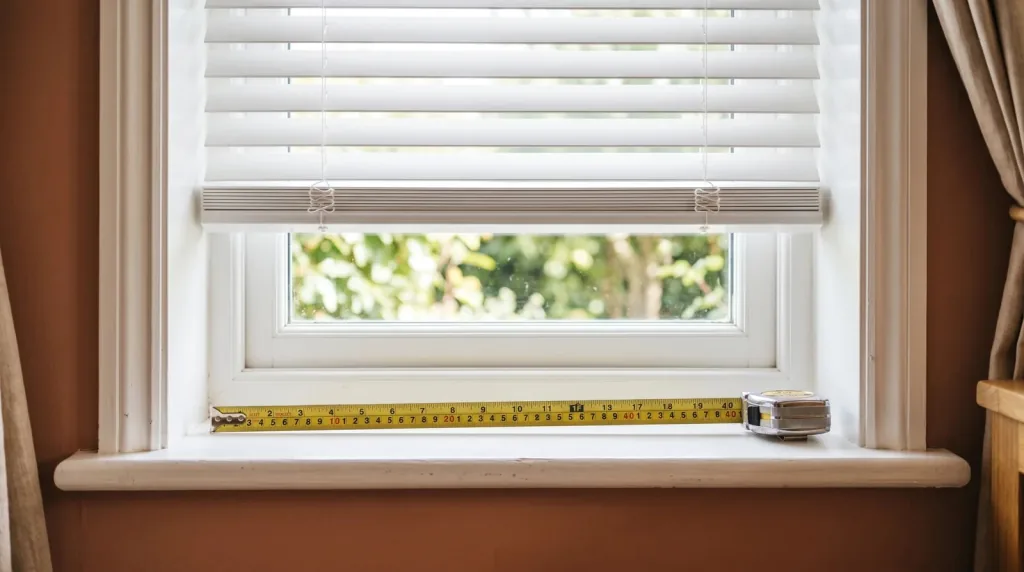
- A steel tape measure. Cloth tapes stretch and read long.
- Pen and paper, or a note on your phone, with one line per window and the room named on it.
Round to the nearest 1/8 inch and write width before height (W x H). That order is the industry standard, and reversing it is the most common ordering mistake we see on a first order.
How to measure for an inside mount
- Measure the width in three places, at the top, middle, and bottom of the opening. Use the narrowest number.
- Measure the height in three places, at the left, center, and right. Use the tallest number.
- Measure the depth of the frame from the glass to the front edge of the opening, and check it against the minimum depth listed for the blind you want.
- Take no deductions. Report the exact opening. The factory takes the small fit allowance for you, and doing it twice is what makes a blind come out too narrow.
Look at what is already living in that opening too: a crank handle, a window lock, an alarm sensor. Any of those can push a window to an outside mount even when the depth is fine.
How to measure for an outside mount
- Decide your coverage first. For privacy and light control, add at least 3 inches on each side of the opening, so 6 inches on the total width, and overlap the top by 3 inches or more.
- Measure the total width you want the blind to cover, not the opening.
- Measure the total height from where the headrail will sit down to where you want the blind to stop, at the sill or below it.
- Check the mounting surface. You need flat wall or flat trim for the brackets, with no molding in the bracket path.
How to measure for vertical blinds inside mount and outside mount
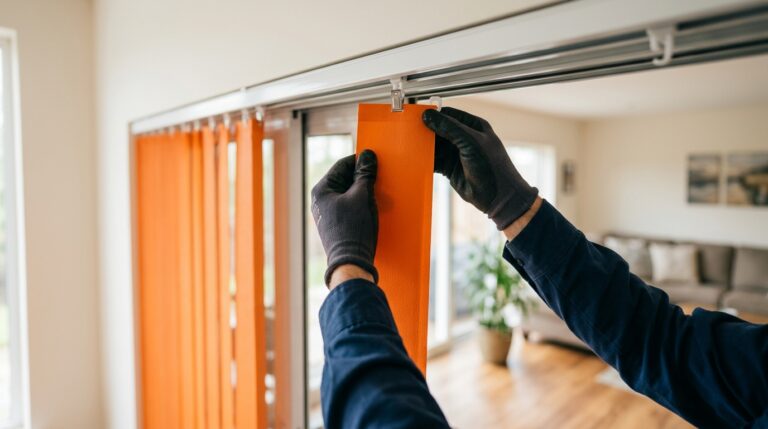
Verticals follow the same rules with three differences worth knowing before you order.
- Depth. A vertical headrail is deeper than a typical horizontal blind headrail, so a frame that easily takes a 2 inch faux wood blind will not always take verticals inside. Measure the depth against the minimum listed for the product.
- The stack. Vanes gather to one side, or split to both sides, and that stack sits somewhere. On an inside mount it covers part of the glass. On an outside mount you can extend the width and park the stack over the wall instead, which is why sliding doors are usually outside mounted. There is more in our guide to vertical blinds for sliding glass doors.
- Floor clearance. On a door height blind, most installers keep the bottom of the vanes about 1/2 inch off the floor so they do not drag. Measure the height to that point, not to the floor.
For a slider, measure the full opening width, then add your side coverage and the clearance you need for the handle. Take the height from the intended headrail position down to the finished floor, then subtract the clearance. If the door is your main traffic path, look at the sliding door treatments we fit most often before you commit to a mount.
| Mount | Width to record | Height to record |
|---|---|---|
| Inside mount | Narrowest of three readings across the opening | Tallest of three readings in the opening |
| Outside mount | Coverage width, opening plus about 3 inches each side | Headrail position down to sill or below |
| Verticals on a slider | Coverage width plus room for the vane stack | Headrail down to about 1/2 inch above the floor |
Common measuring mistakes
- Using a cloth tape. It stretches, and the readings come out long.
- Reversing width and height. Always W x H.
- Making your own deduction on an inside mount. That is what causes a blind to come out too narrow to fill the opening.
- Skipping the depth check and finding at install time that the headrail sticks out past the frame.
- Measuring one window and copying it. In an older Bergen County house, two windows in the same wall can differ by 1/4 inch. Measure every opening.
- Measuring an existing blind instead of the window. That blind was already cut down, so you inherit somebody else’s error.
After the measurement: mounting the blind
Ordering correctly is most of the job. Installation is short if the numbers were right.
- Hold the headrail up and mark the bracket positions. On an inside mount the brackets go in the top of the opening, set back far enough that the headrail clears the trim. On an outside mount they go on the wall or trim at the height you measured from.
- Check level before you drill. An old frame can be out of level even when it looks fine, and the blind will show it.
- Pilot drill into hardwood trim or plaster, then fasten the brackets.
- Snap the headrail in, add the valance or cap, and test the lift and tilt through a full cycle before you walk away.
- Deal with cords and chains. Anchor any continuous loop chain to the wall with the tension device supplied. With small children or pets at home, read our notes on child safe window treatments and go cordless.
Wide, tall, arched, and bay windows are the ones that go wrong. A bay has three or more openings meeting at angles, and each needs its own measurement and its own mount decision. See bay window treatments and blinds for large windows before you measure those.
What we would put on the window
- Deep frame, good trim, standard bedroom windowInside mount 2 inch blind, so the trim still reads as trim.
- Shallow or out of square frame in an older houseOutside mount on the trim, sized to hide the frame entirely.
- Sliding patio door you use every dayOutside mount verticals with the stack parked off the glass.
- Bathroom or kitchen window that gets dampFaux wood on an outside mount, since real wood moves with moisture. See faux wood vs wood blinds.
- Living room that wants daylight without the glareAn inside mount shade rather than a blind. Compare the options under shades.
Frequently asked questions
Should I get inside or outside mount blinds?
Inside mount for a clean, built-in look when the frame is deep enough. Outside mount to make the window look bigger, to cover a shallow or out of square frame, or to block more light at the edges.
Do you deduct anything when measuring inside mount blinds?
No. Report the exact opening. The manufacturer makes the small deduction for a proper fit automatically.
How do I measure a window that is not square?
Measure the width in three spots and use the narrowest, then the height in three spots and use the tallest. If it is badly out of square, an outside mount hides it better than any amount of careful measuring.
Can vertical blinds be inside mounted?
Yes, if the frame is deep enough for the headrail and you accept that the vane stack will sit over part of the glass. On a sliding door, an outside mount is almost always the better answer.
Free in-home measuring in Bergen County
You can do this yourself, and plenty of our customers do. But if a window is arched, extra wide, out of square, or you have twelve of them, let us take the numbers.
The Curtain is a family-owned window treatment showroom at 545 Broad Ave in Palisades Park, in business since 2007 and serving Bergen County. Owner and designer Sejun Park looks at the window, takes the measurements, and tells you which mount actually suits it. We are a Hunter Douglas partner, so we sell and install Hunter Douglas shades, blinds, and shutters, and we make custom drapery. The in-home measurement is free and the quote comes in writing.
Bring your own numbers and we will check them. If a blind you already own is not sitting right, see our repair page.
- Browse what we fit under window treatments, or read the custom blinds buying guide.
- See finished installs in the gallery and the towns we cover on areas we serve.
- Book a free consultation or call (201) 302-9111 and we will measure every window in the house.