You want blinds cheap, but you’ve seen how that search usually ends: flimsy slats, warped vinyl, or a “bargain” that fades and sags within a year. It’s a fair worry. Quality and affordability aren’t actually opposites, though. This guide shows you how to shop smart, know what drives cost, and land window treatments that look custom without the custom price tag.
Why ‘Cheap’ Doesn’t Have to Mean Low Quality
The real cost drivers behind window treatment pricing
Let’s fix the word “cheap” first. It doesn’t mean flimsy slats that warp in a year. It means paying a fair price for a product that actually performs, without the markup that pads big-box budgets. Smart value is a strategy, not a compromise. In fact, affordable can mean better engineered, once you know what you’re shopping for. You’ll also learn which corners are safe to trim and which ones bite you later in repair costs.
Three forces push prices down honestly. Bulk material buying lowers per-unit cost on fabrics and vinyl without touching craftsmanship. Local fabrication cuts out shipping and middleman markups that national catalogs tack on. Seasonal promotions, the kind many local businesses run a few times a year, let you time a purchase for real savings rather than a fake “sale” sticker. None of that requires thinner slats or weaker cord mechanisms. It’s just smarter sourcing. If you’re also weighing whether this spending pays off long term, it helps to look at research on whether window treatments add resale value, which reframes the purchase as an investment rather than a pure expense.
Here’s the honest part: a showroom rooted in one town since 2007 operates differently than a warehouse chain. A family-owned operation in a place like Palisades Park isn’t juggling national ad budgets or franchise fees. That overhead has to come from somewhere, and usually it comes from your wallet. A local shop skips that tax entirely, passing the savings straight to the install.
blinds cheap: What Actually Affects the Price You Pay
Price isn’t random. Four things drive it every time: material, size, mounting style, and whether you want motorization. Wood costs more than faux wood. Faux wood costs more than basic metal. Motorized lift systems add the most to any order, full stop. Once you know where the money actually goes, a quote stops feeling mysterious.
Material and style price ranges
Here’s a rough breakdown of what you’re really paying for, per standard window, before any promotions or seasonal discounts kick in.
| Material/Style | Typical Price Range | Best For | Trade-Off |
|---|---|---|---|
| Faux wood blinds | $60–$150 | Bathrooms, kitchens, humidity | Heavier, limited slat colors |
| Real wood blinds | $120–$300 | Living rooms, offices, resale value | Warps near moisture |
| Aluminum/metal blinds | $40–$100 | Rentals, tight budgets | Bends easily, thin look |
| Cellular (honeycomb) shades | $80–$220 | Insulation, energy savings | Higher upfront cost than metal |
| Motorized add-on (any material) | +$150–$400 per window | Convenience, tall or hard-to-reach windows | Biggest single price jump |
Notice cellular shades cost more than metal but often win on energy bills over a few winters. That’s the trade-off to think about, not just the sticker price.
Hidden costs of buying the wrong blinds
Stock sizes look cheap on the shelf. But if your window’s even a half-inch off, you get light gaps, drafts, and a crooked mount that bugs you every day. Custom-fit blinds cost more upfront, usually 20-40% more than stock, yet they eliminate the gaps that waste heating and cooling dollars. A deeper look at custom curtains costs shows the same pattern: the sticker price isn’t the whole story once you factor in years of use. Oddly shaped windows make this worse. If you’ve got an arch or angled frame, guessing at measurements almost guarantees a return trip, and learning the basics of how to hang curtains on arched window designs helps you spot a bad fit before you commit. This is exactly where a free in-home consultation earns its keep. A trained eye catches sizing problems, mounting issues, and style mismatches before you spend a dime. Skip it, and the “cheap” option can turn into a second purchase.
Comparing Budget-Friendly Options: Blinds, Shades, and Shutters
Best low-cost options for renters vs homeowners
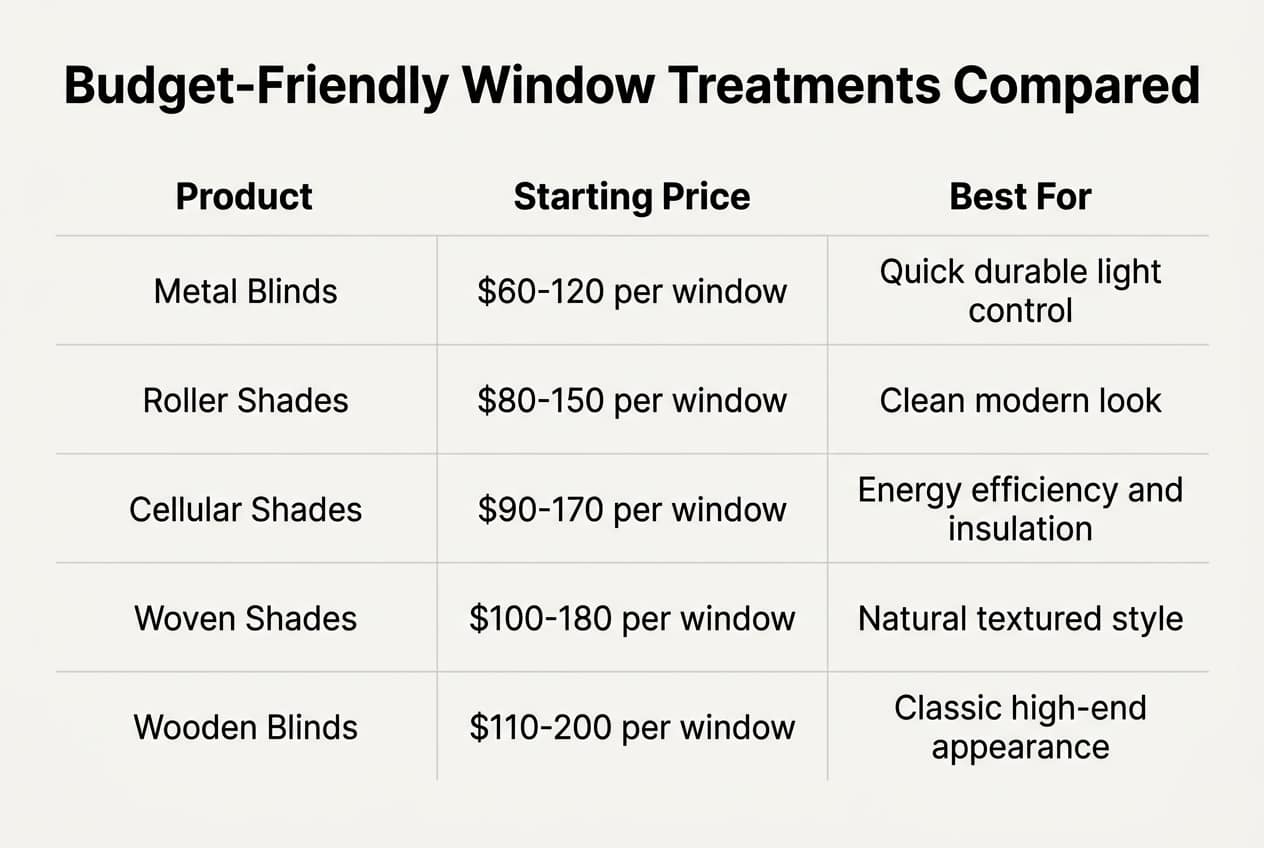
Renters usually want something cheap, easy to install, and easy to take down without a fight over the security deposit. Homeowners can think longer-term and weigh upfront cost against years of use. Either way, the right pick depends on what problem you’re solving: light control, privacy, or cutting energy loss through the glass. The table below lines up the four most common budget products side by side.
| Product | Typical Cost (per window) | Durability | Insulation Value | Best For |
|---|---|---|---|---|
| Metal blinds | $25–$60 | Moderate; slats bend easily | Low | Renters, quick fixes |
| Wooden blinds | $60–$150 | Good, lasts 7–10 years | Moderate | Homeowners wanting a warmer look |
| Roller shades | $40–$100 | Good with quality fabric | Low to moderate | Glare control, simple spaces |
| Cellular shades | $50–$130 | Very good, 10+ years | High | Energy savings, temperature swings |
Metal blinds win on price but show wear fast. Wooden blinds cost more and hold up longer, a fair trade if you’re staying put. Roller shades are great for blocking glare and, if you’re weighing solar fabric against window film, it helps to learn top 5 shades for privacy and light in New Jersey before deciding. Cellular shades cost a bit more but earn it back in lower heating bills. Shutters sit outside this table entirely — they run $200 and up per window, but a well-made set can outlast every option here by decades. That’s the real tradeoff: pay once and stop thinking about it, or save now and replace sooner.
Solving Common Home Problems Without Overspending
Most home comfort problems don’t need a contractor crew or a five-figure budget. They need the right window covering, chosen for the specific job. Before you spend on bigger fixes, it helps to match the problem to a treatment built for it.
- Outside noise gets noticeably softer with cellular shades or woven shades, both of which trap sound in their folds or weave, offering a far cheaper fix than any renovation involving new walls or glass.
- Temperature swings respond well to insulating cellular shades, which trap air in honeycomb pockets and cut drafts for a fraction of what a full window swap costs, though a failed seal or single-pane window may still need a window contractor eventually.
- UV damage to floors and furniture slows down with light-filtering roller shades or cellular shades, which block harmful rays while staying adjustable, unlike permanent window film applied directly to the glass by a separate specialist.
- Glare and heat from direct sun calm down with solar roller shades or woven wood shades hung inside the room, giving you control over brightness without blocking your view entirely.
- Exterior heat buildup is a different animal: awnings stop sun before it ever reaches the glass, which is a separate, exterior-only solution that interior shades simply can’t replicate.
- Motorized convenience for hard-to-reach or frequently adjusted windows comes through PowerView automation, which lets you schedule shades to open and close without manual cords.
Here’s the practical order of operations: start with the cheapest fix that solves the actual complaint, not the one that sounds most impressive. If a room feels drafty, try insulating shades before you call anyone about replacement glass. If you’re torn between a motorized shade and a full smart-home overhaul, reading up on which smart window treatment fits your home will clarify what you actually need versus what a salesperson wants to sell you. Privacy concerns often get lumped into this same budget conversation, and comparing options like privacy curtains against shades can save you from buying twice. Skip the upsell, solve the real problem first.
Steps to Get Affordable Custom Window Treatments
Getting a good price on window treatments isn’t about luck. It’s about following a sequence that puts your money where it matters most. Skip steps and you’ll likely overspend on the wrong rooms or end up replacing something that just needed a screw tightened. Here’s the order that actually saves you money.
What happens during a free consultation
A real in-home visit should feel more like a measuring and planning session than a sales pitch. A designer walks your space, checks light exposure, notes which windows get the most wear, and talks through fabric and material options before any number gets written down. Understanding the design process of custom window treatments ahead of time helps you ask sharper questions when the designer arrives. Use the visit to build a plan, not just collect a price.
- Schedule a free in-home design consultation first, since accurate measurements prevent costly reorders and expert recommendations steer you away from materials that won’t hold up in your specific rooms.
- Ask directly about seasonal promotional offers on select product lines, because timing a purchase around a sale can shave real dollars off cellular shades, roller shades, or wood blinds without downgrading quality.
- Prioritize rooms by impact, starting with the living room or bedroom windows that take the most sun or sit closest to street noise, and leave low-traffic spaces for later.
- Choose cordless or PowerView motorized lift systems, which remove dangling cords for safety and add scheduling convenience without the expense of wiring a full smart-home system.
- Consider repair before replacement when existing blinds have minor issues like a broken tilt wand or a stuck cord lock, since hardware fixes usually cost a fraction of new units.
Notice what’s missing from that list: panic-buying the cheapest blind you can find online. That approach almost always backfires. A smarter path layers these five steps together — consult, ask about deals, prioritize, pick the right lift system, and repair what’s fixable. If you’re pairing shades with sheers for softer light, a sheer curtains guide is a useful reference point before your consultation. And if drafts trace back to the window unit itself rather than the covering, insulating shades help, but guidance on ac installation for new construction is worth reviewing too, since comfort problems aren’t always solved by the window treatment alone.
When Cheap Isn’t the Right Call
Specialty and oversized windows: why standard sizing fails
Some windows just don’t play by the rules. Arched tops, angled bays, oversized picture windows, odd trapezoids over a staircase — these all need treatments built to the exact opening, not trimmed down from a stock size. Try to save money with an off-the-shelf blind here and you’ll end up with gaps, crooked lines, or a headrail that can’t support the extra width. That’s money spent twice. Specialty-shaped window treatments cost more upfront because every measurement is custom, but that’s the only way the fit actually holds up.
Sliding glass doors fall into a similar category. A cheap vertical track or mismatched louver set will bind, sag, or fall off the clips within a year or two of daily use. Spending a bit more on a proper track system built for the door’s width pays off in how smoothly it glides a decade later. If you’re weighing options for a patio door, it’s worth learning how vertical blinds for sliding glass doors are sized and mounted before you buy on price alone.
Commercial spaces bring their own version of this problem. High-traffic lobbies, storefronts, and conference rooms take a beating — constant adjusting, sun exposure, dust. For these, you’ll typically get surface-mounted roller or cellular shades installed over the existing glass, not blinds built directly into the glazing unit itself. Integral between-glass systems are a different product entirely, sourced from the glazing manufacturer at the time the windows are made. Custom drapery and specialty shapes take more precise fabrication across the board, and that precision is exactly what extends the lifespan and keeps the fit tight for years, not months.
Maintaining Your Budget Blinds for Maximum Lifespan
Repair vs replace: a quick cost guide
Cheap blinds don’t have to mean short-lived blinds. A dry microfiber cloth, a vacuum with a brush attachment, or even an old sock slipped over your hand once a month will keep dust from grinding into the slats and wearing out the finish. For roman shades, that upkeep looks a little different. Folds trap more dust than flat slats, so a light vacuum on low suction, paired with a gentle hand-steaming, keeps the fabric looking crisp without pulling threads or flattening the pleats. If you want a deeper walkthrough, it’s worth covers: “roman shades” care in more detail.
When something actually breaks, don’t assume the whole thing is trash. A snapped lift cord, a stripped tilt wand, or a bracket that’s pulled loose from the frame is almost always a repair job, usually at a fraction of replacement cost. Full replacement only makes sense once the headrail is warped, the fabric is sun-rotted through, or repair costs start creeping past half the price of new. Hardware problems are cheap to fix. Fabric damage usually isn’t.
One distinction worth remembering: repair technicians fix mechanisms, not stains. If your shades are dingy or smoke-damaged rather than mechanically broken, that’s a job for a dedicated fabric cleaner, not a repair appointment. And if you’re noticing fog between panes or a window that won’t seal right, that’s a glazier’s territory entirely — no blind or shade repair will solve a glass problem, no matter how good the technician is. Know which professional you actually need before you book anyone. This kind of upkeep applies whether you’re in Fort Lee, Cliffside Park, Edgewater, Leonia, Englewood, Tenafly, Ridgewood, or Franklin Lakes — basic care doesn’t change by zip code, though humid rooms near the Hudson waterfront towns may need slightly more frequent dusting.
For homes with arched, angled, or otherwise unusually shaped windows, finding treatments that actually fit can be a challenge, which is why The Curtain’s specialty shaped window treatments are worth exploring. As a family-owned business in Palisades Park, NJ serving Bergen County since 2007, they’ve partnered with Hunter Douglas to bring thoughtful solutions to even the trickiest window shapes. If this sounds like your home, a free in-home design consultation is a simple way to see what’s possible.