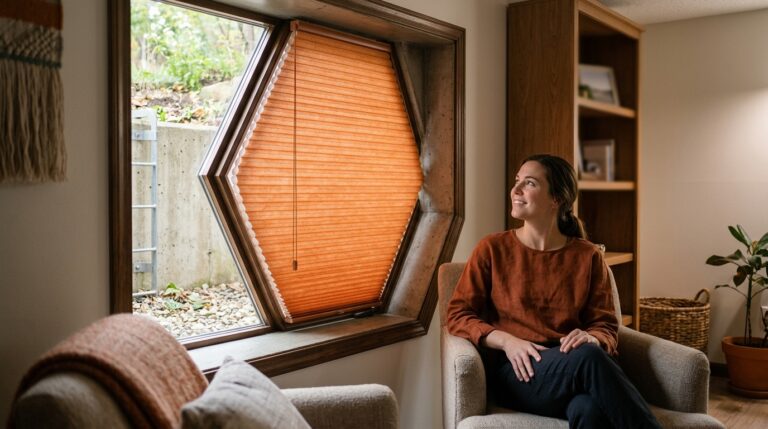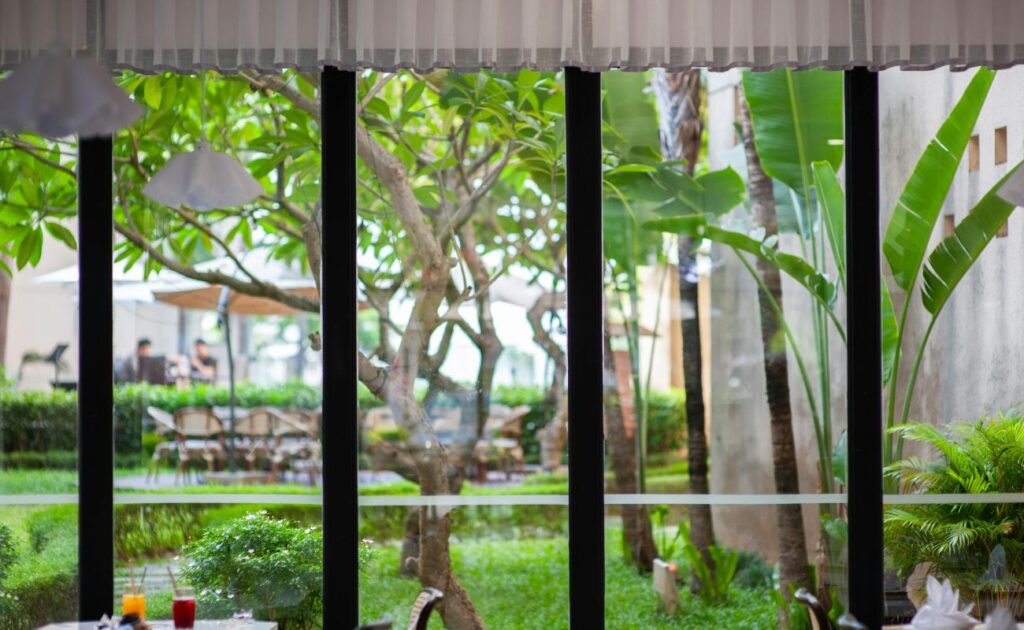
Cafe curtains cover the bottom half of a window and leave the top half bare. That single idea is why cafe window treatments still show up in so many Bergen County kitchens and bathrooms. You get privacy at standing eye level, and the daylight above the rod stays exactly where it is. This guide covers fabric, fullness, mounting and measuring, and it flags the windows where a half curtain is the wrong call.
What cafe window treatments actually cover
A cafe curtain, also called a tier, hangs from a rod mounted across the middle of the window and stops at or just below the sill. The rod does not have to sit at the exact midpoint. Raise it and you show more glass. Drop it and you block more of the view in from the sidewalk. Decide that height before you decide the length, because the two numbers depend on each other.
A tier on its own is the simple version. Add a valance across the top and you have the classic cafe set, which frames the opening and hides the hardware. Our valance guide covers the shapes that sit well over a short panel.
- Covers the lower half, or lower two thirds, of the window
- Hangs from a tension rod, a bracket mounted cafe rod, or a wire
- Made up as a rod pocket, tab top, or clip ring panel
- Usually a lightweight, washable fabric you can take down yourself
- Pairs with a valance, or with a shade above it, for more control
What we would put on the window
- Kitchen window over the sinkA washable cotton or cotton blend tier on clip rings, hemmed to skim the sill.
- Bathroom window facing the neighbor’s drivewayA tightly woven linen blend tier, unlined, with the top half left open so steam clears.
- Sunny breakfast nookSheer linen at cafe height to soften glare, with a roller or cellular shade above it for the hour the sun is direct.
- Ground floor window on a busy streetA cafe tier for daytime, plus a top down bottom up cellular shade for after dark.
- Dutch door or a door with divided glassA rod pocket panel on rods top and bottom so the fabric stays flat when the door swings.
Cafe curtains in a Bergen County kitchen
The window over the sink is the classic spot. A tier keeps the neighbors from looking straight in at counter height while the top half still lights the countertop, and the short length keeps fabric out of the splash zone and away from a gas burner. Pick something you can throw in the wash, because kitchen fabric picks up cooking grease whether you notice it or not. Clip rings help here: unclip the panel, wash it, clip it back.
Pattern is where a kitchen tier earns its keep. Red or blue gingham reads farmhouse, plain natural linen reads quiet and modern, and a bold print on a small panel gives you strong pattern without committing the whole room to it. If you are weighing a curtain against a blind or shade over the sink, read our roundup of kitchen window treatments first.
Bathroom curtains: privacy at eye level, steam out the top
Bathroom curtains have one job that no other room asks for. You need the sightline blocked at the height where someone standing outside would look in, and you need moisture to leave. A cafe tier does both, because the open top half lets steam reach the glass and dry off instead of sitting in a lined panel.
Keep bathroom fabric simple. Unlined, tightly woven cotton or a linen blend beats a heavy lined panel that stays damp. Hem the tier to skim the sill rather than sit on it, so standing water never wicks into the hem. Over a tub, where the panel will get splashed, we steer people to a moisture tolerant hard treatment instead. Our guide to bathroom privacy and moisture compares those, and faux wood versus real wood explains which one belongs in a wet room.
One thing a half curtain does not do: it does not hide you from a second story window across the street, and it does nothing after dark once the light is on inside. If either applies, pair the tier with a shade or read how much people can actually see through your window coverings before you order.
Rod pocket, clip rings, or tension rod
Cafe curtains live or die on the hardware, because the rod sits at eye level in the middle of the glass instead of hiding near the ceiling.
| Mount | Best for | Trade off |
|---|---|---|
| Spring tension rod inside the frame | Rentals, or trying a look before you commit | Needs a square frame and a light panel, or it creeps down |
| Bracket mounted cafe rod | A finished look, wider windows, heavier fabric | Screws into the frame or wall, so set the height once and get it right |
| Clip rings on a rod | Panels you take down and wash often | Rings raise the fabric about an inch, so subtract that from the drop |
| Wire or cable | Minimal hardware in a modern kitchen | Sags on a long span, sheers only |
A rod pocket gives the tightest, most even gathers and is the traditional cafe look, but the panel does not slide, so choose it for a window you leave closed. Tab tops and clip rings slide, and rings get the tier down for washing in seconds. For finishes and bracket depth, see our curtain rod and hardware guide. If you cannot drill, our notes on tension rods and hanging curtains without drilling cover the workarounds.
Fabric, fullness and length
Fullness is the difference between a custom tier and a flat sheet of cloth. Add up your panel widths and aim for 1.5 to 2 times the rod width. At 1.5 times you get a relaxed, casual gather. At 2 times you get deep, even folds that stay put when the panel is closed. Under 1.5 the fabric pulls flat and the window looks unfinished.
For fabric, lightweight and washable is the rule in kitchens and baths: cotton, linen, cotton blends and polyester blends all work. Sheer linen diffuses light and keeps the room open. Embroidered and eyelet cottons give you the vintage, cottage look. Heavy drapery fabrics belong on full length panels, not on a tier hanging from a thin rod.
On length, a cafe curtain should kiss the sill or float about half an inch above it. Anything longer breaks against the sill and reads as a mistake. If the window has an apron below the sill, the bottom of the apron is the other correct stopping point. Our short curtains guide covers where to end a panel that does not reach the floor.
How to measure a half window
- Set the rod height first. Stand outside at the sidewalk and note the height where you can see in. Mark the rod above that line.
- Measure the width. For an inside mount, measure the inside of the frame at the rod height. For an outside mount, measure the rod itself, bracket to bracket.
- Measure the drop. Measure from the top of the rod down to the sill, then subtract for rings, or add the header allowance if you are ordering rod pocket panels.
- Check the frame is square. Measure the width at two heights. Older Bergen County houses settle, and a half inch of difference decides between an inside and an outside mount.
Measure every window separately, even the two that look identical. If you would rather not, we measure in your home for free and put the numbers in writing. Our guide to measuring for blinds covers the hard treatment version.
When a cafe curtain is the wrong answer
Cafe curtains solve one problem well and several problems badly. Skip them when:
- You need the room dark. A bedroom that faces a street lamp needs a blackout shade or a lined panel, not a half curtain.
- The window is a slider or a patio door. Traffic through the opening rules out a mid height rod. See sliding door treatments instead.
- You want privacy and daylight at the same time, all day. A top down bottom up cellular shade covers the bottom of the glass and drops light in over the top, which is the cafe idea in a hard treatment.
- The window has a crank casement or a deep tile sill. Hardware and depth get in the way of a mid mounted rod, so an inside mounted roller shade is usually cleaner.
There is a middle path. You can run a shade for function and a fabric tier for character on the same window, the same layering logic covered in our custom drapery guide.
Custom cafe curtains from our Palisades Park showroom
The Curtain is a family owned window treatment showroom at 545 Broad Ave in Palisades Park, in business since 2007 and serving homeowners across Bergen County. Owner and designer Sejun Park can show you fabric in person, which matters here, because how a linen or a gingham hangs at half length is hard to judge from a photograph.
We make custom drapery, including made to measure cafe tiers, and we are a Hunter Douglas partner, so if the honest answer for your kitchen or bath is a shade or a shutter rather than fabric, we can fit that instead. Browse the gallery or the full range of window treatments to see both sides of that.
Measuring is free and in your home, and the quote comes in writing. Call (201) 302-9111 or book a free consultation to get on the schedule.