Panels usually get chosen first and the hardware gets chosen last, which is backwards. The rod decides how the fabric hangs, how far the panels stack off the glass, and whether the window reads as custom or as temporary. This guide covers the different types of curtain rods, the brackets and rings that go with them, and what we would actually hang on a Bergen County window.
The Different Types of Curtain Rods, and What Each One Is For
Standard decorative rods
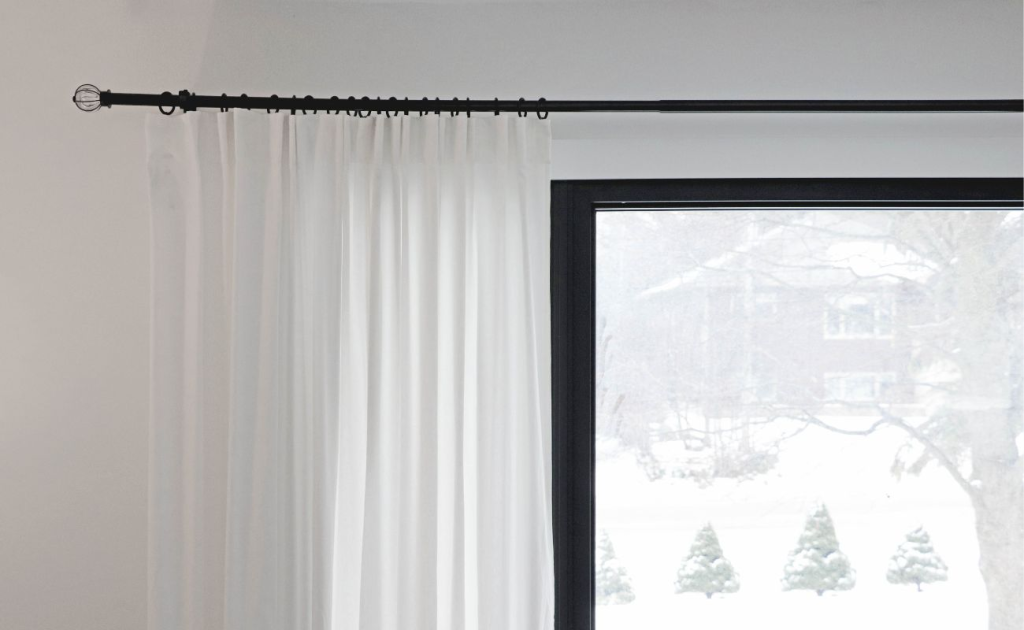
This rod is meant to be seen. It carries a finial at each end and sits on brackets fixed to the wall or the window frame. Common diameters run 3/4 inch, 1 inch, 1-1/4 inch and 1-3/8 inch, and heavier fabric calls for the thicker end of that range. Decorative rods suit ring-top, grommet and tab-top panels, where the heading is part of the look.
Traverse rods
A traverse rod hides a cord or wand mechanism that pulls the panels open and closed on carriers, so nobody is handling the fabric twice a day. It is the right call for pinch-pleat drapery, for goblet and cartridge pleats, and for any window you work every morning.
Ceiling-mounted tracks
A track fastened to the ceiling puts the hardware out of sight and starts the fabric as high as the room allows. It solves two problems that show up constantly in older Bergen County houses: not enough wall above the window to mount a rod, and a header that does not sit square to the ceiling line. Tracks are also the cleanest way to hang floor-to-ceiling panels.
Double rods
Two rods on one bracket let you run a sheer on the back rod and a heavier drape in front, so daylight is softened during the day and the room closes down at night. Read double rods versus single rods and how to layer curtains before ordering, because the front rod needs extra projection to clear the back panel.
Tension rods
Spring-loaded and sized to press against the inside of the window frame, with no drilling. Good for sheers, cafe panels and bathroom windows, and the usual answer in a rental. They carry light fabric only, so do not ask one to hold a lined drape. More in our tension rod guide and in how to hang curtains without drilling.
Cafe rods
Small diameter rods that mount inside the frame at the midpoint of the window, so the bottom half is covered and the top half still lets light in. They belong over a kitchen sink or in a ground-floor bathroom. See cafe curtains.
Motorized tracks
A motorized track moves the panels with a remote, an app or a schedule. It earns its place on tall windows you cannot reach, on a long run of glass where several panels should move together, and where loose operating cords are a concern. See automated blinds versus automated shades and child-safe window treatments.
What we would put on the window
- Wide slider off the family roomCeiling track or traverse rod with a one-way draw, so the stack parks on one side and clears the handle.
- Street-facing bedroomDouble rod: sheer on the back rod, lined blackout panel on the front.
- Dining room bay windowRod sections joined with corner connectors, or a track bent to the angles, so panels turn the corners instead of stopping at them.
- Kitchen window over the sinkSmall-diameter cafe rod inside the frame, panels hemmed to clear the counter.
- Apartment where you cannot drillTension rod inside the frame, carrying sheers or another lightweight panel.
Curtain Rod Bracket Types, and Which One Your Window Needs
Brackets do the actual work. Four things separate the curtain rod bracket types you will be choosing between.
- Open or closed. An open bracket cradles the rod so you can lift it straight out to wash the panels. A closed bracket rings the rod, which holds better but means the rod slides out the end.
- End or center support. End brackets sit just past the last ring. A center support carries a long rod in the middle so it does not sag under the fabric.
- Inside, outside or ceiling mount. Inside brackets fasten to the window frame, outside brackets to the wall around it, ceiling brackets to the ceiling itself.
- Projection. How far the bracket holds the rod off the wall. Most single-rod brackets sit roughly 3 to 4 inches out, which clears standard trim. You need more when the panel has to pass a blind, a shade, a deep sill or a crank handle.
Then match the anchor to the wall. Landing on a stud is best. Drywall alone needs toggle or self-drilling anchors rated above the weight of the treatment, and plaster and masonry each take their own hardware. Lined drapery gets heavy fast, and so does anything in velvet, so pair it with a 1-1/4 inch or larger rod and brackets rated for the load.
How to Size the Rod
- Measure the window width including the frame. Measure it, do not work off the size of the blind that is up there now.
- Add 6 to 12 inches on each side. That extension is where the open panels park, so the glass stays clear and the window looks wider than it is.
- Set the height. Four to six inches above the frame reads standard. Mounting as close to the ceiling as the header allows reads taller, and it is usually the better move in a room with 8 foot ceilings.
- Add supports for the span. Use the table below.
| Rod length after extension | Support brackets | What it means for the panels |
|---|---|---|
| Up to 48 inches | Two end brackets | Panels slide the full width with nothing in the way. |
| 48 to 96 inches | Add one center support | Ring-top panels have to be lifted past the support, so plan on two panels that meet in the middle, or use a traverse rod. |
| Over 96 inches | Two center supports | Go with a traverse rod or a ceiling track so the draw is uninterrupted. |
Two more notes. Finials add length past the bracket, so measure the wall you actually have between the window and the corner before you commit to a 5 inch scroll. And some windows are never one straight piece of rod: a bay window takes sections and corner connectors or a bent track, an arched window takes hardware shaped to the curve, and a run over sliding doors or other large windows wants a one-way draw so the stack is not parked in front of the glass.
Rings, Carriers, Finials and Holdbacks
- Rings. Clip rings pinch the top edge of the panel. Eyelet rings take a drapery pin sewn into the heading, which hangs cleaner on custom work. Space them roughly one every 4 to 6 inches, and put the last ring outside the end bracket so the leading edge closes flat.
- Carriers. What rings become inside a traverse rod or track. Pins hook into the carriers and the cord or motor does the pulling.
- Finials. Ball and cap shapes disappear, scroll and crystal announce themselves, squared shapes suit a newer build.
- Holdbacks and tiebacks. Both pull the panel off the glass during the day. A holdback is fixed to the wall, a tieback is fabric or cord that wraps the panel.
Curtain and Drapery Terms You Will Hear at the Measurement
- Heading. The top of the panel and how it attaches: rod pocket, tab top, grommet, pinch pleat, goblet, cartridge.
- Fullness. How much fabric width goes across the window. Pleated drapery is usually cut at 2 to 2.5 times the rod width, which is why a custom panel looks fuller than a packaged one.
- Stack back. The wall width the panels take up when fully open. This is what the 6 to 12 inch extension is for.
- Return. The short piece of fabric that turns from the rod back to the wall at each end and closes the light gap.
- Overlap. Where the two leading edges cross at the center of a traverse rod, so no light line runs down the middle.
- Break. How the hem meets the floor: floating just above it, kissing it, or puddling on it. See should curtains touch the floor.
Finishes That Match the Rest of the Room
Pick the finish after you know what else is in the room.
- Brass and gold. Polished, brushed or antique. Warm, and forgiving with most fabric colors.
- Matte black. Strong contrast against light walls and light panels. Reads contemporary, and works in farmhouse-style rooms.
- Brushed nickel and chrome. Cool metals for modern rooms. Brushed is softer, polished chrome is reflective.
- Oil-rubbed bronze. Dark brown with copper highlights, at home with traditional and rustic finishes.
- Wood and wood-look. Oak, walnut, mahogany and painted options, for rooms that need texture rather than shine.
Rods do not have to match your door knobs, but keeping every metal in one tone family is what makes a room look considered.
See the Hardware in Palisades Park Before You Order
The Curtain is a family-owned window-treatment showroom at 545 Broad Ave in Palisades Park, in business since 2007 and serving Bergen County. Owner and designer Sejun Park runs it. Comparing finials, finishes and rod diameters in person beats guessing at scale from a photo. We are a Hunter Douglas partner, so we sell and install Hunter Douglas shades, blinds and shutters, and we make custom drapery to fit the window you have.
Measuring is the part most people would rather hand off, so we do it. Book a free in-home measurement and you get a written quote. Call (201) 302-9111, or check the towns on our service area page. If the trouble is the rod or track you already have rather than the fabric, see our repair page. You can also browse the gallery, compare product types under window treatments, or read how to hang curtain rods if you are installing them yourself.