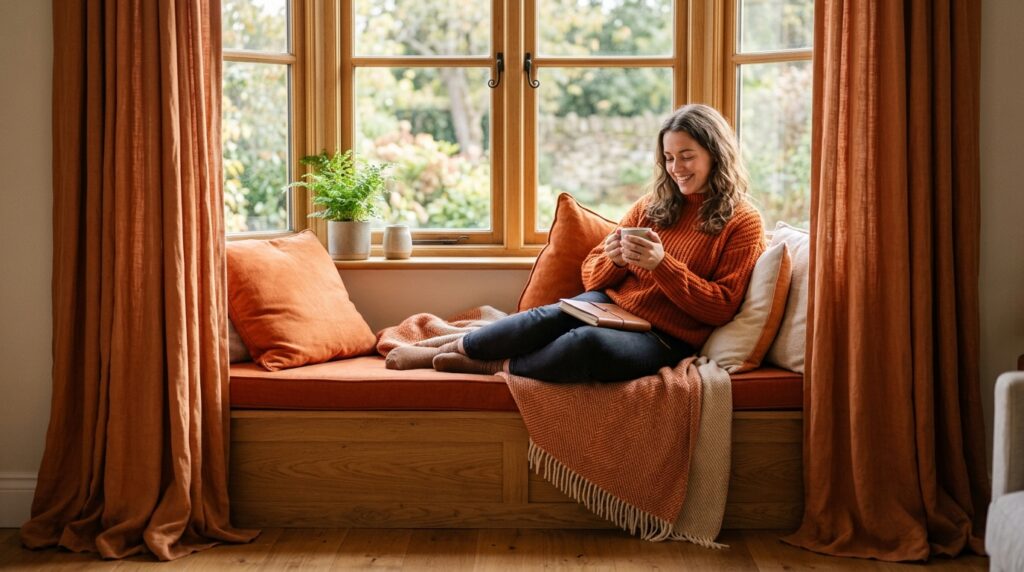
Bay windows add architectural charm, but they turn what should be a simple curtain purchase into a genuine puzzle of angles, corners, and awkward hardware decisions. Standard rods just won’t cut it. Choosing the right drapery for bay window installations means balancing curved or angled tracks, fabric weight, and light control without blocking your view or overwhelming the space. This guide breaks down exactly what works, so you can shop with confidence and get a polished result on the first try.
Why Bay Windows Present a Unique Design Challenge
Common Bay Window Configurations
Most bay windows fall into a few familiar shapes. The classic box bay has three panels set at 90-degree angles, jutting straight out from the house. The bow window is gentler. It uses four or five panels curved into a soft arc. Then there’s the angled bay, usually built at 30 or 45 degrees, which is common in older colonial-style homes across northern New Jersey. Each version looks charming from the curb. Each one is also a headache the moment you try to hang a single straight rod across it.
That’s because standard hardware just wasn’t built to turn corners. A rod meant for one flat window will either leave a gaping triangle at each seam or force you to mount separate rods that never quite line up. Knowing your exact configuration before you shop saves real money and frustration down the line. Some homeowners even sketch their bay’s angles on paper first. It sounds old-fashioned, but it genuinely helps when comparing curtain rod and track options later.
How Angles Affect Fabric Choice
Here’s the part people miss: each pane in a bay window faces a slightly different direction, so it gets different light, different heat, and different eyes from the street. The center pane might face south and flood with afternoon sun, while the two side panels catch morning glare or block a neighbor’s view. That means one fabric weight rarely suits all three sections equally. A heavy blackout drape on every panel can feel like a cave. A fabric too sheer everywhere kills privacy where you need it most.
Angles also change how fabric hangs and folds. Corners create tight pinch points where thick material bunches awkwardly, while thin panels can look flimsy against a strong architectural line. Getting this wrong leaves visible gaps at the joints or blocks sightlines you actually wanted to keep open. Many homeowners browsing inspiration boards on Bay Window Curtains notice this variation immediately once they start comparing real installed photos rather than showroom mockups. Bottom line: measure the angles first, choose fabric second. Skip that order and you’ll pay for it twice.
Drapery for Bay Window Setups: Styles That Actually Work
Curved Rods vs. Separate Rod Sections
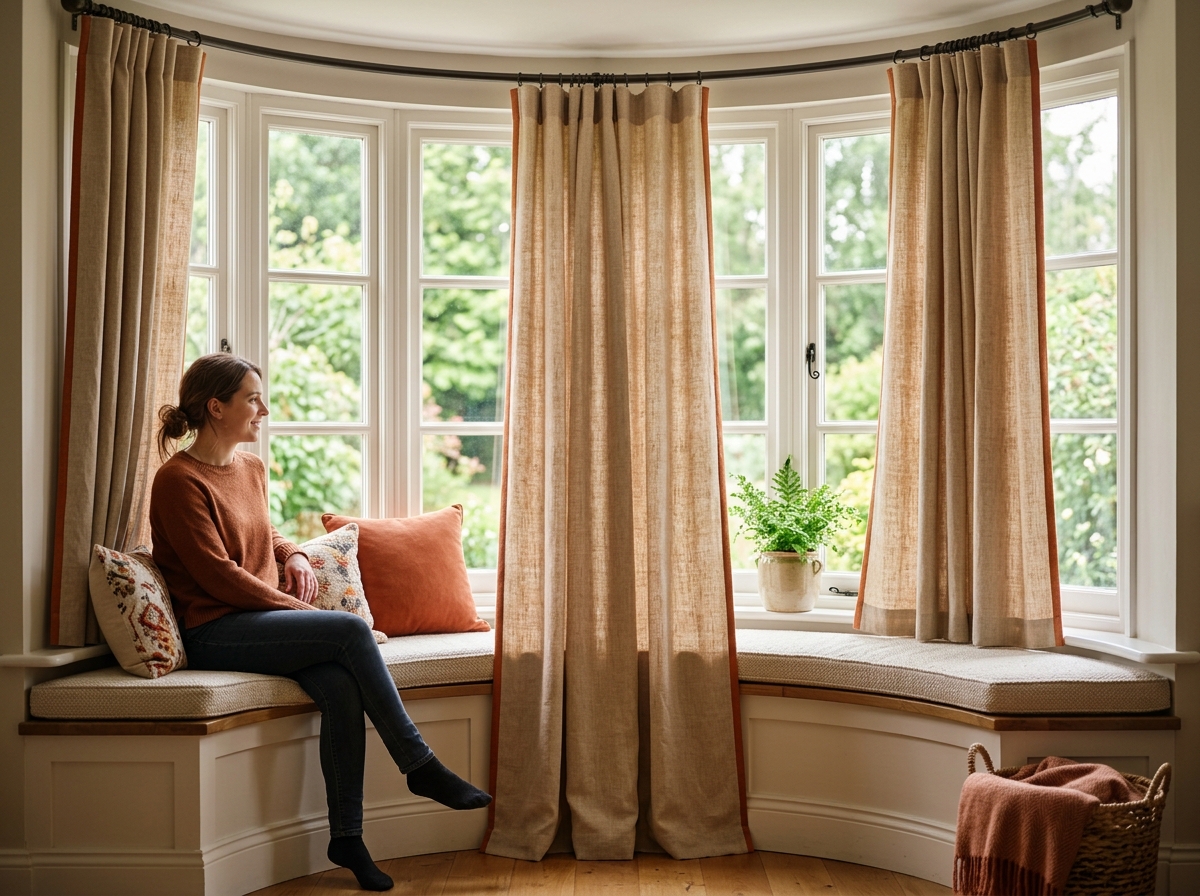
Once you’ve settled on drapery for a bay window, the next real decision is hardware. You’ve basically got two camps: a single curved (or angled) continuous track that follows the whole bay, or three separate rods, one per window section. The continuous track gives you a clean, unbroken sweep of fabric and lets panels glide around corners without snagging. It’s the choice most designers reach for when the goal is a soft, unified look rather than three distinct little windows fighting for attention.
Separate rod sections cost less and install easier, which matters if you’re on a budget or renting. But they create visual breaks at each corner post, and panels can bunch awkwardly where two rods meet at an angle. Corner clearance is the real issue here — cheap curved tracks sometimes bind at tight angles, so measure your bay’s corner degree before buying. For deeper comparisons on hardware behavior, many homeowners find it useful to browse general Window Treatment Ideas for Bay Windows before committing to one system.
Honestly, if your bay window is the focal point of the room, spend the extra money on the curved track. Three choppy rod sections rarely photograph well, and you’ll notice the seams every day, not just in pictures.
Pairing Drapery With Cellular Shades or Roman Shades
Drapery alone rarely handles a bay window’s full job list: privacy, light control, insulation, and style all at once. That’s why layering works so well. Sheers hung close to the glass filter daylight softly during the day, while heavier drapery panels stack to the sides for evening privacy and warmth. Add cellular shades underneath — their honeycomb pockets trap air and cut heat loss noticeably, especially valuable on a bay window’s three exposed glass panes.
Roman shades pair well too, especially in dining nooks or breakfast bays where a tailored, flatter profile suits the smaller footprint better than bulky stacked panels. If you’re mixing textures across a home, it helps to see how similar layering ideas get used in other rooms, and learning how room divider curtains handle privacy and light can spark ideas for your own bay window combination. Fabric weight should match the room. A living room bay can carry heavier linen or velvet drapery over cellular shades for insulation. A bedroom bay benefits from blackout-lined panels for sleep quality. A dining nook wants lighter cotton or woven texture — nobody wants heavy drapery pooling near a breakfast table.
One more thing: don’t skip moisture-prone spaces just because they’re small. If your bay window sits near a bath or laundry area, the same privacy-and-durability logic used in bathroom window treatments privacy and moisture solutions that last applies to fabric choice near steam and humidity.
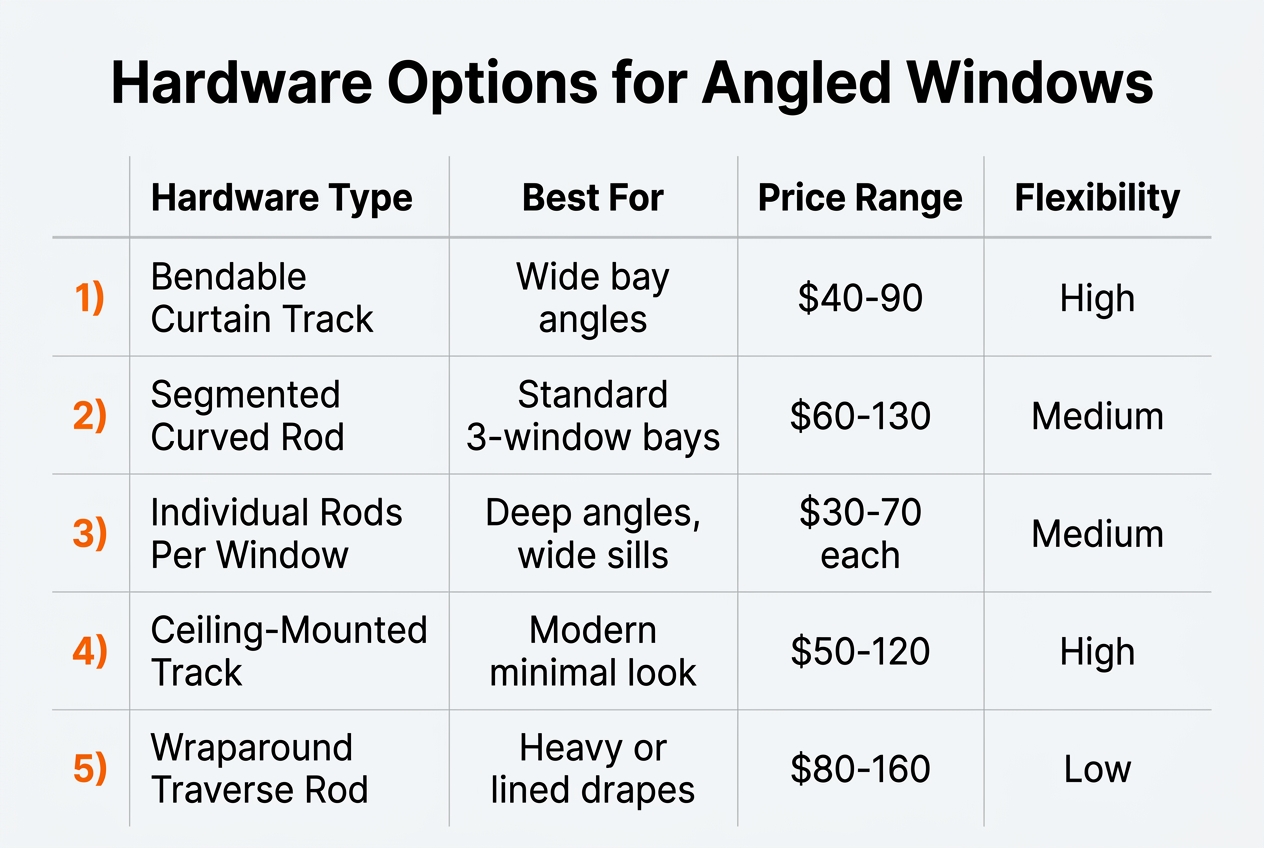
Comparing Hardware Options for Angled Windows
Bay windows don’t play nice with standard curtain rods. The angles at each corner mean your hardware has to either bend, break into segments, or run on a track built for the job. Before you pick fabric or color, get the hardware sorted — everything else in the room depends on it. Some folks lean on a curtain tension rods guide when weighing a no-drill option against something more permanent, since tension mounts skip wall damage entirely but sacrifice some load capacity.
Here’s how the four main choices stack up on cost, effort, and everyday flexibility.
| Hardware Type | Typical Cost | Installation Difficulty | Best For |
|---|---|---|---|
| Bendable curved traversing rod | $150–$400+ | Moderate to hard | Seamless coverage across all panes |
| Individual rods per pane | $30–$80 each | Easy | Tailored, layered looks |
| Motorized track (PowerView-compatible) | $400–$900+ | Professional recommended | Automated, hands-free operation |
| Decorative rods with finials | $60–$200 per section | Moderate | Traditional, ornamental styling |
A single curved traversing rod gives you one continuous sweep of fabric, which looks clean but usually needs a professional to bend and mount correctly. Going with individual rods per pane is the budget-friendly route, and it’s genuinely easier for a DIYer to handle on a Saturday afternoon. Motorized tracks cost more up front, but they pair with automation systems for scheduled opening and closing — handy if you’re already using smart shades elsewhere in the house. Decorative rods with finials bring a traditional look, though ornate hardware at three separate angles can visually clutter a small bay. Match the hardware to how you’ll actually use the window, not just how it looks in a showroom photo. If you’re curious how curved hardware compares to angled solutions used on other window shapes, this how to hang curtains on arched window breakdown covers some overlapping mounting logic. And before committing, it’s worth skimming real homeowner experiences in this Bay window curtains : r/DesignMyRoom thread, where plenty of people share what actually held up long-term.
Choosing Fabrics for Light, Privacy, and Insulation
Matching Fabric Weight to Room Function
Bay windows don’t just sit flat against a wall. They jut out into the room, catching light from three directions and losing heat through three sets of glass instead of one. That means fabric choice matters more here than on a standard window. Picking the wrong weight isn’t just a style miss — it’s a comfort problem you’ll notice every single day, especially in winter.
Start by thinking about what each room actually needs, not just what looks good on a swatch card. A home office might want soft, glare-free light. A bedroom wants dark and quiet. Here’s how fabric weight and type tend to break down by function:
- Sheer fabrics let in maximum daylight while gently blurring the view inside, which works well for living rooms and dining areas that face the street.
- Blackout linings give bedrooms and media rooms real control over glare and privacy, useful for shift workers or anyone who wants a dark room at 8 a.m.
- Insulating fabrics cut down on the drafts bay windows are prone to, since their angled, projecting shape exposes more glass surface to outside air.
- UV-resistant fabrics guard furniture, flooring, and artwork from fading, which matters a lot in a bay window that pulls in sun most of the day.
- Noise-dampening, heavier weaves help buffer sound for homes near busy roads, a common concern in denser Bergen County neighborhoods.
If you want a side-by-side breakdown of which shade types handle privacy versus light best, this guide on shades for privacy and light lays out the tradeoffs clearly. For a natural, breathable option that still filters light nicely, it’s worth taking time to learn about linen curtains before committing to a heavier fabric you might regret. And if you’re still shopping around for base inspiration, browsing options built specifically for Bay Window shapes can help you see what’s realistic before you fall in love with a fabric that won’t cooperate with the angles.
Design Ideas to Make Your Bay Window a Focal Point
A bay window is already the biggest feature in most rooms. Dress it right, and it becomes the thing people notice first when they walk in. Style choices here matter more than in a standard window, since three panes and an alcove give you room to layer texture, color, and finish in ways a flat wall opening just can’t match.
Before picking fabric, decide what role the drapery should play: star of the show, or quiet frame around something else. Both work. Committing to one clear intent keeps the finished look from feeling busy or indecisive. A few approaches that hold up well in real bay window rooms:
- Use jewel-toned drapery — think sapphire, emerald, or deep amethyst — to add drama and contrast against neutral or white walls.
- Frame the view with slim, narrow panels that stay mostly pulled open during the day, letting the glass and light stay the focus.
- Layer two-tone panels, pairing a sheer under-layer with a richer solid outer panel, to build depth and dimension across each angled section.
- Keep drapery in a neutral palette when a window seat, cushions, or statement furniture piece is meant to be the star.
- Mix patterns on throw pillows or cushions while keeping the drapery solid, for a curated, collected-over-time look rather than a matchy one.
- Add trim, banding, or tassels along the leading edge for a tailored, made-for-you finish that off-the-shelf panels rarely deliver.
Not sure which direction fits your space? Browsing curated bay window treatment ideas before you shop can save you from an expensive change of heart later. It also helps to see how designers handle tricky proportions; a piece walking through curtain solutions for hard window shapes shows how professionals adjust panel width and placement around angled glass. Whatever style you land on, the goal is the same: draw the eye, don’t clutter it.
Measuring and Installation: What to Expect
Why Professional Measurement Matters for Angled Corners
A bay window isn’t one window. It’s three (sometimes five) working together at odd angles, and that geometry is exactly where a tape measure and good intentions fall apart. A trained installer works through a set sequence, checking numbers twice, because a single bad angle throws off every panel that follows.
The table below walks through that sequence, from first measurement to final hardware check.
| Step | What’s Measured | Why It Matters |
|---|---|---|
| 1. Individual pane width | Each pane, left to center to right | Bay panes are rarely identical; assuming symmetry causes gaps |
| 2. Total span | Full width across all panes combined | Needed for continuous rods that curve through the corners |
| 3. Return angle | Degree of each corner joint | Determines whether standard elbows or custom-bent rods are required |
| 4. Wall and ceiling clearance | Depth from glass to nearest obstruction | Prevents hardware from hitting trim, sills, or radiators |
| 5. Stacking space | Room needed for panels when fully open | Stops fabric from blocking the view or overlapping at corners |
Notice steps one and two aren’t interchangeable. Pane-by-pane numbers determine how fabric is cut and where seams fall; the total span tells the fabricator how long a continuous rod needs to bend. Skip either one and you’ll likely end up short on fabric, or with hardware that sits crooked at the joints. If you’re browsing ready-made options first, it’s worth comparing standard Curtains for Bay Window in Living Room, Kitchen settings against your actual angles before ordering anything. DIY measuring usually misses stacking space entirely, which is why open panels end up bunched against the glass. A free consultation puts a laser measure and a trained eye on the problem, so nothing gets guessed at.
Solving Everyday Comfort Problems With the Right Window Treatment
Traffic noise, chatty neighbors, a dog barking three doors down — bay windows catch it all because of their angled glass and extra surface area. The fix isn’t complicated. Layering heavier drapery panels over cellular shades or woven shades adds mass, and mass absorbs sound. A lined drape with a thick cotton-blend or velvet face does far more work than a single sheer panel ever could. If you’re weighing your options, choosing between blinds and curtains often comes down to how much noise dampening you actually need versus how much light control matters.
Temperature swings are the other big complaint near bay windows, and it makes sense — three exposures mean three angles for heat loss or gain. Insulating cellular shades, especially double-cell styles, trap air and slow that exchange. Pair them with interlined drapery panels and you’ve got a real barrier, not just a decorative one. That combination alone can noticeably even out a room’s temperature in both January and July.
Sun damage sneaks up on people. Fabrics fade, wood floors bleach, and by the time you notice, it’s too late to reverse. UV-filtering shades or drapery liners block the worst of it while still letting daylight in. Many homeowners browsing bay window curtain options are surprised how much fabric choice affects both fade protection and energy efficiency.
When to Add Automation for Convenience
PowerView motorization makes sense once you’re tired of adjusting three or more window sections by hand every morning and evening. Set a schedule, and shades open with the sunrise and close before the evening chill sets in. No cords to untangle, no ladder for that awkward center window. It’s a small upgrade with an outsized payoff — honestly, once people try it, going back to manual cords feels like using a rotary phone.
For a fully solved bay window, combine automated shades with drapery panels and add shutters or woven shades where privacy matters most. Layering products this way handles noise, temperature, sun, and style all at once — no single treatment does all four alone.
Before you commit to any one fix, it helps to be honest about what’s actually bothering you: if the glass itself is failing — fogging between panes, drafts you can feel from a foot away, a cracked sash — that’s a glazier or window contractor’s work, and no covering will substitute for it. But if the real problem is afternoon glare, fading floors, or rooms that run hot and cold with the sun, ask how much control you want to keep: film and exterior awnings commit you to one permanent condition, while interior options like solar roller shades, woven woods, or insulating cellular shades let you dial the light up or down by the hour and by the season. Weigh the cost of each path against how long you plan to stay, how the room is used, and whether you’d rather solve the problem once at the glass or adjust it every day from inside.