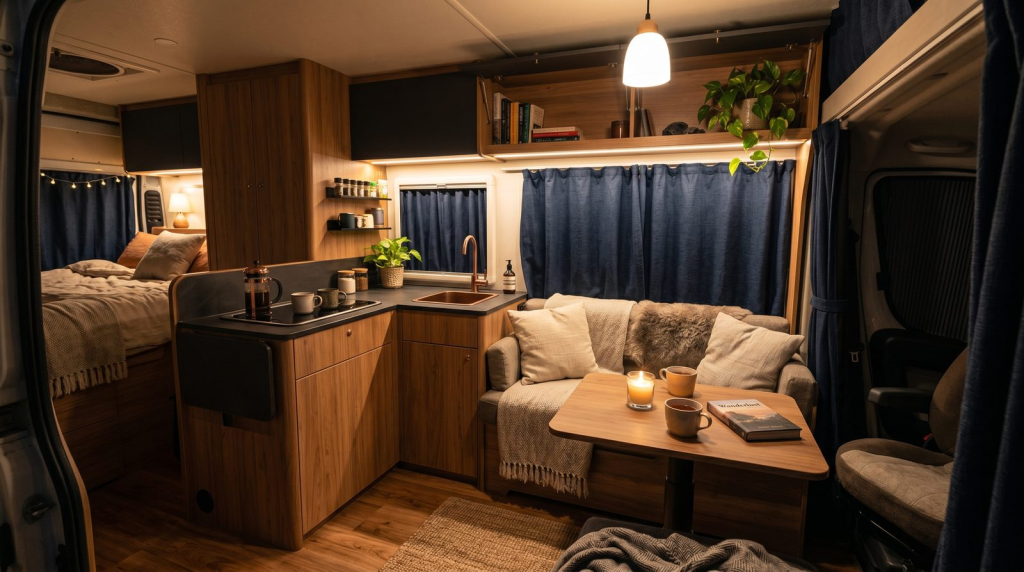
The camper curtains that come with most RVs are an afterthought. They are thin, dated, and not good at the one job that matters, which is blocking light so you can sleep. If your rig winters in a Bergen County driveway and spends the summer in campgrounds, new panels are one of the cheapest upgrades you can make to it.
Camper windows are not house windows. They are smaller, rarely square, boxed in by cabinetry, and they travel at highway speed. Here is how to pick fabric, hardware and sizes that survive all of that, and what we would put on each window.
What we would put on the window
- Bunk or bed window you sleep besideA blackout-lined panel on a spring tension rod, with snaps at the bottom corners so it cannot lift.
- Wide dinette or lounge windowTwo lightweight blackout panels that meet in the middle with a few inches of overlap, on a stick-on track.
- Entry door windowOne short flat panel, sill length, anchored top and bottom so it stays flat while you drive.
- Bathroom or shower windowA washable, mildew-resistant privacy panel instead of blackout, since that window gets wet.
What makes camper curtains different from house curtains
- Blackout does the heavy lifting. You park under campground lights, at rest stops, and in other people’s driveways. A true blackout lining is the difference between sleeping and staring at the ceiling.
- Space is tight. A thick rod and deep pleats eat into a small cabin and crowd the window frame. Flat or lightly gathered panels on a low-profile rod read cleaner and take up less room.
- No-drill is usually the rule. Most RV walls are thin, and there can be wiring behind them, so tension rods, adhesive hooks and stick-on tracks do the work that screws do at home.
- Everything moves. A panel that swings or rattles at highway speed will wear on you by the second hour. Snaps, magnets and snug tracks hold the fabric still.
- Humidity is constant. Cooking, showering and closed-up storage all put moisture in the air, so the fabric needs to wash easily and resist mildew.
The best types of RV and camper curtains
- Blackout panels. The priority for the bedroom, the bunks, and any window you sleep near. Look for fabric with an opaque lining rather than just a dark color, because color alone does not stop light.
- Lightweight thermal panels. A thermal lining adds insulation against summer heat and cold nights, which matters more in a thin-walled rig than it does in a house. Our thermal curtains guide covers how those linings are built.
- Day and night combinations. A sheer inner panel for privacy with daylight, plus a blackout outer panel you close at bedtime. It is the same idea as layering at home, scaled down.
- Snap or magnetic panels. Panels that fasten to the frame stay put on the road and seal the edges at the same time. They are the most travel-friendly option and the least fussy to live with.
Fabric and lining: what actually blocks the light
Light gets through a curtain two ways, through the weave and around the edges. The weave is a fabric problem and the edges are a hardware problem, so solve them separately.
For the weave, an opaque blackout lining behind a decorative face fabric blocks far more light than a single layer of dark fabric. Tightly woven polyester and poly-cotton blends handle camper life well because they wash, dry fast and resist mildew. Loose linens and heavy velvets look great in a living room and are the wrong call in a small, humid cabin. For the longer version of that comparison, read our guide to blackout curtains.
For the edges, plan the overlap before you pick the fabric. Panels that run past the opening on each side, plus magnets or snaps that pull the hem tight to the frame, kill the glow that a perfectly good blackout fabric otherwise lets in at the sides.
How to hang RV curtains without drilling
- Spring tension rods inside the window recess. Fast, removable, no holes, and easy to swap when you change fabric. See our tension rod guide for sizing.
- Adhesive hooks for very light panels. Clean the surface first and give the adhesive a full day to cure before you hang anything on it.
- Stick-on track or channel systems made for RVs. These give you a real glide and a straight top line across a wide window.
- Magnetic tape along a metal window frame. It seals the edge, stops the sway, and comes off without a mark.
Our no-drill hanging guide runs through the same methods for apartments and rentals, where the obstacle is a lease instead of a wall panel.
How to measure RV and camper windows
Measure every window on its own. Two windows that look identical in a camper are often a half inch apart, and a half inch is a visible light leak at 6 a.m. Write the numbers down window by window, with a note about which one is which.
| Measurement | How to take it | Why it matters |
|---|---|---|
| Width | Measure the opening at the top, middle and bottom, then use the widest number. | Camper openings are rarely square, and the widest point is where the gap shows. |
| Overlap | Add roughly 2 inches past the opening on each side. | Most light sneaks in at the sides, not through the fabric. |
| Height | Measure from the rod or track position down to just below the sill. | A short hem clears furniture and will not swing while you drive. |
| Clearance | Note the depth of any cabinet, valance box or shade housing above the window. | It decides whether the rod fits inside the recess or has to mount on the face. |
Short panels are the norm here, and they are their own skill. For the reasoning behind sill-length and apron-length hems, our short curtains guide covers it.
Hardware that holds up on the road
Pick the anchor first and the fabric weight second, not the other way around. Heavier panels need a track or a rod with real tension. Lighter panels can live on adhesive hooks and magnets.
- Snaps at the bottom corners hold a panel flat against the wall so it cannot lift when a vent is open.
- Sew-in magnets in the leading edge let two panels pull themselves together in the middle.
- Hook and loop tabs along the side of the frame seal the last inch of the edge and take two seconds to release.
- A track with gliders is worth it on the widest window in the rig, because a long tension rod will sag under a lined panel.
The same rules work on the house windows
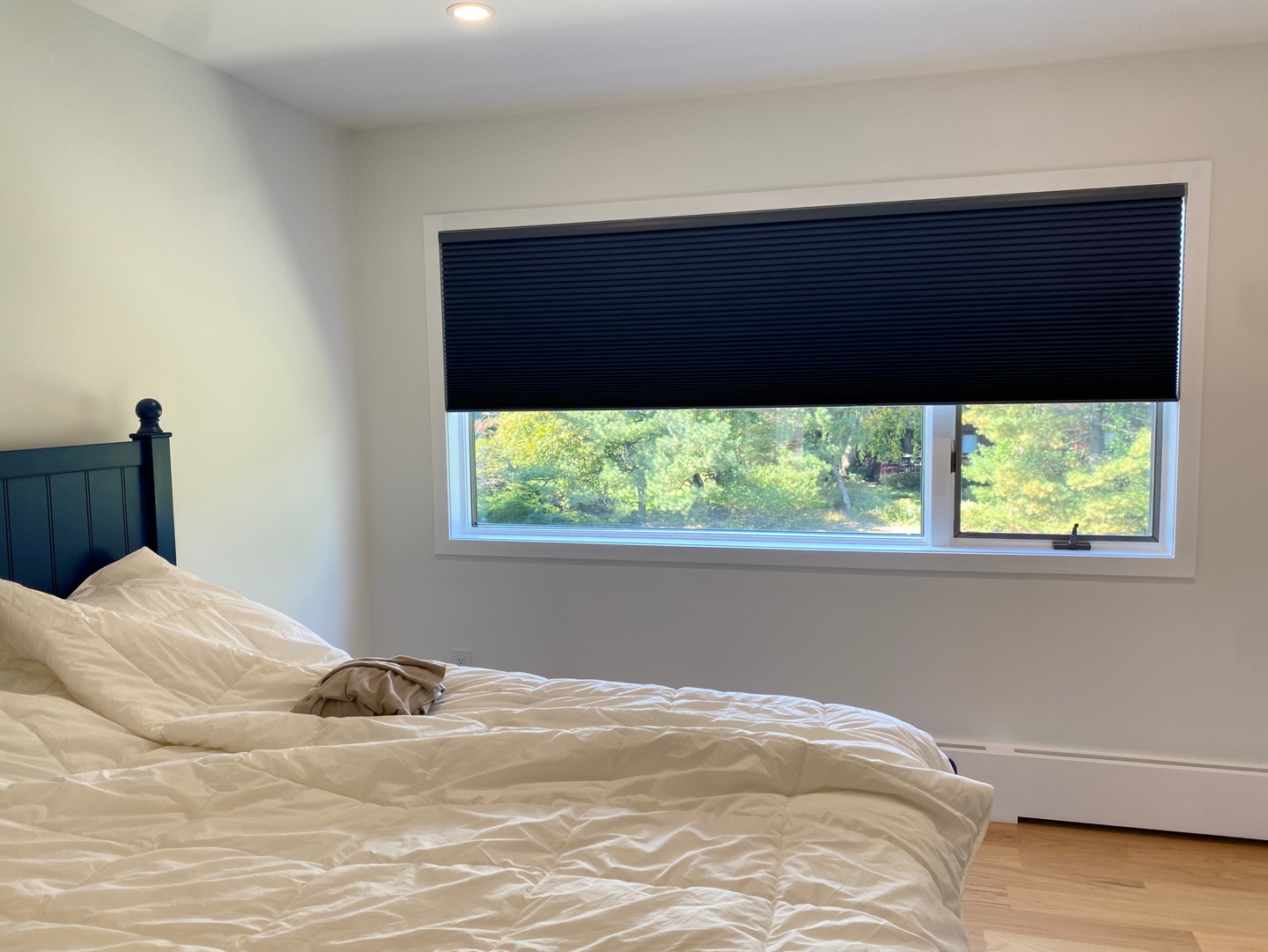
Everything above is a compact version of what we do in Bergen County homes every week. If the camper taught you that you sleep better in a dark room, the bedroom at home deserves the same treatment. That usually means a lined drapery panel, a blackout shade, or a cellular shade that insulates as well as it darkens. Our bedroom curtain guide walks through the fabric choices, and the full window treatments section shows what goes on the harder shapes.
Frequently asked questions
What kind of curtains are best for a camper?
Lightweight blackout panels. They block light for sleeping without taking up space, and they are easy to wash. A thermal lining is a smart add-on because a camper wall holds almost no insulation.
How do you hang RV curtains without drilling?
Spring tension rods inside the window recess, adhesive hooks for light panels, RV-specific stick-on tracks, or magnetic tape along a metal frame that both holds and seals the panel.
How do I stop camper curtains from swinging while driving?
Anchor the bottom and the sides. Snaps, sew-in magnets or hook and loop tabs at the hem, plus a snug track or a tension rod that does not sag, keep the panel from moving.
Do I really need blackout curtains in an RV?
Most people find them essential. Campgrounds, rest stops and driveways are brighter at night than they look, and RV walls are thin enough that light and heat both come straight through.
Can camper curtains be made to a custom size?
Yes, and for odd openings it is often the only way to get a clean fit. A custom panel lets you set the exact width, the hem length, the lining and the fastening hardware for each window instead of trimming a stock panel and hoping.
From our own installs in Bergen County
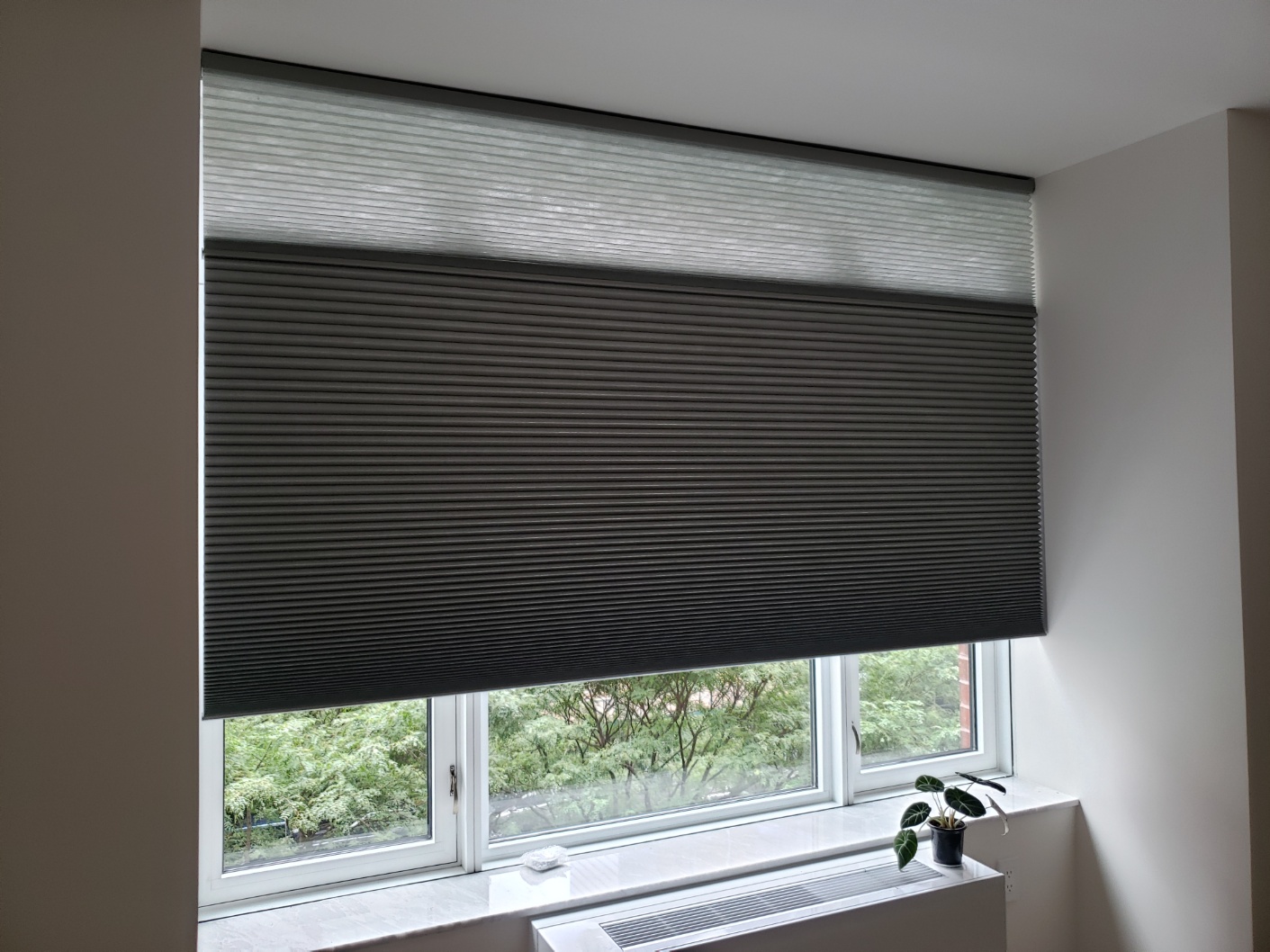
Custom panels from our Palisades Park showroom
The Curtain is a family-owned window treatment showroom at 545 Broad Ave in Palisades Park, New Jersey, serving Bergen County since 2007. Owner and designer Sejun Park makes custom drapery, which means a panel can be made to an exact width and hem length with the lining you choose, instead of being trimmed down from a stock size. We are also a Hunter Douglas partner and sell and install Hunter Douglas shades, blinds and shutters for the house.
Bring your measurements to the showroom and we can go through fabric and hardware options with you. For the windows in your home, we offer a free in-home measurement and a written quote. Call (201) 302-9111, book a free consultation, see finished work in the gallery, or check the towns we cover on our service area page.