Sliding glass doors and oversized windows pose a real challenge: standard blinds often can’t handle the width, the weight, or the constant foot traffic. If you’ve been searching for vertical blinds for windows that actually stand up to daily use while still giving you control over light and privacy, you’re in the right place. This guide breaks down what works, what doesn’t, and how to choose smart. No fluff.
What Are Vertical Blinds and Why They Still Matter
Where Vertical Blinds Work Best
Vertical blinds hang from a headrail and rotate on a track, stacking to one side or splitting open in the middle. That design isn’t an accident. It’s built for glass that’s wide, not tall, which is exactly the kind of opening horizontal blinds struggle with. A sliding door that’s 6 or 8 feet across needs vanes that can travel sideways without sagging under their own weight.
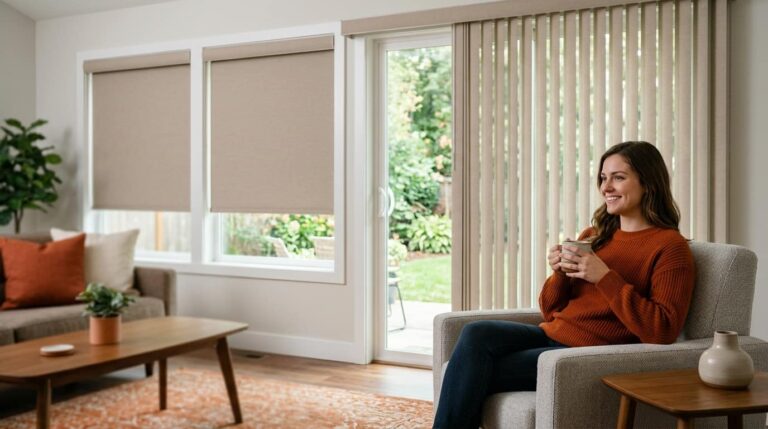
That’s why you’ll see them most on sliding glass doors, patio doors, and oversized picture windows in living rooms, dens, and home offices. If you’re searching for practical vertical blinds for sliding glass doors, you’re really solving a coverage problem first and a style problem second. Wide glass needs wide coverage, and verticals were made for that job from the start.
Oversized conference room windows and glass walls in small offices fall into the same category. Anywhere the glass runs long instead of tall, verticals tend to outperform other formats on pure function.
How They Differ from Horizontal Blinds
Horizontal blinds stack vanes on top of each other and raise them with a lift system. That mechanism works fine on a standard window, but on anything wide, the slats get heavy, the cords stretch, and sagging becomes a real risk over time. Vertical blinds spread that weight sideways instead, which is a sturdier setup for daily use.
Operate a vertical blind every day for years and the mechanism holds up. Horizontal lift systems on oversized windows can’t always say the same. That durability is one reason vertical blinds remain a go-to choice in Bergen County homes with glass doors opening onto decks, patios, or sunrooms, where the blinds get touched multiple times a day.
There’s also a practical light-control difference: verticals rotate to filter or block light evenly across a wide span, where horizontal slats on a tall door can leave uneven gaps. Neither style is universally better. It’s about matching the mechanism to the shape of the glass in front of you.
Vertical Blinds for Windows: Styles, Materials, and Where They Fit in Your Home
Fabric vs Faux Wood Vanes
Fabric vanes are the classic sliding door choice, and for good reason. They’re soft, quiet when they sway, and come in hundreds of colors and weaves, from sheer light-filtering fabrics to tighter room-darkening weaves. On a large glass slider that gets opened and closed daily, fabric’s light weight means less wear on the headrail over time. It also softens a room the way linen curtains do on a standalone window, which matters if you want the door treatment to feel like part of the room’s fabric story, not just a mechanical cover.
Faux wood vanes bring a different personality. They’re stiffer, a bit heavier, and read as more architectural — think of them as a vertical cousin to wooden blinds for windows. Smooth finishes suit modern spaces; textured or embossed faux wood hides fingerprints and handles humidity near patio doors better than painted wood ever could. On a sliding door that sees direct sun for hours, faux wood resists warping, where some fabrics can fade unevenly.
So which wins? Depends on the door and the light. South-facing sliders in full sun lean faux wood for durability. North-facing doors with gentler light do beautifully in fabric. There’s no universal right answer here, just a trade-off between softness and sturdiness.
Coordinating Doors and Windows in the Same Room
Most rooms with a sliding glass door also have a window or two nearby, and treating them identically rarely makes sense. Vertical blinds are built for wide, tall openings like sliders; they’re not the right scale for a standard double-hung window. That’s why pairing vertical blinds on the door with wooden blinds or cellular shades on the adjacent window tends to work better than forcing one product to do two jobs. Cellular shades in particular add insulating value where verticals can’t, which matters on a drafty winter window right next to a well-sealed slider.
The trick to making mismatched products look intentional is coordinating color, not shape. A warm taupe vertical vane next to a taupe cellular shade reads as a set, even though the mechanisms are completely different. Matching sheens, grain patterns, or fabric tone across the two treatments pulls the whole wall together. Skip the coordination step and you get a room that looks like two separate shopping trips, which, honestly, it often was.
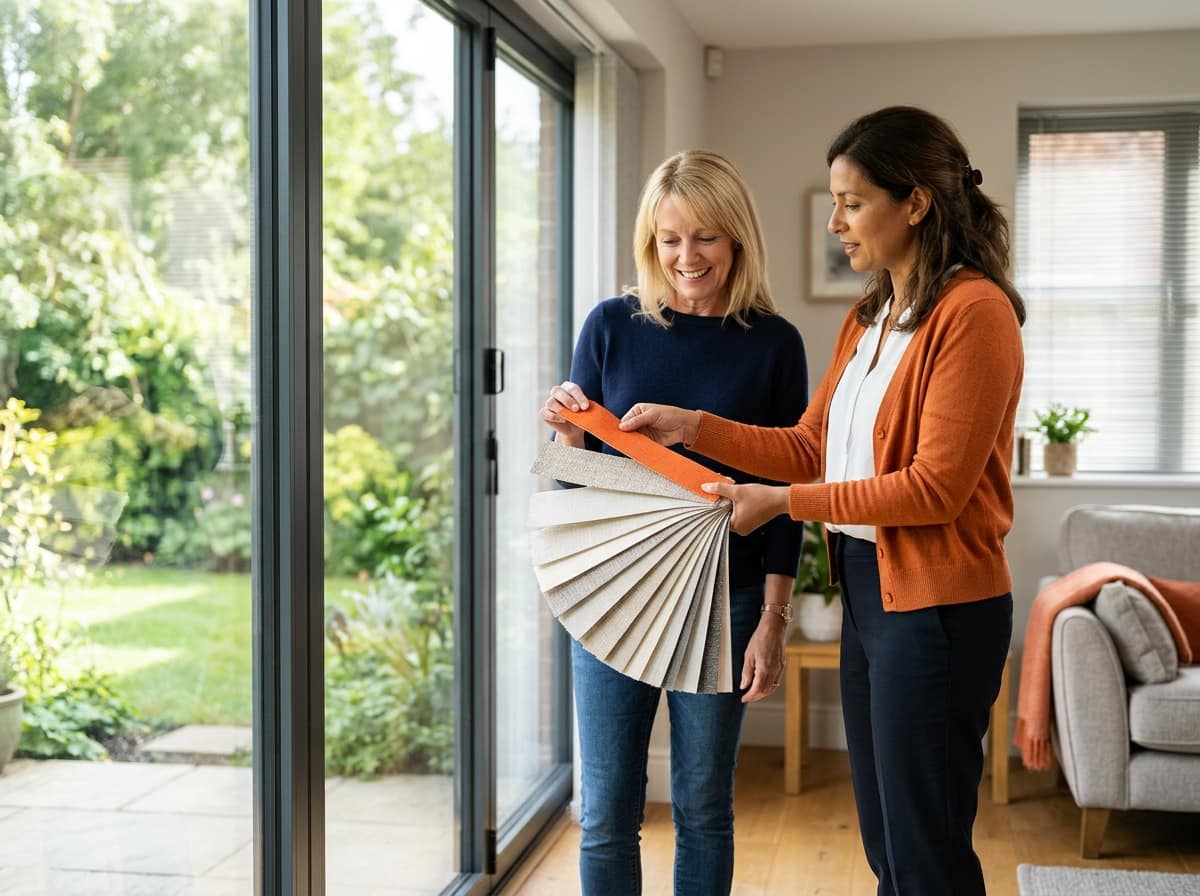
Seeing this in person helps more than any photo can, since vane color shifts dramatically under morning light versus evening lamp light. A free in-home consultation lets you hold fabric and faux wood samples against your actual window, at your actual time of day, before committing. Some homeowners also check our reviews alongside other local feedback sources when vetting a provider, the same due diligence worth applying to whoever measures and installs your blinds.
Vane Shapes, Wand Control, and Stack Positions Compared
The small specs matter more than people expect. Vane shape, how you open the blind, and which way it stacks — these decisions shape your daily routine far more than the fabric pattern does. Get them wrong and you’ll be fighting your own blinds every time you walk the dog out back.
Curved vs. Flat Vanes
Curved (S-curve) vanes overlap more tightly when closed, so they block more light and cast softer, less defined shadow lines on the floor. Flat vanes give crisper lines and a more architectural look, but they tend to leave thin gaps of light between panels, even when fully closed. If you’re using the room for movie nights or shift-work sleep, curved wins. If you want a clean, modern edge along a patio door, flat usually looks sharper.
Wand vs. Cord-and-Chain
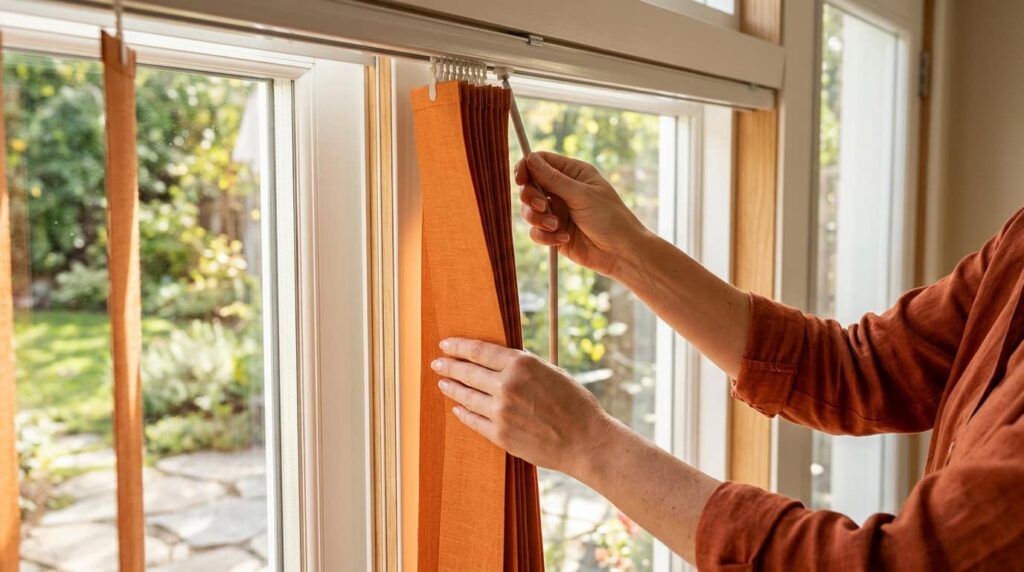
A wand rotates vanes open and closed with a twist of the wrist and feels more intuitive to guests. Cord-and-chain systems separate the rotate function from the traverse function, which gives finer control but takes a beat longer to learn. Neither has dangling loops the way old-style pull cords do, which matters if small kids or pets are around.
| Feature | Curved Vanes | Flat Vanes | Wand Control | Cord-and-Chain |
|---|---|---|---|---|
| Light blockage | Higher | Moderate | N/A | N/A |
| Shadow lines | Soft | Crisp | N/A | N/A |
| Learning curve | N/A | N/A | Low | Moderate |
| Best for | Bedrooms, media rooms | Modern living areas | Daily quick-use doors | Precise light tuning |
Stack Position and Traffic Flow
Left stack, right stack, or center-split — this is about where the fabric bunches when open, not looks. Center-split pulls both directions and clears the entire doorway, ideal for doors used constantly. Left or right stack keeps all the fabric on one side, which works fine if only one half of the door ever opens. For anyone researching small-window layouts, the same stacking logic shows up when comparing curtains for small windows, where panel weight and clearance decide the arrangement.
Measuring and Mounting Basics Before You Buy
Inside Mount vs Outside Mount
Before you grab a tape measure, decide where the headrail will actually sit. An inside mount fits inside the window or door frame, giving you a clean, built-in look that works well on standard windows with enough depth. An outside mount attaches to the wall or trim above and around the opening, which hides an uneven frame and lets the blind cover more glass. For sliding doors, outside mount almost always wins, since the vanes need room to stack fully off to one side without bumping the handle.
Steps for Measuring a Sliding Door or Large Window
Once you know the mount type, measuring follows a logical order. Learning how to measure for blinds correctly up front saves you a return trip and a restocking fee later. The table below walks through the basic sequence most installers use.
| Step | What to Measure | Why It Matters |
|---|---|---|
| 1 | Width at top, middle, and bottom | Frames are rarely perfectly square; use the narrowest reading for inside mount |
| 2 | Height at left, center, and right | Catches sloped headers or uneven flooring before they cause a short drop |
| 3 | Depth of the frame | Confirms whether an inside mount has enough clearance for the headrail |
| 4 | Stack-back clearance beside the door | Gives vanes room to gather fully without blocking the handle or latch |
| 5 | Obstructions (handles, locks, trim) | Flags spots where an outside mount or offset bracket is needed |
Three width points and three height points, not one. It sounds fussy, but a quarter-inch gap at the bottom of a sliding door looks sloppy and lets light leak through. A free in-home consultation sidesteps all of this guesswork, since a designer brings the right tools and measures the opening on-site, accounting for trim, handles, and flooring quirks a DIY tape measure might miss. That same visit is also a practical time to talk through fabric and light control, which is a separate conversation from the measuring itself.
Solving Everyday Window Problems with the Right Treatment
Vertical blinds are great at light control and privacy for a sliding door, but they’re not a cure-all. Matching the problem to the right product saves you money and disappointment. The deciding factor in blinds vs curtains choosing the right window treatment often comes down to what you’re actually trying to fix: noise, heat, fading, or safety. Each has a different answer, and vertical blinds only solve one of them well.
Here’s a quick rundown of common issues near large glass and what actually addresses them:
- Outside noise bleeding into the room is a fabric and layering problem, so cellular shades or heavier drapery absorb sound far better than vertical vanes, which are built for light and privacy, not acoustics.
- Sun fading floors and furniture near a sliding door calls for light-filtering vertical blinds or solar roller shades, since both cut UV without the permanence of film applied directly to the glass. Film stays on your glass forever once it’s installed; shades you can open, close, or swap out anytime.
- Temperature swings by a large glass door often start with insulating cellular shades, a cheap first move before assuming you need new glass entirely. If the door itself has failed seals or single-pane glass, that’s a bigger job for a window contractor.
- Failed seals or single-pane glass is a different animal altogether. That’s a glazier or window contractor’s job, not a shade company’s.
- Dangling cords near kids or pets are best handled with cordless lift systems or PowerView motorized shades, which remove the loose cord without pretending to be a safety device. For actual security concerns like window bars or guards, you’ll want a specialist in that field.
- Glare on a TV or workspace near patio doors usually responds well to woven wood shades, which soften light without blacking out the room completely.
Think of it as triage. Identify what’s actually bothering you, then pick the product built for that job. Guessing wastes money fast.
Vertical Blinds vs Other Treatments for Sliding Glass Doors
Sliding glass doors need a treatment that can handle wide spans without sagging or getting in the way of daily traffic. Three options dominate this category: vertical blinds, panel track shades, and interior plantation shutters. Each handles light, privacy, cost, and upkeep a little differently, and the right pick often comes down to budget and how “finished” you want the door wall to look.
| Treatment | Light Control | Privacy | Typical Cost Range | Maintenance |
|---|---|---|---|---|
| Vertical blinds | Good, adjustable by rotating vanes | Strong when closed | Most budget-friendly | Occasional dusting, vane clips wear over time |
| Panel track shades | Good, fabric panels slide to filter or block | Strong, no gaps between panels | Mid-range | Low, fabric holds up well |
| Plantation shutters | Excellent, louvers tilt precisely | Excellent | Highest | Very low, wipe clean occasionally |
| Woven shades | Moderate, softer diffused light | Moderate to good | Mid-range | Low, occasional vacuum brush |
Interior shutters give sliding doors a furniture-grade, built-in look that few other treatments match. These are indoor plantation shutters meant for light and privacy, not storm or wind protection, so keep that distinction in mind if hurricane prep is your actual goal; that’s a job for a licensed exterior contractor. They’re also the priciest of the bunch, which rules them out for budget-conscious renovations. Vertical blinds remain the most practical choice for wide glass, especially on rentals or larger homes with multiple doors to cover. If hard vanes feel too stark for your taste, woven shades offer a fabric-like texture that softens the room while still handling the width. For readers weighing privacy against natural light more broadly, this comparison of top 5 shades for privacy and light in new jersey breaks down how different fabrics perform. Whatever you choose, test it against how often the door actually gets used — a treatment that snags on daily foot traffic gets annoying fast.
Adding Motorization and Planning Your Installation
What PowerView Adds to Vertical Blinds
PowerView turns a manual wand or chain into something you control from a phone or a set schedule. Vertical blinds on a sliding door can open automatically at 7 a.m. and close at sunset, no walking over and tugging a cord. It’s a small upgrade with a big daily payoff, especially on doors you use constantly. Scheduled or app-based control is the whole point here, not a house full of sensors and hubs.
That’s also where it’s worth drawing a line. If you’re weighing motorized shades against a bigger smart-home push, learning the practical differences between automated blinds and shades will help you figure out what you actually need before you spend money. PowerView talks to your window treatments and, if you want, a voice assistant. It does not rewire your thermostat, locks, or lighting into one master system.
That broader job, whole-house wiring and multi-room control, belongs to an AV integrator, not a window treatment installer. Keep the two separate in your head. One’s a convenience add-on for your blinds; the other’s a construction project.
When to Call for Repair vs Replacement
Not every problem means buying new vanes. Worn or discolored vanes, a broken chain, or a wand that won’t turn are classic repair jobs, and fixing them usually costs a fraction of full replacement. Most repair visits take less time than people expect, too. If the headrail and motor are sound, there’s rarely a reason to tear the whole system out.
Glass is a different story. Foggy seals, cracked panes, or a door that won’t latch right are glazier territory, not window treatment work. Don’t confuse hardware problems with glass problems — swapping vanes won’t fix a failed seal, and no installer should tell you otherwise.
Before committing either way, it helps to see and touch the materials. A showroom visit, paired with seasonal promotions on select lines, makes comparing fabric weights and vane finishes a lot easier than scrolling photos online. This applies whether you’re in Fort Lee, Cliffside Park, Edgewater, Leonia, Englewood, Tenafly, Ridgewood, Franklin Lakes, or elsewhere across Bergen County. Bring a measurement or two, snap a photo of your current setup, and you’ll get a straighter answer on repair versus replace.
Frequently Asked Questions About Vertical Blinds for Windows
These questions come up in almost every consultation, so let’s settle them here. A few quick, honest answers will save you a lot of guessing before you commit to a style.
Will vertical blinds work on a standard window, not just a slider?
Yes, but think size first. Vertical blinds really shine on wide or oversized openings, picture windows, and wall-to-wall glass. On a standard double-hung or small window, the vanes can look bulky and out of proportion. Cellular or roller shades usually fit those smaller frames with a cleaner, tighter look.
Do vertical blinds block heat the way window film does?
Not quite the same way, and that’s actually the point. Film is permanent once it’s applied to the glass; you can’t remove it or adjust it later. That’s not something we install anyway. Shades and blinds stay flexible instead. You open them, close them, angle the vanes, done. Light-filtering fabrics and solar roller shades split the difference, cutting glare and UV exposure while still letting you control the room by hand or motor.
Can a window treatment company clean vertical blinds too?
Partly. Repair services handle the mechanical side, broken tilt wands, damaged headrails, worn chains, that sort of thing. Fabric cleaning is a different job entirely, and it’s best left to a dedicated cleaning service that specializes in window coverings. Mixing the two up is a common mistake; don’t expect one appointment to cover both.
Before any of that, it helps to know what privacy you’re actually getting, since many homeowners wonder whether can people see through my blinds at night with the lights on, and the honest answer depends heavily on vane material and spacing.
How do I actually get started?
Skip the guesswork. A free in-home consultation puts real samples in your hands, in your actual light, next to your actual door frame. This consultation focuses on the window treatment itself, fabric, color, light control, not full-room design or furniture choices. Here’s what a good session typically covers:
- Accurate measurement of the door or window opening, including depth for the headrail and clearance for the stack
- A side-by-side look at vane styles, from fabric to PVC to faux wood, under your room’s actual lighting
- A decision on mount type, inside the frame or outside, based on depth and whether there’s a handle in the way
- A comparison of control options, including wand, cord, or motorized operation for daily convenience
- Honest guidance on whether vertical blinds are even the right call, or if another treatment fits the space better
That last point matters more than people think. A good consultation sometimes talks you out of a product. That’s a sign it’s working, not a sign something went wrong.
Getting the light control and privacy right often comes down to trying a few options in the room where the windows actually live, since fabric and slat choices tend to look different once they’re hung than they do in a showroom. For sliding glass doors specifically, The Curtain works with vertical blinds built for that wider track and smoother glide, which is worth keeping in mind if that’s part of what you’re outfitting. From there, it’s really just a matter of narrowing down which rooms need the most attention first and letting that guide the rest of the decisions.