Standing in a New Jersey showroom with a hundred fabric swatches and three different product categories can leave you more confused than when you walked in. Curtains, blinds, and shades all promise privacy and light control, but they behave very differently through a Jersey winter’s drafts and a summer’s glare. Picking wrong is an expensive mistake. This guide breaks down exactly which option fits your windows, budget, and lifestyle in 2026, so you can choose with confidence instead of guesswork.
How to Choose Curtains for Every Room in Your Home
Fabric and Lining Options
Drapery sets the mood before anyone notices the furniture. Weight, length, and header style all do quiet work in a room. A heavy linen panel with a pleated header reads formal and grounded. A light cotton with a rod-pocket top feels relaxed and breezy. Length matters too: panels that just kiss the floor look tidy, while a slight break or puddle adds drama in a formal dining room. There’s no single right answer, but the choice should match how the room actually gets used.
Sheer fabrics filter light softly, letting a room glow without harsh glare. That’s ideal for living rooms and home offices where you want brightness but not a spotlight. Lined panels go the other direction, adding privacy and real light control, and they’re worth it in bedrooms facing the street or a neighbor’s porch light. For anyone still deciding which weight suits a window, a sheer curtains guide breaks down the trade-offs between airy and opaque options in plain terms.
Blackout lining deserves a special mention for bedrooms and media rooms. It blocks light, yes, but it also dampens outside noise and adds a layer of insulation against drafts. Not every room needs it, and over-lining a sunroom would defeat the purpose. Match the lining to the job, not the trend.
Matching Drapery to Existing Shades or Blinds
Curtains alone rarely do all the work a window needs. Pairing drapery with a functional layer underneath, like cellular shades or roller shades, gives you both style and real performance. The fabric panels frame the window and soften the room, while the shade handles daily light adjustments, privacy, and insulation. This two-layer approach is standard in well-designed homes for a reason: it looks finished and it actually functions, rather than being decoration for decoration’s sake.
Custom drapery makes this pairing work cleanly. It’s made to the exact dimensions of your window, so you avoid the gaps, short panels, and awkward pooling that come with off-the-shelf curtains sized for a generic window that doesn’t exist in your house. That precision matters even more in older New Jersey homes, where window openings are rarely a standard size. For tricky openings, curtains for small windows require a different proportion of fabric to hardware than a picture window does, and getting that ratio wrong is an easy way to make a small room feel smaller.
Coordinating fabric, hardware, and trim across a home ties everything together. Use the same rod finish in connected rooms, repeat a trim color, or stick to one or two fabric families throughout the main floor. It doesn’t have to be matchy. It just has to feel like one house, not six unrelated rooms stitched together.
Curtains, Blinds, and Shades: Which Fits Your Window
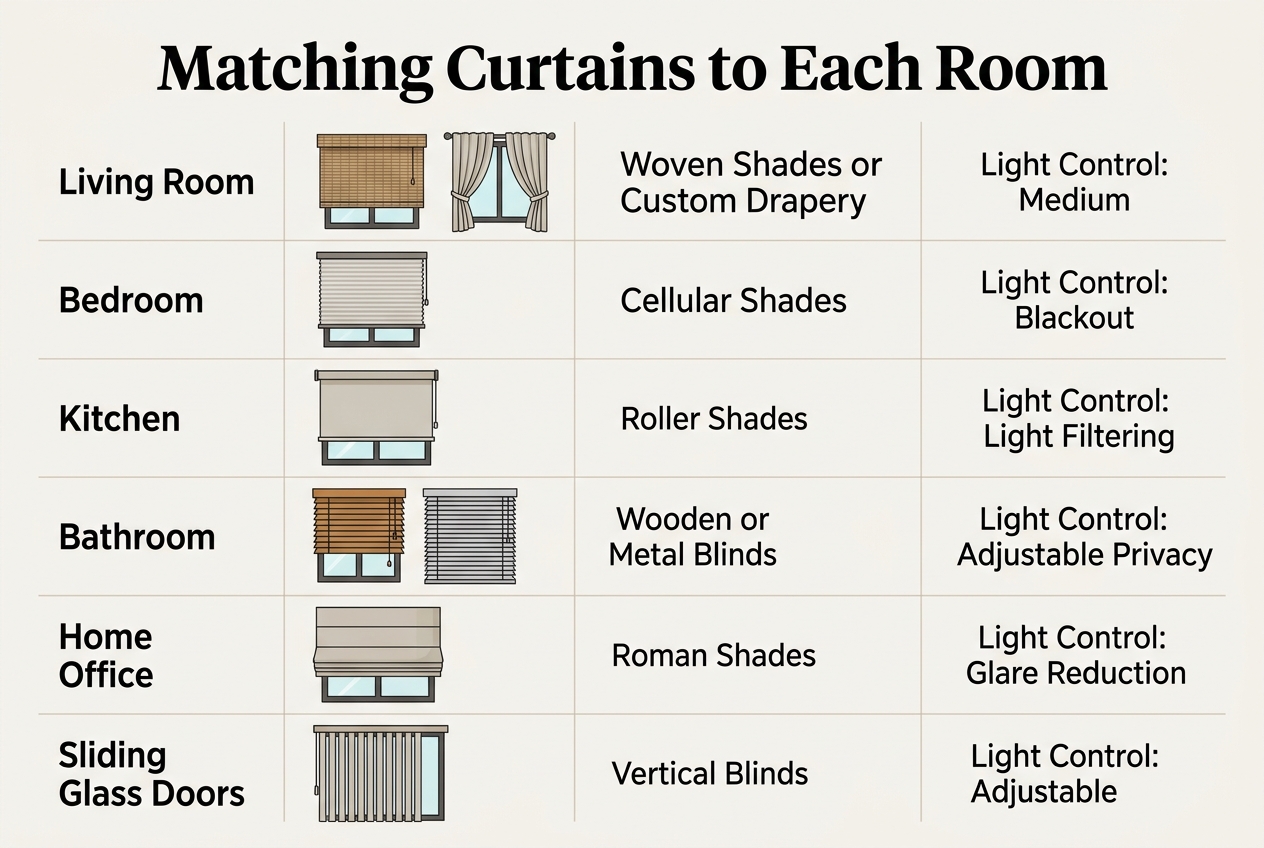
Picking a window treatment isn’t about taste alone. It’s about what a room actually needs. A kitchen window over the sink has different demands than a north-facing bedroom or a sliding glass door off the patio. The table below breaks down the basics so you can stop guessing and start matching product to problem.
| Product | Light Control | Privacy | Maintenance | Typical Use Case |
|---|---|---|---|---|
| Wooden blinds | Adjustable, moderate gaps | Good when closed | Dust regularly | Living rooms, home offices |
| Metal blinds | Adjustable, slim slats | Good when closed | Easy wipe-down | Kitchens, bathrooms |
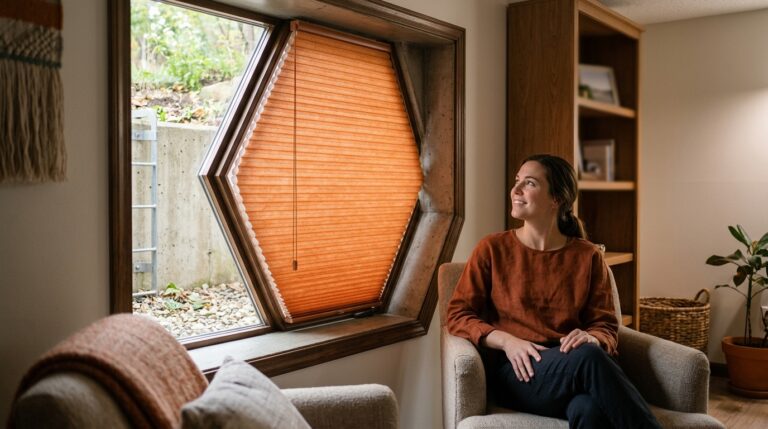
| Cellular shades | Light filtering to blackout options | Very good | Low | Bedrooms, nurseries |
| Roller shades | Depends on fabric opacity | Fair to good | Very low | Sunrooms, home offices |
| Roman shades | Moderate, fabric-dependent | Good | Low | Dining rooms, formal spaces |
| Woven shades | Soft, natural filtering | Fair | Low | Family rooms, dens |
| Custom drapery | Full blackout with lining | Excellent | Occasional cleaning | Bedrooms, media rooms |
Light Control and Privacy Levels
Metal and wooden blinds give you precise tilt control, which is handy over a sink or desk where glare shifts throughout the day. Cellular shades and custom drapery offer the deepest privacy and near-total blackout, good for bedrooms. Roller and woven shades sit in the middle: pleasant, diffused light, but not a true blackout fix on their own.
Insulation and Energy Performance
Cellular shades win here, hands down. Their honeycomb pockets trap air against the glass, which cuts drafts and eases strain on your heating system; for a deeper look at seasonal upkeep, a resource on heating maintenance is a useful companion read alongside choosing insulating shades. Wooden and metal blinds offer little insulation value since slats leave gaps, while heavyweight custom drapery with thermal lining adds a respectable buffer against cold glass in winter. Woven shades, being made of natural reeds and grasses, barely insulate at all. If energy performance is your top priority, cellular shades or lined drapery beat blinds every time. Other national retailers like JCPenney or Bed Bath & Beyond carry comparable lined panels, though fit and lining quality vary widely between off-the-shelf and custom options.
Solving Common Window Problems with the Right Treatment
Most window complaints boil down to five things: noise, temperature swings, sun damage, drafts, and glare. Each one has a fix, but it’s not always the fix people expect. Before you shop, it helps to match the actual problem to the right product instead of guessing.
- Outside noise gets softened by layered fabric treatments and cellular shades, whose honeycomb pockets trap sound as well as air, making a bedroom or home office noticeably quieter near a busy street.
- Temperature swings indoors are tamed by insulating cellular shades that hold a layer of air right against the glass, which cuts the cold creeping off a window in January and the heat gain in July.
- UV fading on furniture, floors, and artwork is reduced with light-filtering roller shades or sheer shades, a smarter pick than window film since film bonds permanently to the glass while a shade can be raised, lowered, or swapped whenever you like.
- Major drafts from single-pane or failing windows usually point to the window itself, not the covering; that’s a job for a licensed window contractor, though insulating shades make a sensible, lower-cost first step while you weigh replacement.
- Glare and heat pouring through south- or west-facing glass respond well to solar roller shades or woven wood shades, an interior alternative to exterior awnings, since awnings block sun before it ever reaches the glass and shades manage it once it’s inside.
Worth noting: woven wood shades get dismissed as dated, but that reputation hasn’t aged well, and are woven wood shades out of style is a fair question with a pretty clear no for an answer. If fabric softness matters more than structure for your noise or light goals, it’s also worth reading up on linen curtains as a complementary layer over shades. None of this replaces a proper diagnosis, though. A drafty window and a noisy window can feel identical from the couch but need completely different solutions.
Specialty Windows and Hard-to-Fit Openings
Arches, Angles, and Oversized Glass
Standard-size blinds and panels work fine on standard-size windows. An arched Palladian window over a front door, a steeply angled gable window, or a wall of oversized glass in a newer Bergen County build is a different story. These openings need treatments cut and mounted to the exact geometry of the frame, not a close-enough fit forced into place. A true arch top shade or a shaped panel built to the window’s precise curve or slope looks intentional. Anything else looks like a shortcut.
This is where off-the-shelf options stop being useful. You can’t order a stock roller shade for a 70-inch angled window and expect it to hang straight or seal out light along the edges. Specialty-shaped treatments require actual measurements of the frame, often taken in person, along with a decision on whether the piece will be fixed in place or operable. Some arched windows get a stationary fabric treatment on the curved top half and a functioning shade below for the rectangular section underneath.
Oversized glass brings its own headaches, mainly weight and light control. A wide picture window may need multiple shades joined with a valance to hide the seam, rather than one oversized piece that sags over time. If UV exposure on furniture is the real worry, a solar roller shade sized correctly for the opening does more than a stock panel ever could.
Sliding Doors vs. Closet and Divider Panels
Sliding glass doors are usually better served by vertical blinds than by curtain panels. Fabric panels on a slider tend to bunch, drag, or get caught in the track every time the door opens. Vertical blinds stack cleanly to one side and operate smoothly alongside the door’s own motion, which is why they remain the default choice for patio and deck sliders across Fort Lee, Edgewater, and similar towns with a lot of glass-door construction. If you want the full case for why, vertical blinds for sliding glass doors is a comparison worth reading before you commit to one style.
Closets and room dividers are a separate category entirely, and it’s a common mix-up. Sliding closet doors, bifold doors, and panel-track room dividers run on their own hardware systems, built for door panels rather than window fabric or slats. Vertical blinds address glass doors specifically; they’re not a substitute for closet door hardware or barn-door track systems, and no window treatment provider installs those. If you’re trying to divide a room while keeping some softness and flexibility, it’s worth knowing that privacy curtains can solve a similar visual-separation problem in open layouts, even though they run on different mounting hardware than a true room divider.
Skylights and roof windows fall outside this category altogether. They need a dedicated skylight shade specialist, since the mounting angle, heat exposure, and tilt mechanisms are unlike anything on a vertical wall. A free in-home design consultation is still the fastest way to sort out which category your opening actually falls into — arch, angle, slider, or something that needs a different specialist entirely.
Automation, Cords, and Everyday Convenience
What PowerView Does and Doesn’t Control
PowerView automation lets your shades open and close on a set schedule, or at the tap of an app, no cords involved. Want them rising at 7 a.m. and closing at sunset? Done, automatically, every day without you touching a thing. You can also group rooms into scenes, so a single tap lowers the shades across the whole front of the house before a movie or a nap.
Cordless lifting systems and motorized shades also solve a practical household problem: dangling cords. For homes with young kids or pets underfoot, that’s a real consideration, though it’s worth being honest about what it is. It’s a convenience and design feature, not a certified child-safety product, so don’t treat it as a substitute for actual safety hardware if that’s your primary concern.
It’s also worth knowing where PowerView’s job ends. It controls window treatments, full stop. It won’t dim your lights, lock your doors, or run your thermostat. If you’re chasing that bigger smart-home picture with multi-device integration and custom wiring, that’s a job for an AV integrator, not a shade system. Keep expectations in the right lane and you’ll be happier with the result. On a related note, if you’re weighing whether any of this is worth the investment at all, it helps to look at how window treatments affect home value before deciding how far to go with upgrades.
Before you buy, check the practical stuff: battery life, app pairing, and voice assistant compatibility. Some motorized shades run six months to a year on a charge; others need a hardwired adapter for heavy daily use. Confirm the app plays nicely with your phone’s operating system, and if voice control matters, check it actually pairs with the assistant you already own. Skip that homework and you’ll end up with shades that look great but frustrate you daily.
Shutters and Interior Light Control Options
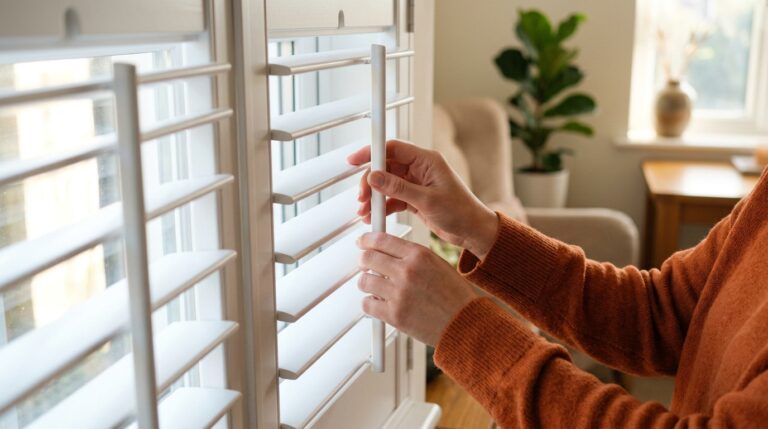
Plantation shutters mounted inside a window frame give you adjustable louvers that tilt open or closed, so you control exactly how much light and sight-line gets into a room. They look a lot like the decorative shutters you see flanking windows on the outside of a house, but don’t confuse the two. Interior shutters are built for daily light and privacy control, not for anything structural. That’s a different job entirely.
Here’s the part people often get wrong: interior shutters are not wind-rated or storm-tested. If you’re in a flood zone or dealing with storm prep, that’s a separate project requiring a licensed exterior contractor installing impact-rated panels or shutters built for that purpose. Same goes for exterior facade shutters added purely for curb appeal — that’s siding or exterior-contractor work, not a window treatment decision. Don’t let anyone tell you otherwise. Indoor shutters handle glare, nosy neighbors, and afternoon sun. They don’t handle a hurricane.
Where shutters really shine is pairing with something softer. A lot of homeowners put plantation shutters on the bottom half of a window for privacy and layer a sheer shade above for diffused light. It’s a combination that works especially well in rooms where moisture or humidity is a factor, and if you’re furnishing a bathroom, it’s worth reading up on privacy and moisture solutions that last before committing to one treatment. Hard louvers plus soft fabric gives you precision and comfort in the same window.
Maintenance, Repair, and When to Call a Professional
Window treatments wear out in predictable ways. A lift cord frays after years of daily use, a tilt wand gets stiff, slats start hanging crooked. Repair services exist to fix that hardware, swapping worn parts so the unit tilts, raises, and lowers the way it did on day one. But not every problem belongs to a repair technician, and knowing the difference saves you money and wasted calls.
Signs It’s Time for Repair vs. Replacement
Before you pick up the phone, run through a quick checklist. Some issues are a quick fix. Others mean it’s time to start fresh.
| Symptom | Likely Cause | Repair or Replace? |
|---|---|---|
| Slats hang unevenly or won’t tilt | Worn tilt mechanism | Repair |
| Shade won’t raise or stays crooked | Broken lift cord | Repair |
| Fabric looks dingy or discolored | Dust, smoke, or sun buildup | Neither — needs a textile cleaner |
| Glass looks foggy between panes | Failed window seal | Neither — call a glazier |
| Frame is warped or faded beyond repair | Age, sun exposure, moisture | Replace |
Fabric that’s gone dull or smoky needs a dedicated textile cleaner, not a repair appointment. And if you see fog or cracking in the glass itself, that’s a glazier’s job. Repair techs work on the treatment, not the pane behind it; for a broader primer, choosing the right window treatment is worth understanding before you invest in fixes.
Commercial Window Treatment Upkeep
Offices and storefronts usually run surface-mounted roller or cellular shades, and those can be serviced like any residential unit. Blinds built directly into a glazing unit are a different story. Those come from the glass manufacturer, not a treatment repair service, so factor that into upkeep budgets early.
Getting Expert Guidance Through a Design Consultation
A design consultation isn’t a full home makeover visit. It’s focused, start to finish, on your windows. A designer looks at fabric, color, light control, and layout, nothing more. They won’t rearrange your sofa or pick your paint color. That’s a different job, handled by a different kind of professional. Think of this as expert help narrowed to one problem: what goes on the glass.
Most visits follow a similar pattern. The designer comes to your home, measures each window on-site, and brings actual fabric and material swatches so you can see how they look against your existing walls and furniture, not just on a screen. That in-person step matters more than people expect. Light changes everything, and a sample that looked crisp white in a catalog photo can read warm or gray once it’s sitting in your living room at four in the afternoon.
A consultation is also where side-by-side comparisons actually make sense, rather than guessing from online photos. Here’s what a good session typically helps you sort out:
- Whether roman shades or roller shades suit a kitchen window that gets steam and grease splatter versus a quiet home office;
- Whether drapery or shutters make more sense for a living room where you want softness one season and hard privacy the next;
- How much natural light a room actually gets at different times of day, which affects fabric opacity choices;
- Whether a bedroom needs a layered approach, sheers plus a blackout layer, instead of a single treatment;
- Which fabrics and finishes hold up best near entryways or high-traffic rooms where fading is a concern.
If you’re leaning toward a softer, tailored look, it helps to learn how roman shades fold and stack before you commit to a fabric. Families across Fort Lee, Cliffside Park, Edgewater, Leonia, Englewood, Tenafly, Ridgewood, and Franklin Lakes can set up a visit by calling (201) 302-9111. It’s also worth asking about timing, since seasonal promotions on select product lines can shift the math on when to book.
Before deciding, it helps to separate what’s actually bothering you about the room from the product category you think you need—glare and heat can often be solved at the glass with shades rather than at the wall with film, and drafts sometimes call for a simple layer of insulation before a bigger window project is justified. It’s worth asking whether the fix needs to be permanent or adjustable, and whether the problem is really about the window itself or just what’s covering it. A quick conversation with someone who can look at the actual light, the actual glass, and the actual room tends to clarify more than browsing options in the abstract.