Standard curtain poles snap, sag, or simply refuse to bend around a bay’s awkward angles. That leaves you with gaps that let in cold air and prying eyes. It’s frustrating. The right bay window curtain rail solves this properly, curving smoothly around your window’s shape while still supporting the full weight of your fabric. Here’s everything you need to know to choose one that fits perfectly and lasts for years.
Why Bay Windows Need Special Curtain Hardware
Common Bay Window Configurations
Most bay windows in older and newer Bergen County homes alike follow a three-panel layout: one large center pane flanked by two smaller angled panes. Some larger builds stretch to four or five panels, especially in bump-out additions or turret-style rooms. Each configuration creates a different set of angles where the panels meet. That’s the whole problem in a nutshell. There’s no single “standard” shape, which is why off-the-shelf rods so often fall short.
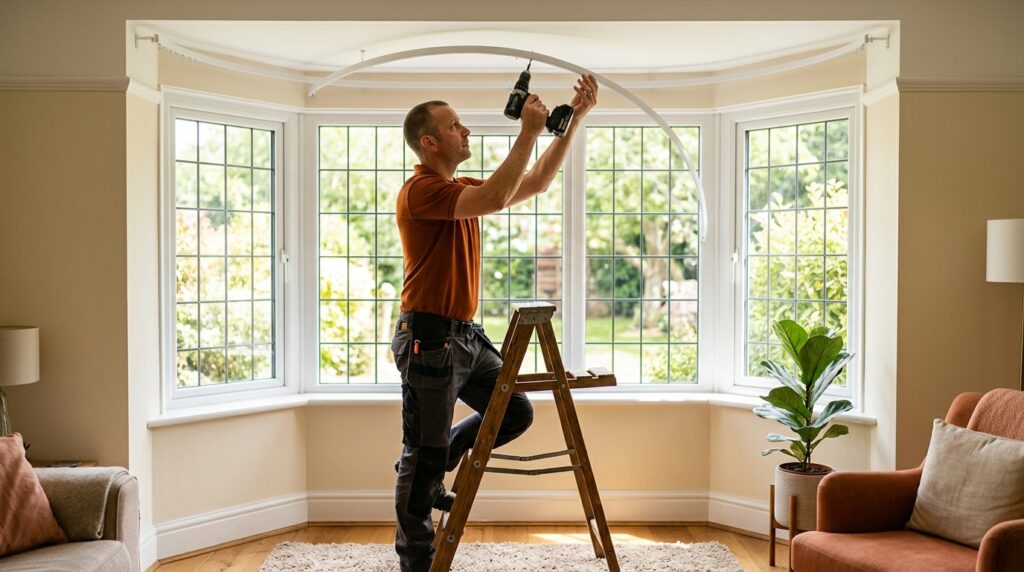
A straight curtain rod is built for one flat plane. It has no way to bend or pivot at the seams where a bay window’s panels join. Try to force one across three angled sections and you’ll end up with a rod that either bows awkwardly or leaves the end panels uncovered entirely. The shape of the window has to dictate the shape of the hardware, not the other way around.
Getting familiar with the basics helps before you shop. A solid curtain rods and hardware guide will walk you through terminology like return lengths, bracket spacing, and joint types you’ll encounter when comparing bay-specific systems.
How Angles Affect Hardware Choice
Bay window panels typically meet at obtuse angles, usually somewhere between 120 and 150 degrees. That’s wide enough that a rigid rod can’t follow the turn, but too wide for many flexible options to hug the corner without sagging. This is where jointed rails, flex track systems, or hinged rod segments earn their keep. They’re built specifically to bend at those in-between angles rather than a clean 90-degree corner.
Skip the fitting details and you’ll pay for it later. A gap of even half an inch at a panel seam lets in drafts, street noise, and UV rays that fade upholstery over time. Poorly fitted rails also throw off the room’s visual balance, since bay windows are meant to read as one continuous, symmetrical feature. When the rail actually follows the angles correctly, insulation improves, sound transmission drops, and the whole wall of glass looks intentional rather than patched together.
If you’re shopping for angle-specific hardware, it helps to see how corner and bay-specific rods are engineered before committing. Browsing Bay Window Curtain Rods & Corner Drapery Rods gives a useful sense of how joints and returns are typically configured.
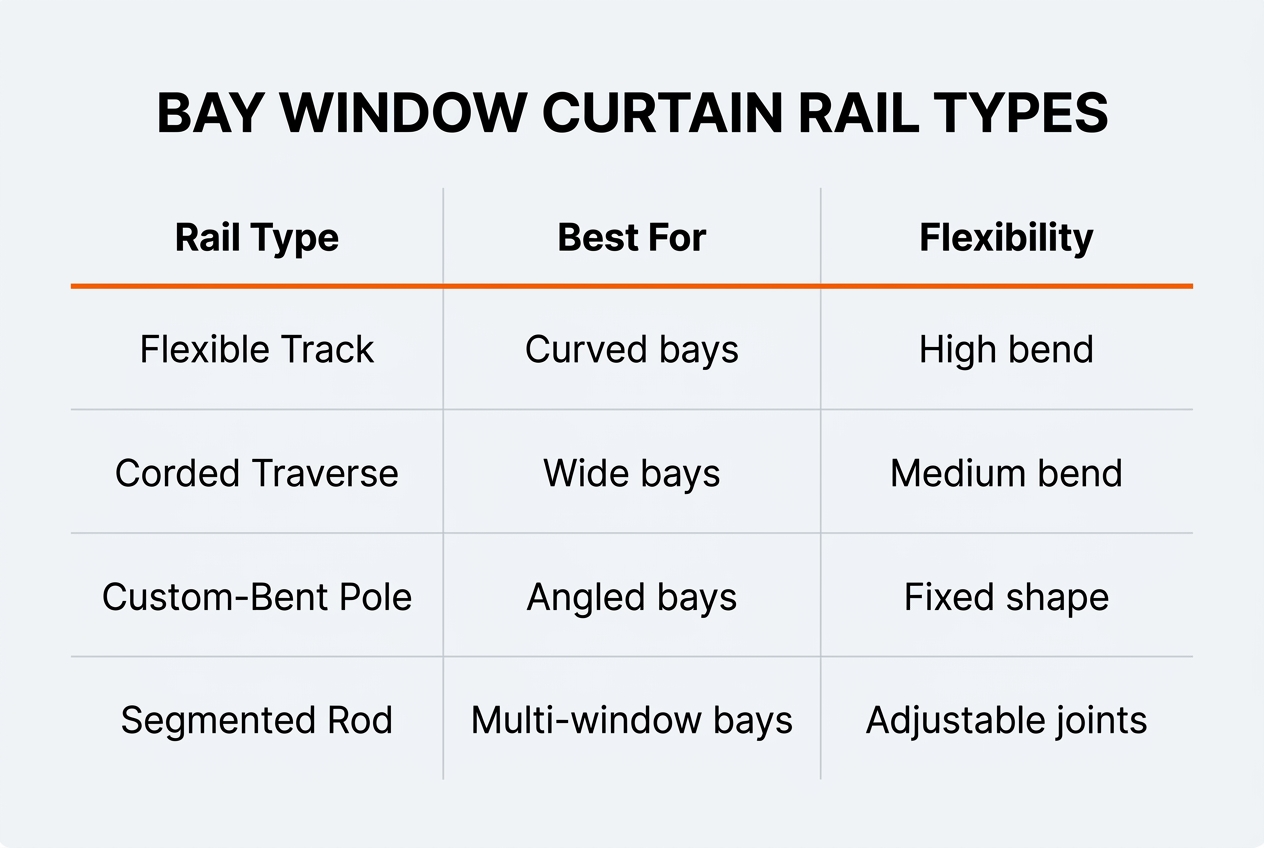
Bay Window Curtain Rail Types Compared
Flexible vs Rigid Track Systems
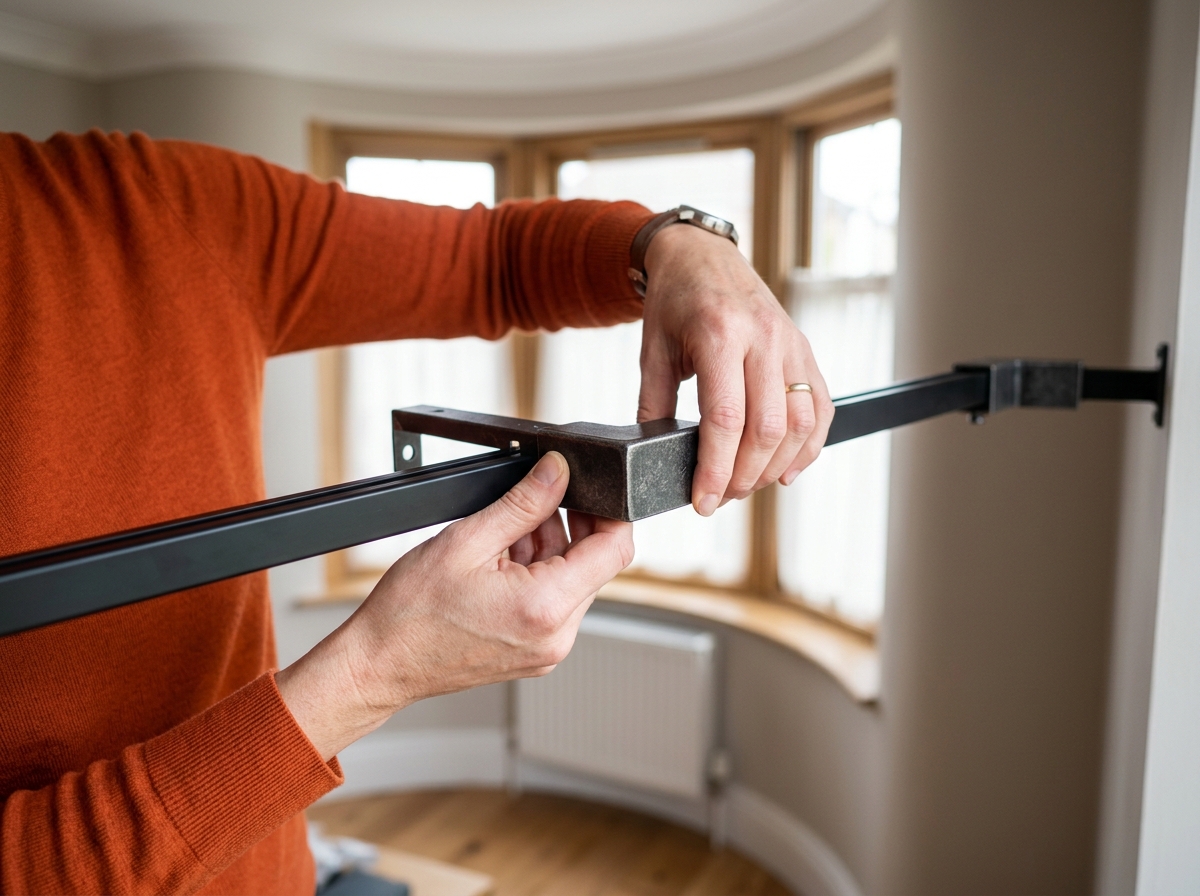
Bay windows bend, so your hardware has to keep up. There are three main approaches: flexible bendable track that you shape by hand around the angles, rigid jointed rail with pre-set corner connectors, and corded track systems that add a pulley mechanism for smooth pulling without touching the fabric. Each handles curves differently, and each has a sweet spot depending on the window’s angle and how heavy your drapery is.
Mounting matters just as much as track style. Ceiling-mounted brackets suit bays set into a deep recess, since they stretch the curtain higher and make the window look taller. Wall-mounted brackets work better on shallow bays or where a ceiling fixture just isn’t practical. If you’re weighing the two, understanding Bay Window Curtain Track options before you buy will save you a return trip to the hardware store.
| Track Type | Material | Best For | Weight Capacity |
|---|---|---|---|
| Flexible bendable | Aluminum | Curved or angled bays | Light to medium fabric |
| Rigid jointed rail | Steel | Sharp-angle bays, heavy drapes | Medium to heavy fabric |
| Corded track | Aluminum or steel | Frequent daily use | Medium fabric |
| Wood-effect PVC track | PVC over wood grain | Traditional decor styles | Light to medium fabric |
Material changes the equation too. Aluminum stays lightweight and resists rust, which is why it shows up in most flexible tracks. Steel costs more but carries heavier fabric without sagging over time. Wood-effect PVC gives you a traditional look at a lower price, though it’s not meant for heavy velvet or lined drapery. Match the material to your fabric weight, not just your decor style — that’s the mistake most people make.
Manual vs Motorized Options
Manual tracks are cheap, reliable, and simple to install. Motorized track systems, on the other hand, let you open and close drapery on a schedule or with a remote, which is handy on bay windows where multiple panels would otherwise mean reaching across furniture. If privacy is your main concern, reviewing options for privacy curtains alongside a motorized setup can solve two problems in one purchase. Motorization does add cost and requires access to power or batteries near the track.
Before deciding, think about how the fabric drapes across each bend. That’s covered more in drapery for bay window setups. And if you’re tackling a full renovation alongside the window update, knowing general yard dumpster dimensions helps you plan debris removal without guessing on container size.
Measuring and Installing Rails Correctly
Step-by-Step Measuring Process
Bay windows aren’t one shape, they’re three (or more) shapes joined together. That means you can’t just run a tape measure across the whole thing and call it done. Get sloppy here and the rail either binds at the corners or leaves gaps that let light and drafts sneak through.
- Measure each panel of the bay separately, recording width and height for the center section and both angled sides on their own.
- Measure the angles between panels with a protractor or angle finder, since most bay windows sit somewhere between 30 and 45 degrees rather than a clean 90.
- Account for return depth, meaning the distance the rail sits out from the wall, so the curtain closes flush instead of gapping at the corners.
- Add a few inches of stack-back space on each end panel so drawn curtains don’t block the glass entirely.
- Double-check every measurement a second time before ordering, since bay window hardware is rarely a simple return-and-exchange item.
Mounting style matters just as much as the numbers. Ceiling mounts work best for tight bay recesses where wall space is limited or the window sits close to the ceiling line. Wall mounts suit deeper ledges, giving you more flexibility on projection and a sturdier anchor point for heavier fabrics. If your windows are on the small side, it also helps to look at curtains for small windows for proportion tips that carry over to bay setups.
When to Call a Professional
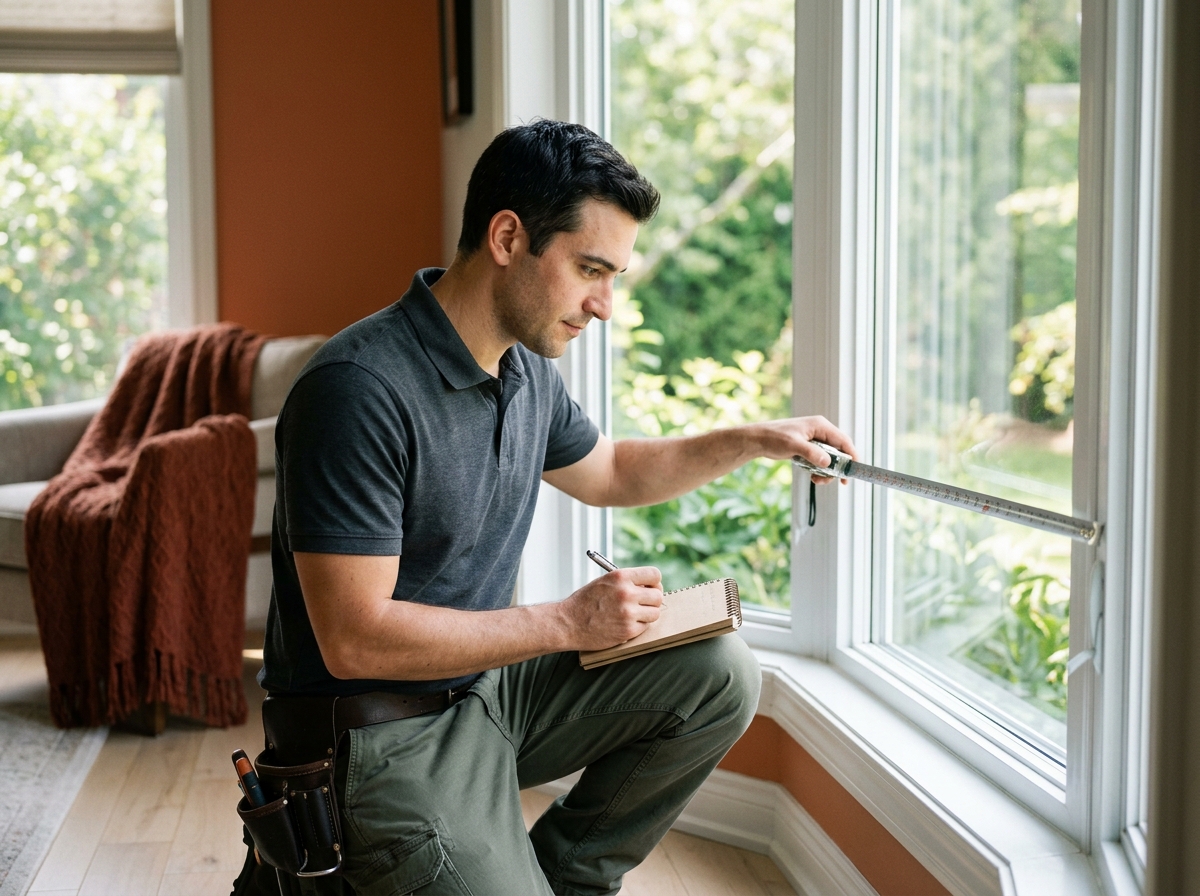
You can measure this yourself. Bending and joining the track to match your exact angles is a different story. Professional installation avoids sagging tracks, uneven gliders, and that annoying scrape sound every time you open the curtains. A poorly mounted rail is a daily irritation, not a one-time mistake. Products like a flexible ultra-thin aluminum curtain rail for bay window installs are worth comparing against rigid three-piece sets before you commit. Free in-home consultations remove the guesswork entirely, since a trained eye can spot angle discrepancies a tape measure misses.
Choosing Fabric and Hardware That Work Together
Matching Rail Strength to Fabric Weight
Heavy drapery looks stunning in a bay window, but it comes with baggage. Lined linen, velvet, and thick blackout panels can weigh several pounds per foot, and that weight pulls hard on brackets and gliders. If the rail isn’t rated for it, you’ll see sagging at the corners within months, and the gliders will stick every time you open the curtains. Look for reinforced brackets anchored directly into studs, plus metal gliders instead of plastic ones — plastic simply can’t take the daily friction that heavy fabric demands, especially at the angled joints where bay windows bend.
Sheer fabrics are a different story entirely. They’re light, they flow, and they don’t need brawny hardware to stay put. A lightweight, flexible track — the kind that bends smoothly around 120- or 135-degree angles — works well here, since there’s no real strain on the mounting points. Many homeowners exploring options for a bend-friendly setup end up comparing an aluminium flexible curtain track for bay windows against heavier corded traverse systems before deciding, and for sheers, the lighter option almost always wins.
Here’s the blunt truth: mismatching fabric and hardware is the single most common mistake people make in a bay. Gorgeous velvet on a flimsy track just sags — it’s not a style failure, it’s a physics failure. Get the pairing right and the whole window feels effortless instead of strained.
Separate Systems for Shades Within the Same Bay
Roman shades and woven wood shades rarely share a rail with your drapery, and that’s by design. Each window in a bay typically gets its own headrail, mounted inside or just above the frame, while the drapery track runs continuously across all three angles on a separate plane in front. This layering lets you operate shades independently on each pane — handy when morning sun hits one side of the bay harder than the other — without fighting for space on a single track.
Mounting brackets for shades are usually shallower and mount flush to the window casing, so they don’t collide with the curtain track’s projection. It’s worth measuring the clearance between the two systems before installation; a gap of even half an inch too little can cause the drapery to catch on the shade’s headrail every time it’s drawn.
Finish, Color, and Layered Light Control
Rail finish matters more than people expect. Antique brass warms up a traditional room, matte black reads modern and crisp, and plain white disappears against a light wall — which is exactly the point in minimalist spaces. Pick a finish that either matches your existing hardware (door handles, light fixtures) or contrasts deliberately, not accidentally. A mismatched rail finish is a small thing that somehow makes a whole room look unfinished.
Layering rails with shades isn’t just an aesthetic choice, either. Pairing a drapery track with cellular or roman shades underneath gives you real control over both light and temperature, since the shade handles insulation while the drapery handles softness and framing. For a deeper look at how these combinations affect heating and cooling costs, your guide to energy efficient window coverings breaks down which fabrics and constructions actually make a measurable difference. Once the layers are installed, keeping fabric looking sharp is its own small task — a quick read on how to get wrinkles out of curtains can save you an unnecessary trip to the dry cleaner.
Solving Common Bay Window Problems
Noise and Temperature Control
A bay window juts out into weather and street noise on three sides, so it takes the brunt of what your house deals with. That’s why the fix has to be more than decorative. Lined drapery hung on a well-fitted track absorbs sound before it bounces around the room, and the fit matters more than the fabric weight. A loose track leaves gaps at the corners where noise sneaks right through.
Temperature swings are the other headache. Bay windows have more glass surface than a standard window, which means more heat loss in winter and more glare in summer. Insulating cellular shades layered underneath your curtains create a buffer of trapped air right against the glass. Pair that with a heavier drape on top and you’ve got a two-layer system doing double duty. If you’re still mapping out hardware options, using a flexible curtain track for your bay window solves a lot of the corner-gap problem before it starts.
A few upgrades handle the most common bay window complaints at once:
- Lined drapery on a properly fitted track blocks outside noise instead of just muffling it slightly.
- Insulating cellular shades under curtains cut down on drafts and keep heating bills from creeping up.
- Light-filtering fabrics reduce UV exposure that fades furniture, rugs, and hardwood flooring over time.
- Custom-bent track sections close the awkward gaps at each corner angle, so light and sound don’t leak through.
- Double-layered treatments give you sound control and insulation without sacrificing natural light during the day.
Automating Multi-Panel Bays
Bay windows usually mean three or more panels, and reaching the center one is never fun. That’s where motorization earns its keep. PowerView automation lets you open, close, or schedule every panel from a single remote or app, no stretching over furniture required. It’s a small convenience that solves a real physical problem. For homes with oddly shaped or angled glass nearby, it’s worth knowing that how to hang curtains on an arched window follows similar rail-bending logic. And if you’re weighing the investment, research on whether window treatments increase home value suggests upgrades like these pay off beyond daily comfort.
Custom vs Off-the-Shelf Curtain Rails
Pros and Cons of Each Approach
An off-the-shelf kit is the budget move. It’s cheap, it’s in stock, and it’ll get a rail on your wall this weekend. The catch: those flex kits are built for gentle, standard bay angles, and most bay windows don’t play along. If your corners are sharper or wider than average, the joints look pinched or gappy no matter how carefully you bend them.
Custom-fabricated rails skip that guesswork entirely. Someone measures your actual bay, bends the track to your actual angles, and finishes it to match your actual trim. That precision also matters if you’re planning ahead for motorization — a rail cut to spec integrates cleanly with PowerView-style systems, while a bent-on-site kit often can’t handle the extra hardware without visible workarounds. Fit is the whole game here, and one approach simply guarantees it more than the other.
Cost and Lead Time Expectations
Here’s the honest trade-off, laid out plainly:
| Factor | Off-the-Shelf Kit | Custom Rail |
|---|---|---|
| Upfront cost | $40–$120 | $150–$450+ |
| Lead time | Same day to 3 days | 2–4 weeks |
| Angle accuracy | Approximate, adjusted on-site | Measured to exact degrees |
| Motorization-ready | Rarely, needs retrofitting | Built in from the start |
| Return visits | Common for re-fitting | Rare |
That upfront gap looks bigger than it really is once you factor in second attempts. A lot of people online debate this exact tradeoff when they compare what curtain poles and rails actually hold up in bay windows, and the consensus tends to favor whatever was measured on-site. If you want the numbers spelled out further, a detailed breakdown of store bought vs custom window treatments walks through where the extra cost actually goes. Fewer replacement purchases, fewer awkward gaps — that’s usually where custom earns back its price tag.
Getting Expert Help in Bergen County, NJ
What to Expect From a Free Consultation
A free in-home visit isn’t just a sales pitch. A designer actually measures your bay’s angles, checks how sunlight moves through the room across the day, and asks about any street noise that bothers you. That’s the whole point: your bay window is not a standard rectangle, and a cookie-cutter rail rarely fits it right. Expect real questions, a tape measure, and honest recommendations rather than a rushed quote.
Bring up your specific frustrations. Glare on the TV in the afternoon? Traffic noise from a nearby road? These details shape whether you’ll need a flexible track system, a rigid custom-bent rail, or something in between. On-site assessment catches problems a phone call never would, like an uneven wall or a radiator that limits where brackets can go.
Many local businesses also keep a showroom stocked with sample rails and fabric swatches, so you can touch materials before committing. Seeing a bent-metal track next to a flexible cord system side by side makes the choice obvious in a way photos never do; you’ll also want to review guidance on choosing and installing custom draperies before your visit so your questions are sharper. Some showrooms pair premium shade lines with drapery for layered light control, giving you options beyond rails alone.
Repair and Maintenance Support
Rails wear out. Brackets loosen, gliders stick, cords fray. A dedicated provider that’s been serving towns like Fort Lee, Cliffside Park, Edgewater, Leonia, Englewood, Tenafly, Ridgewood, and Franklin Lakes since 2007 has likely seen every failure mode there is. That kind of track record matters more than a flashy showroom display.
Repair calls are usually quicker than replacement, and cheaper too. A technician can often rehang a sagging curved track or swap a broken glider in under an hour, saving you the cost of a full new system. If you’d rather shop components yourself first, browsing a bay window curtain track listing gives a sense of typical parts and pricing before you call for a quote.
Timing helps your budget, too. Seasonal promotions often trim the cost of custom rail-and-fabric packages, so ask about current offers before scheduling. For questions on repair, maintenance, or booking a consultation, a direct call to (201) 302-9111 usually gets a faster answer than an email ever will.
Before you commit, it helps to get clear on what you’re actually solving for: if the glass itself is failing—fogging between panes, cracked seals, drafts pouring in around a single-pane sash—that’s a job for a glazier or window contractor, and no covering will substitute for it. But if the real complaint is afternoon glare, heat building up in one room, or a lack of privacy after dark, insulating cellular shades and solar roller shades address those same symptoms at a fraction of the cost, with the advantage that you can adjust them by the hour instead of living with a permanent change to the glass. Worth asking yourself, too, how much the look matters alongside the performance, since that answer often decides between a simple roller shade and something like woven woods or plantation shutters.