Sliding, French, and patio doors let in gorgeous light, but they also bring glare, lost privacy, and awkward gaps that standard curtains just can’t solve. Choosing door blinds means balancing clearance, operation, and style against how that door actually gets used every day. Get it wrong, and you’re stuck with hardware that snags or a look that fights your room. This guide walks you through picking coverage that works as hard as your doors do.
What Are Door Blinds and Which Doors Need Them
Common Door Types That Require Coverage
Here’s the thing most people miss: door blinds aren’t a separate product category. They’re regular window coverings, just adapted to fit glass that happens to open and close. Any door with a large pane of glass, whether it slides, swings, or sits fixed beside an entryway, can be treated the same way you’d treat a picture window. The difference is in the details: hardware, clearance, and how the covering behaves when someone actually walks through the door.
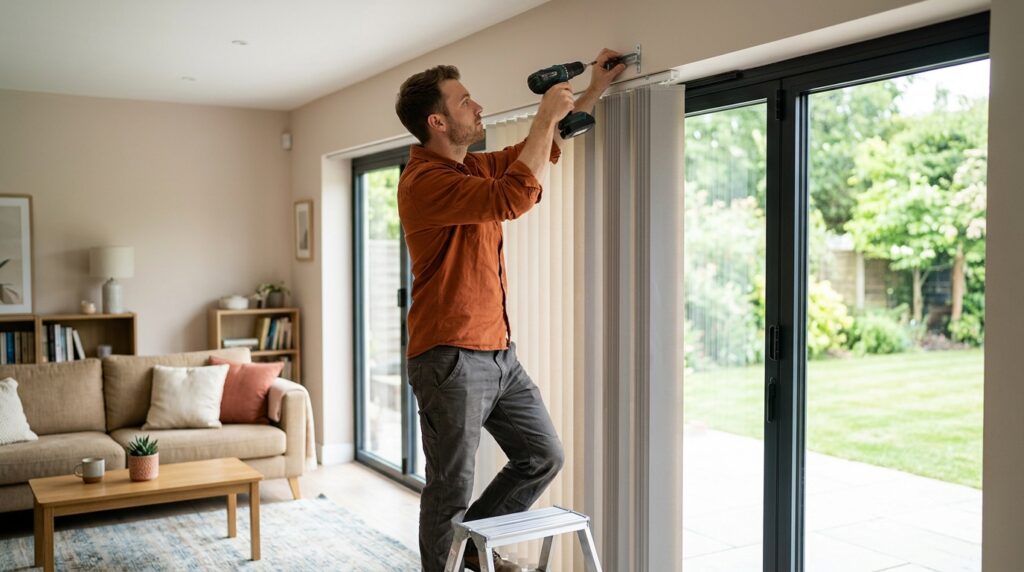
Sliding glass patio doors are the most common candidate, and they come with their own quirks. The panel that slides needs a covering that moves with it. That’s why vertical blinds for sliding glass doors remain a go-to choice rather than a horizontal blind that would jam against the track. French doors present a different puzzle: two swinging panels, often with hardware right in the middle, mean mounting has to avoid handles and hinges entirely.
Glass-paneled entry doors add a third wrinkle. These are usually narrower, sometimes oddly shaped with sidelights or arched tops, so off-the-shelf sizing rarely works. If you’ve ever tried hanging a stock shade over a slim entry panel, you know it looks wrong and functions worse. This is closer to the sizing challenge you’d face with curtains for small windows, just applied to a door instead of a window frame.
Full-Height Glass and Foot Traffic
Full-height glass doors create a problem ordinary windows don’t have: people walk through them. A covering that’s perfect for a stationary window can get in the way fast if it dangles, swings loose, or bunches at the bottom every time the door opens. The goal is coverage that manages privacy and light without turning into an obstacle course for anyone carrying groceries or letting the dog out.
That’s why stack height and side clearance matter so much on these installations. A treatment has to retract fully out of the door’s swing path or slide clear of the track, not just look tidy when closed. Get the fitting wrong and you’ll be fighting your own blinds every time you step outside. Nobody wants that.
Why This Comes Up So Often in Bergen County Homes
Walk through most neighborhoods in Fort Lee, Tenafly, or Ridgewood and you’ll spot the pattern: patio doors leading to decks, French doors opening onto yards, sunrooms with walls of glass. Homes built or renovated in the last two decades tend to favor these bigger glass openings. That means more households are dealing with the sizing and mounting questions above than they might expect.
Older colonials and capes throughout the area often added French doors during a kitchen or family room remodel, while newer construction leans heavily on sliding patio doors for backyard access. Either way, these glass openings are large, visible from the street or yard, and used daily. That combination makes getting the coverage right worth the extra thought.
Door Blinds: Matching the Right Style to Each Door Type
Not every door needs the same treatment. A sliding glass door and a French door move differently, sit in different frames, and honestly, they ask for different hardware. Get the match wrong and you’ll be fighting the door every single day.
Sliding Glass Door Considerations
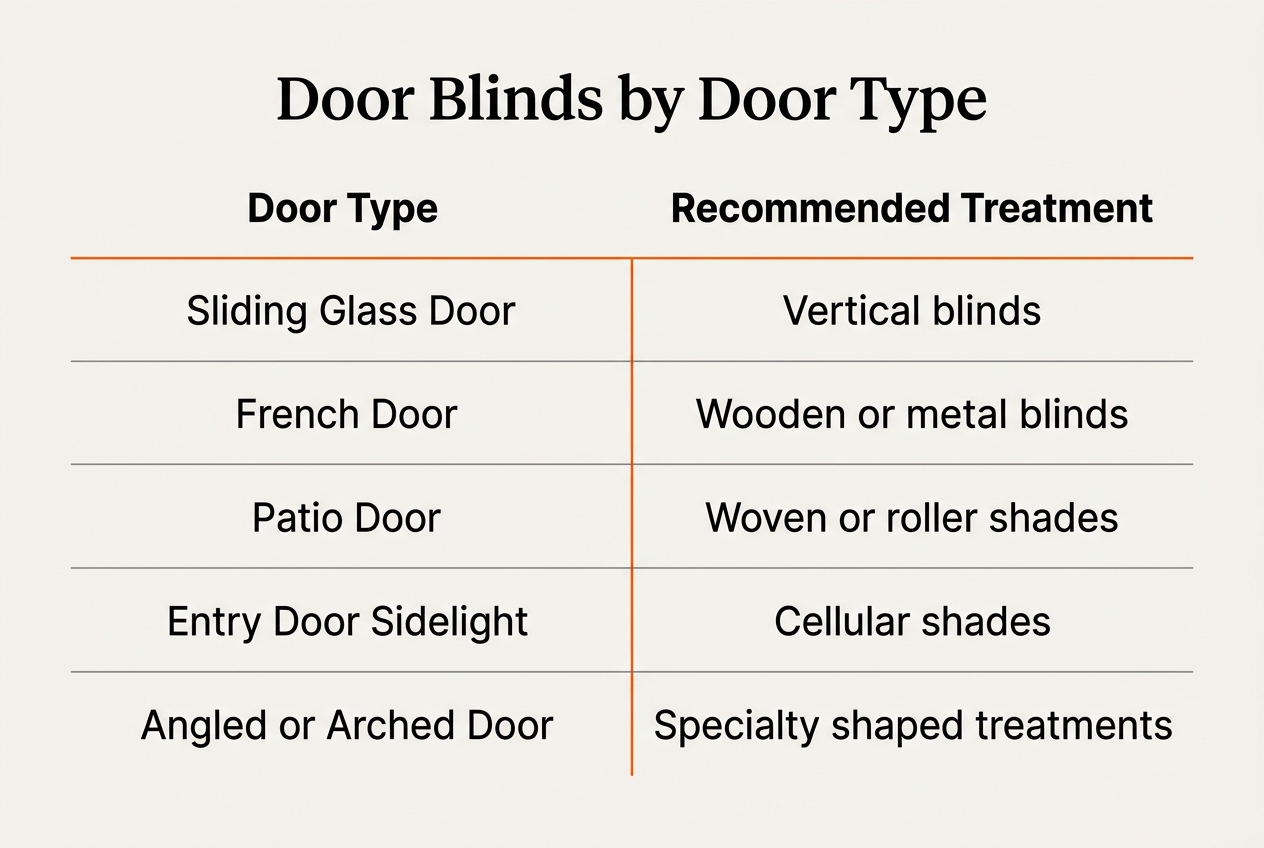
Vertical blinds remain the traditional choice for wide sliding doors because the slats rotate for light control and then stack cleanly to one side, out of the way of foot traffic. Panel-style vertical blinds glide easily for daily access, which is where they beat stationary drapery panels hands down — no bunching fabric, no fumbling with a rod. If you’re dealing with a large panel opening onto a patio or deck, that clean stack-back matters more than people expect.
French Door Considerations
French doors swing rather than slide, so cord clutter and bulky hardware become real problems fast. Cellular shades and roller shades work well here when a cordless, low-profile option is what you want — they mount tight to the door and won’t swing into a wall or catch on a handle. Interior shutters offer a plantation look on French doors where a more furniture-grade appearance is the goal, especially in a dining room or study. And when there’s an arched or angled glass section above the door, specialty shaped treatments come into play; anyone wondering how that even works should look into how to hang curtains on arched window setups before assuming a standard shade will fit.
Here’s a quick side-by-side to help you sort the options before a consultation.
| Door Type | Best-Suited Treatment | Operation Style | Why It Fits |
|---|---|---|---|
| Wide sliding glass door | Vertical blinds | Panel track, side-stacking | Slats rotate and stack neatly, clearing the walkway |
| Narrow sliding door | Cellular shades | Cordless lift | Low-profile fit without a bulky headrail |
| Standard French door | Roller shades or cellular shades | Cordless, mounted to the door | No dangling cords to catch on hardware |
| French door, formal room | Plantation shutters | Louvered, hinged panels | Furniture-grade look with adjustable light control |
| Arched glass above a door | Specialty shaped treatments | Custom-fit, fixed or motorized | Follows the curve instead of ignoring it |
Temperature swings near glass doors often get blamed on the treatment when the real culprit is the seal around the frame. If a door feels drafty no matter what covers it, it may be worth a look from an ac repair technician or a window contractor before assuming new blinds will fix it. Match the door’s motion first, then worry about fabric and finish. A treatment that fights the door’s swing or slide will wear out fast, no matter how nice it looks on day one.
Light Control, Privacy, and Temperature: Solving Common Door-Area Problems
Reducing Heat and UV Exposure Near Glass Doors
Sliding and French doors are basically wall-sized windows, and that’s the problem. More glass means more heat gain and more glare hitting your couch, floors, and artwork at exactly the wrong hour of the day. A standard window might get away with a light curtain. A patio door usually can’t.
Solar roller shades and cellular shades both filter UV rays and cut down on fading, and they do it without becoming a permanent fixture on the glass. Window film sounds appealing, but once it’s applied, it’s applied — you can’t roll it up on a cloudy day or take it down when you move. Shades give you that flexibility, which matters more than people expect once summer glare fades into winter’s low-angle sun. If you’re weighing the two, it helps to first review how privacy curtains compare to shades for glare control, since the fabric density and mount style change how much light actually gets blocked.
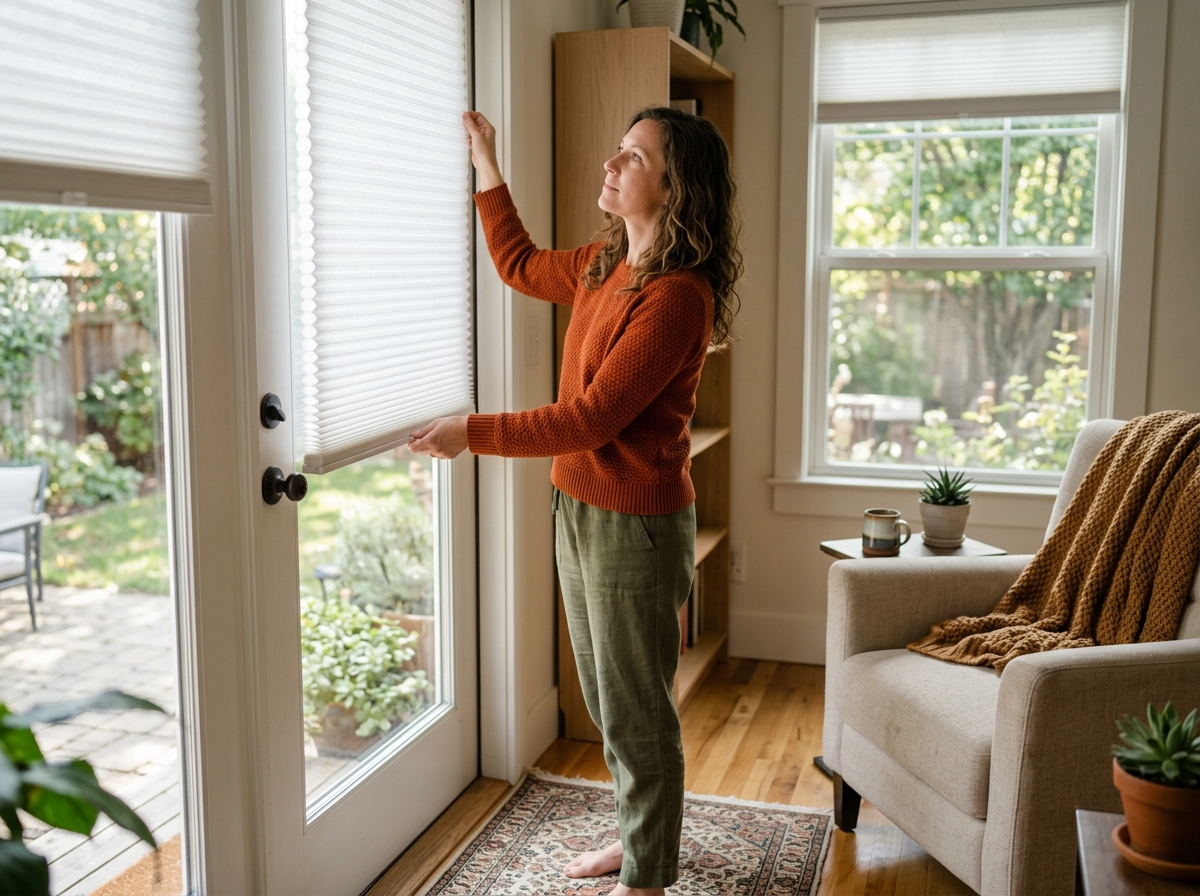
Inside a cellular shade, rows of honeycomb pockets trap air like tiny insulating pillows, which eases the temperature swings you feel standing near a drafty door frame. That said, a shade can’t fix what a bad seal breaks. If the door itself is leaking air around single-pane glass or a worn frame, that’s a job for a window contractor, not a window treatment. Sheer shades, meanwhile, soften harsh afternoon sun on patio doors while still letting you see the yard — no film, no frosted look, just a diffused view. And if noise from a busy street or shared driveway bothers you, layering cellular or woven shades adds a bit of sound-dampening mass that a bare pane of glass simply doesn’t have.
Cordless and Motorized Options for Safety and Convenience
Doors get touched constantly, which is exactly why cords hanging near a sliding or French door are such a bad idea. Kids grab things. Pets get tangled. A cordless lift system solves the problem at the source by removing the dangling cord entirely, so there’s nothing to catch a curious hand or a wagging tail as people move through the doorway all day long.
Motorization takes that convenience further. With PowerView, shades on a hard-to-reach French or patio door can be scheduled to open at sunrise, close at dusk, or respond to a tap on your phone. No more climbing over furniture or wrestling a wand near sliding glass. Before deciding what fits your home, it helps to compare the mechanics, since understanding how automated blinds differ from automated shades will steer you toward the right hardware for your door type.
Here’s what typically factors into that decision:
- Cordless lifts work well on any door-mounted blind or shade and cost less than a motorized upgrade, making them the easier entry point for safety-minded households.
- PowerView motorization suits doors you’d otherwise avoid adjusting, like a patio slider blocked by furniture or a French door set that’s used constantly.
- Battery-powered motors install without rewiring the door frame, which keeps the project quick and avoids cutting into trim or drywall.
- Plug-in motor options work for shades near an outlet and can be a lower-maintenance choice than swapping batteries every season.
- Scene and schedule settings let shades close automatically during peak afternoon sun, cutting glare without you lifting a finger.
One clarification worth making: motorized shades aren’t whole-home smart automation. PowerView controls window treatments specifically. If you’re chasing full smart home wiring, integrated lighting, or multi-system control tied into one hub, that’s a job for an AV integrator, not a shade motor. Keep that distinction straight and you’ll set the right expectations from the start.
Measuring and Installation Tips for Door-Mounted Treatments
Measuring for a door is not the same as measuring for a window. Doors move, swing, slide, and have hardware sticking out at exactly the height a blind wants to hang. Getting the mount type and clearance right up front saves you from a return trip and a re-order. A careful approach to measuring for blinds pays off most on doors, where an eighth of an inch can mean the difference between a smooth close and a blind that catches on the handle every single time.
Inside Mount vs Outside Mount
An inside mount sits neatly inside the door frame, but only works if there’s enough depth to clear the lock, deadbolt, or handle. Outside mount avoids that problem by hanging the treatment above and around the frame, though it needs wall or trim space on both sides. Sliding doors also need enough stack width on one side so vertical blinds or a panel track can bunch up fully and leave the glass clear for walking through.
| Mount Type | Best For | Clearance Needed | Common Pitfall |
|---|---|---|---|
| Inside mount | French doors, hinged doors | 2+ inches of frame depth | Blind hits handle or lock |
| Outside mount | Shallow frames, sliders | Wall space beyond frame | Gaps let light leak in |
| Panel track / vertical | Sliding glass doors | Stack width on one side | Panels don’t clear the glass |
| Low-profile bracket | French doors that swing | Minimal, sits flush | Standard brackets block latch |
French doors are the trickiest of the bunch because the door itself has to keep swinging and latching after the blind goes up. That usually calls for no-drill or low-profile brackets designed to sit flush against the frame. Skip this detail and you’ll end up with a door that won’t fully close, or a bracket that has to be ripped out and reset.
Special Considerations for Double Doors
Double doors look like a matched pair, but they rarely measure like one. One panel is often narrower than the other, especially in older Bergen County homes with settled frames. Each panel needs its own measurement and, in most cases, its own separately sized covering rather than one wide blind stretched across both. Treating them as identical is a shortcut that backfires the first time someone tries to open just one side.
This is also where drafts and temperature swings tend to sneak in, since gaps between mismatched panels let air pass right through. If that’s part of what you’re solving for, it’s worth reading this guide to energy efficient window coverings before you commit to a product, since cellular shades handle drafts differently than a standard roller or roman shade. A professional measurement, not a tape measure and a guess, is really the only way to avoid ordering something that catches on a hinge or a handle after installation.
When Door Blinds Aren’t the Full Fix
Situations That Call for a Different Specialist
Not every door problem is a covering problem. Sometimes the door itself is the issue, and no amount of fabric or slat choice will fix it. Knowing where blinds stop and other trades begin saves you a wasted consultation and a little frustration.
- Foggy or cloudy glass on a sliding or French door usually means a broken seal between panes, a glazing issue that calls for a glazier, not a new blind order.
- Homes in storm-prone areas needing impact protection for glass doors should call a licensed exterior contractor for rated shutters or panels, since interior shutters are built for light and privacy, not wind.
- Blocking sun before it ever reaches the glass, the way an awning or exterior canopy does, is a different category from interior shades, which manage heat and glare after it’s already in the room.
- A screen door with torn or sagging mesh needs a screen specialist for rescreening, not a blinds provider, since that’s a hardware and mesh repair job.
- Persistent drafts around an old or single-pane door frame may point to the door itself needing replacement, a job for a window and door contractor rather than a treatment upgrade.
Sorting these out early matters. If you’re comparing options for glare and privacy on French or sliding doors, reading up on top 5 shades for privacy and light in new jersey is a good next step. But a foggy pane or torn screen? That’s not a design question. It’s a repair one. Get the glass and hardware sorted first, then bring in a treatment specialist for the finishing layer. Skipping that order just means paying twice.
Getting Custom Door Blinds Measured and Installed in Bergen County, NJ
Why a Local Consultation Beats Ordering Online
Ordering blinds off a website means guessing at measurements and hoping the mounting hardware fits your door frame. A free in-home consultation skips the guesswork. A designer comes to your home, looks at your sliding or French doors in person, and factors in swing clearance, handle placement, and how much light actually hits that spot during the day. From there, they’ll talk through fabric weight, light control levels, and whether an inside or outside mount makes more sense for your specific frame. That’s a lot harder to nail down from a product photo and a tape measure alone.
There’s also the matter of quality backing. A partnership with Hunter Douglas brings access to premium cellular, roller, and vertical blind lines, each carrying manufacturer warranty support you won’t get from a bargain online order. Warranty coverage matters more than people expect once lift cords or tilt wands start wearing down after a few years of daily door use. If you’re weighing fabric coordination for the whole room, it’s worth reading up on choosing and installing custom draperies alongside your door treatments, since matching them pulls a room together in a way mismatched pieces never quite manage.
Service Area and Repair Options Across Bergen County
Consultations and installation cover Palisades Park and the towns around it, including Fort Lee, Cliffside Park, Edgewater, Leonia, Englewood, Tenafly, Ridgewood, and Franklin Lakes. That’s a wide stretch of Bergen County, and it means a designer’s visit doesn’t depend on living right next to the showroom. Whether you’re in a high-rise near the river or a colonial further out toward Franklin Lakes, the same on-site process applies.
Not every door blind problem calls for full replacement, either. Broken slats, a stuck lift cord, or a tilt mechanism that won’t respond anymore can often be repaired rather than tossed out. Repair is usually faster and cheaper, and it’s the smarter first call before you assume the whole unit is done for. Seasonal promotions on select product lines also make it more affordable to upgrade several doors at once, which matters if you’re outfitting a whole sunroom or a run of sliders along a back wall. Scheduling either a repair visit or a full consultation is a simple call to (201) 302-9111, no forms or wait times required.
Sliding doors have their own quirks when it comes to coverage, and getting the width, stack, and light gaps right matters more than people expect going in. Thinking through how often the door gets used, how much privacy is needed at night, and whether a cleaner track-free look appeals can help narrow things down before committing to a style, and The Curtain’s vertical blinds for sliding doors are built with exactly this kind of coverage in mind. From there, it’s really just a matter of comparing samples in the actual room, at the actual time of day the light comes through, to see what feels right.