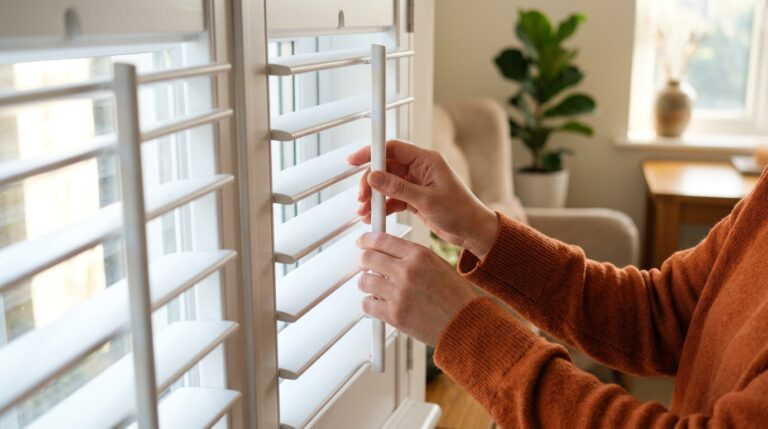
You love the idea of a sun-washed kitchen window, half-covered in soft, textured fabric that moves with the breeze. But you’re not sure if it’s actually practical for everyday privacy and light control. Linen cafe curtains deliver that relaxed, European cafe charm while still letting you see out and keep the lower half of your window screened from street view. They’re not for every room or every light-control need, though. This guide breaks down where they shine, where they fall short, and how to get the look right for 2026.
What Makes Linen Cafe Curtains So Popular for Kitchens and Breakfast Nooks
Where the cafe curtain style originated
Cafe curtains get their name from exactly what you’d guess: French bistro windows. Shop owners hung short panels at mid-sash height so diners inside had some cover from passersby. Sunlight could still pour in over the top. The style traveled to American kitchens decades ago and never really left. A cafe curtain is simply a short panel mounted on a rod roughly halfway up the window, covering only the lower portion of the glass.
That half-covered setup is the whole point. You get screening at eye level, where people actually look in, while the top half stays bare and keeps the room bright. No full-length drapery pooling on the floor, no bulky hardware. It’s a practical, almost humble treatment, which is probably why it’s stuck around this long.
Today it shows up far beyond cafes. Designers lean on it anywhere a window needs a little softness without shutting out the view entirely. That flexibility is exactly why it’s worth understanding before you start picking fabric or hardware.
Linen vs other fabrics for this look
Linen earned its place in this style because of how it behaves, not just how it looks. The fiber has a relaxed, slightly rumpled drape that cotton can’t fake, and it filters light into a soft, even glow instead of a flat glare. Crisp cotton panels tend to hold a stiffer line; synthetic blends can look shiny or plastic-y under direct sun. Linen just moves better. It ages with a kind of lived-in charm instead of looking worn out.
There’s texture too. Linen’s slubby, woven surface catches light in a way smooth fabrics don’t, which is part of why it reads as warm and natural rather than formal. If your style leans toward that relaxed, farmhouse-meets-coastal look, few fabrics do it better. For readers deciding between gauzy versus opaque coverage, understanding the tradeoffs behind privacy curtains options helps clarify how much screening a given weight of linen will actually deliver.
You’ll see linen cafe curtains most in kitchens over the sink, breakfast nooks, bathrooms, and French doors. Basically anywhere full privacy isn’t the goal but some visual screening is welcome. From here, the rest of this guide walks through fit, light control, and styling, so you can match the look to your actual room.

Matching Linen Cafe Curtains to Your Privacy and Light Goals
Not all linen is created equal, and that’s the part people miss when they fall for the look in a catalog photo. The weight and weave of the fabric decide how much of the street sees into your kitchen at dinnertime. Before you order a single panel, it helps to know what each grade of linen actually does once it’s hanging in your window.
| Linen Type | Light Flow | Privacy Level | Best Use Case |
|---|---|---|---|
| Sheer linen | Very high | Low | Street-facing kitchens with limited sightlines or high windows |
| Semi-sheer / medium-weight | Moderate | Moderate, good by day | Everyday cafe windows wanting softness and daytime cover |
| Lined linen | Reduced | Higher, some UV block | Ground-floor windows needing more coverage, less breeze |
| Heavy-lined or layered linen | Low | High by day, lower at night with lights on | Busy sidewalks or close neighbors |
Here’s the honest part nobody likes to hear: lined linen gains opacity but loses the airy drape that made you want linen in the first place. You’re basically trading texture for coverage. And at night, with the kitchen light on, even a lined panel turns into a lit stage for anyone outside. That’s physics, not a product flaw.
There’s a bigger structural issue too. Cafe curtains only cover the lower portion of the window. That’s their whole charm, but it also means the top half stays exposed, day and night, regardless of fabric weight. If you’ve read a sheer curtains guide before, you’ve probably noticed the same tradeoff applies there. For full-window light and privacy control, you’ll want a dedicated shade or blind doing the real work underneath.
When Linen Curtains Alone Aren’t Enough for Heat, Glare, or Privacy
Layering shades behind sheer linen panels
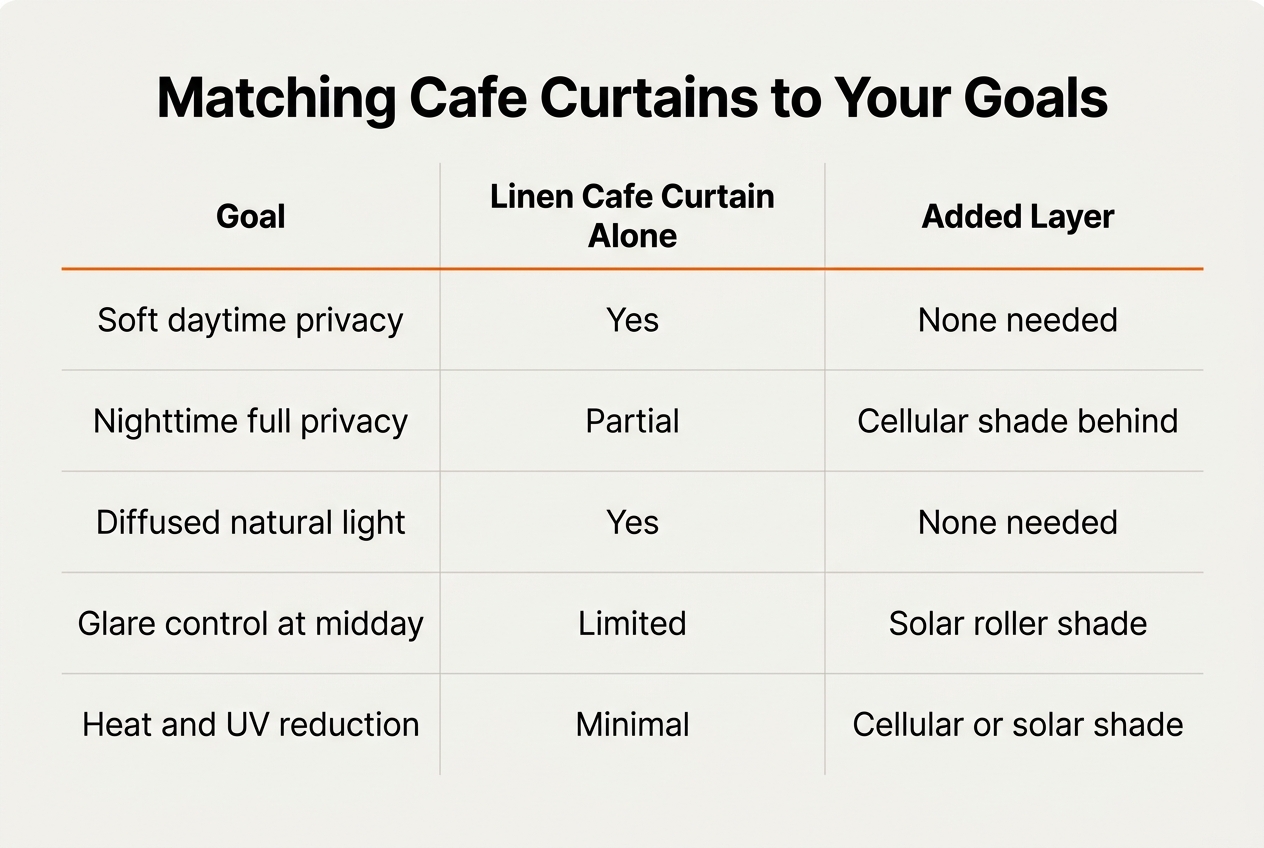
Let’s be honest about what linen actually does. It’s breathable, it drapes beautifully, and it softens a kitchen window with a lived-in, relaxed look. What it doesn’t do is block strong afternoon sun or stop a room from overheating. Linen is decorative, not insulating. If you’ve ever sat at a breakfast nook in July and felt the glare bouncing off the table, you already know the limits of a single sheer panel.
For UV fading protection, skip the idea of treating the glass itself. Window film is a permanent fix, bonded straight to the pane, and once it’s on, it’s on for good. A light-filtering or solar roller shade mounted underneath the cafe curtain gives you the same fading protection but lets you adjust it daily. Raise it for morning light, lower it when the sun hits hardest, all without touching the glass. For readers curious about the mechanics, it’s worth understanding how do solar shades work before choosing a fabric opacity.
Drafty windows are a different animal, and they’re common in older Bergen County homes with original single-pane glass or tired weatherstripping. Insulating cellular shades are a smart, lower-cost first step. Their honeycomb pockets trap air and noticeably cut that cold-glass chill in winter. But if a window is genuinely failed, fogged, or still single-pane after all these years, no shade fixes that. That’s a job for a window contractor, not a fabric layer.
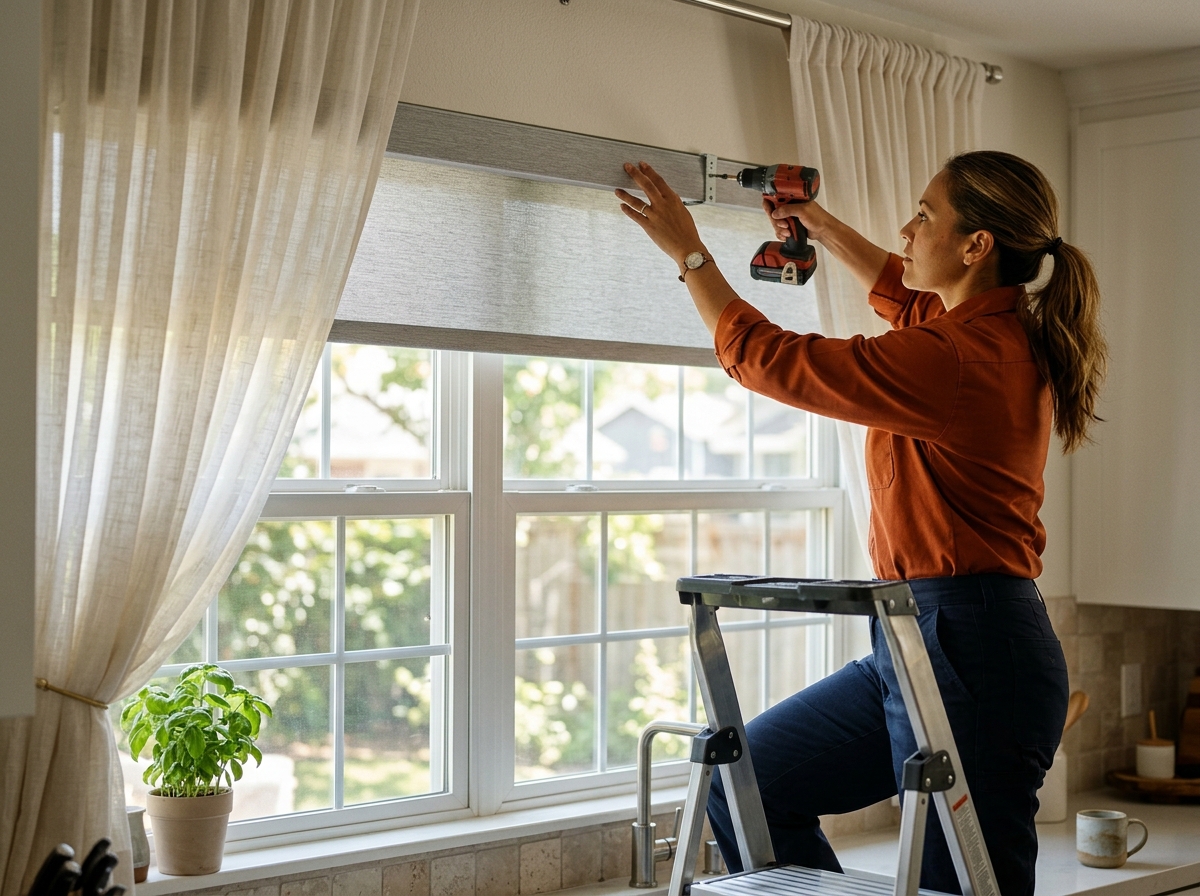
Nighttime privacy is the other gap linen can’t close on its own, since sheer weaves let interior light silhouette right through after dark. A cordless cellular or roller shade mounted inside the frame, set behind the panel, solves it cleanly. You get full coverage at night and the cafe curtain stays the visual focus all day, doing what it does best without competing for attention. Pairing fabrics this way is also covered in more depth in a broader guide to linen curtains and how they work with layered treatments.
Styling Ideas: From Luxury French Linen to Striped and Natural Looks
Not all linen looks the same, and that’s the fun part. The weight, weave, and finish you pick change the whole mood of a kitchen or breakfast nook. Before settling on one, it helps to think about how the fabric will read next to your cabinets, your hardware, and whatever’s already hanging nearby. If you’re mixing textures elsewhere in the house, it’s worth spending a few minutes on how to layer curtains so the cafe panels don’t feel like an afterthought.
- Luxury French linen brings a heavier weight and a subtle sheen that catches light differently than standard cotton-linen blends, and tailored box pleats give it a more formal, higher-end kitchen look.
- Stripe linen curtains add visual rhythm to farmhouse or coastal kitchens, especially when hung near open shelving where the repeating lines echo stacked plates and glassware.
- Natural undyed linen keeps things textural and casual, and it sits well against warm wood tones, exposed beams, or a neighboring woven wood shade.
- Privacy sheer linen uses a tighter, denser weave than typical sheers, making it a smarter pick for bathrooms or ground-floor windows where you still want softness without being seen in from the street.
- Mixed-weight pairing works surprisingly well too, where a heavier French linen panel on one window balances a lighter stripe panel on another, as long as the pleat style stays consistent.
Pairing linen panels with woven wood shades
This is where the natural, textural look really comes together. A woven wood shade mounted inside the frame, with linen cafe panels layered on top at the mid-rail, gives you depth without bulk. The shade handles privacy and light control; the linen softens the edges and adds color or pattern. It’s a combination that suits kitchens with a lot of hard surfaces, since the fabric cuts the visual coldness of tile and stone.
Mounting matters more than people think. Tension rods are the simplest option and work fine for lightweight natural or sheer linen, but they can sag under a heavier French linen panel. Cafe rings or clip rings mounted at the mid-rail give a cleaner, more tailored hang and let the fabric move a bit when a window’s open. Either way, placing the rod at mid-rail height, rather than at the top of the frame, is what keeps the proportions looking like a true cafe curtain instead of a short, awkward drape.
Comparing Linen Cafe Curtains to Woven Shades and Roman Shades
Cafe curtains aren’t the only way to get that soft, natural look at your window. Woven shades and Roman shades both borrow the same organic texture but behave very differently once they’re actually hanging there. If you’re trying to decide which fits your room, it helps to see the trade-offs side by side instead of guessing.
| Treatment | Coverage | Light & Privacy Control | Typical Cost | Installation |
|---|---|---|---|---|
| Linen cafe curtains | Partial, lower half of window | Minimal; mostly decorative | Low | Easy DIY, tension rod |
| Woven shades | Full window | Good filtering; cordless options | Mid | Mounted, simple brackets |
| Roman shades | Full window | Strong control, tailored folds | Mid to high | Mounted, custom fabrication |
Notice what cafe curtains give up for their low price and easy hanging: full coverage. They dress the bottom half of a window nicely, but they won’t block a streetlight or keep a nosy neighbor from seeing in after dark. Woven shades solve that while keeping a similar natural, textured feel, and many now come cordless, which matters if you’ve got kids or pets around dangling pulls. Roman shades go a step further, with tailored fabric folds that can be sewn to match or echo linen drapery already in the room, giving you a coordinated look without sacrificing coverage.
So here’s the short version: pick cafe curtains when you want a decorative accent and nothing more. Pick a shade when light, privacy, or temperature control actually matter. Honestly, a lot of kitchens do fine with cafe curtains alone, since they’re rarely used for sleeping or late-night privacy. For anyone furnishing a whole room, it’s worth reading up on how to choose curtains for living room spaces before locking in one style everywhere. And once your shades or curtains are installed, don’t skip basic upkeep; learning how to get wrinkles out of curtains will keep linen looking crisp instead of rumpled. A free in-home consultation can also walk you through which fabric and fold style will actually coordinate across a room, rather than guessing from swatches alone.
Getting the Fit Right: Measuring and Hardware Basics
Step-by-step measuring approach
Getting cafe curtains to hang right isn’t complicated, but it’s easy to rush. The whole look depends on where that rod sits and how much fabric you let it gather. Get those two things wrong and even gorgeous linen looks sloppy.
Start at the window itself, not a tape measure guess from across the room. Here’s the order that actually works:
- Find the mid-sash point first, meaning the horizontal bar or midpoint of your window frame, since that’s typically where the rod should mount for classic half-window coverage.
- Measure from that mid-sash line down to the sill, then add a few inches depending on whether you want the panel to graze the sill or stop just short of it.
- Decide between rod pocket and clip rings before cutting any fabric, because a rod pocket swallows two to three extra inches in the header while clip rings sit right at the rod line.
- Measure the window’s total width, then plan for finished panels that total one-and-a-half to two-and-a-half times that width for a properly gathered look rather than flat, skimpy fabric.
- Check both sides of the window frame separately, since older homes in particular often have walls that aren’t perfectly square.
Once you’ve got numbers, double-check them against your hardware. For mounting specifics and bracket spacing, a detailed curtain rods and hardware guide can save you a return trip to the store. Standard cafe widths run narrower than full-length drapery, and that’s by design; the fuller the gather, the softer and more relaxed the drape looks against the glass.
Common mistake: hanging too low and blocking the view, or too tight and losing the soft drape
Two mistakes show up constantly. One is mounting the rod too low, which kills the whole point of a cafe curtain: you lose your view and the light along with it. The other is buying fabric that’s too narrow, so the panel hangs flat instead of billowing. Fullness is what makes linen look relaxed instead of stiff. Skimp on width and you’ll end up with something that looks more like a tea towel than a curtain. Measure twice, buy generous, and the fit takes care of itself.
Building a Full Window Treatment Plan Around Your Cafe Curtains
Why a layered approach outperforms curtains alone
A single linen panel looks wonderful, but it’s doing a decorative job, not a functional one. Once you’ve chosen your cafe curtains, the smarter move is treating them as one layer in a two-part system. A free in-home design consultation focuses on coordinating fabric, color, and light control for the rest of the window, not a full room or furniture overhaul. Think of it as a second opinion from someone who looks at windows all day.
That consultation typically means pairing your decorative linen panel with a functional shade underneath, something like a roller shade, cellular shade, Roman shade, or woven shade, depending on how much privacy and light control the room needs. The linen handles the lower half of the window and the look. The shade underneath handles everything from morning glare to nighttime privacy. Mornings open, evenings closed. You get flexibility without touching the fabric at all.
Here’s the part people miss: this layering fixes the biggest complaint about cafe curtains, which is that they only cover half the window. A kitchen facing a busy street doesn’t need full blackout, but it does need a shade that drops down after dark. Layering solves that without forcing you to abandon the breezy look you wanted in the first place.
Adding automation without losing the decorative simplicity
PowerView automation lets the functional shade layer be scheduled or controlled from an app, while the linen panel above stays exactly what it is: purely decorative, no motor, no wiring, nothing to maintain. You set the shade to rise at 7 a.m. and lower at sunset, and the linen just hangs there looking good. It’s a clean division of labor between the two layers.
This setup also solves a quiet safety issue. If cordless operation or child safety is a concern, motorized or cordless shades remove dangling cords from the equation entirely, something a plain fabric panel was never going to address anyway. You’re not retrofitting the curtain for safety. You’re letting the shade layer carry that responsibility instead.
Worth noting: PowerView manages your shades, not your whole house. If you’re picturing a single app running lights, locks, and window treatments together, that’s broader home automation territory, usually handled by an AV integrator. PowerView stays focused on the windows, which, honestly, is plenty to get right.
Keeping both layers looking good over time
Repair services cover the mechanical side: shade hardware, headrails, motor components, broken lift cords. That’s a different job from cleaning linen fabric, and it’s worth keeping the two separate in your head. If a cellular shade stops raising evenly or a roller shade jams, that’s a repair call. If your linen panel has picked up dust or a faint kitchen odor, that’s a job for a dedicated textile cleaner, not a hardware technician.
Linen actually holds up well with occasional gentle washing or professional cleaning, which is more than you can say for some heavier drapery fabrics. Treat the two maintenance paths as separate line items and both layers will last years longer than if you lump them together and hope for the best.
For anyone in Fort Lee, Cliffside Park, Edgewater, Leonia, Englewood, Tenafly, Ridgewood, or Franklin Lakes, a Palisades Park showroom makes it easy to see fabric and shade pairings side by side before committing. If you’d rather start with a conversation, call (201) 302-9111 to set up a personalized consultation and work out which shade layer fits your windows best.
Before deciding, it helps to separate what the glass itself needs from what the room needs: failing seals, drafts, or outdated panes point toward a window contractor, while glare, privacy, and everyday light control are things window treatments solve on their own. A free in-home consultation can clarify which category a problem actually falls into, and whether insulating cellular shades or another layered option makes sense alongside any structural fixes. Weighing those two questions together usually makes the next step obvious.