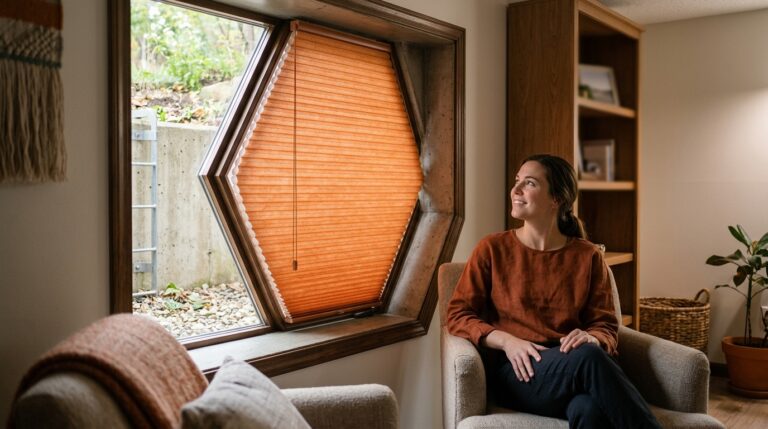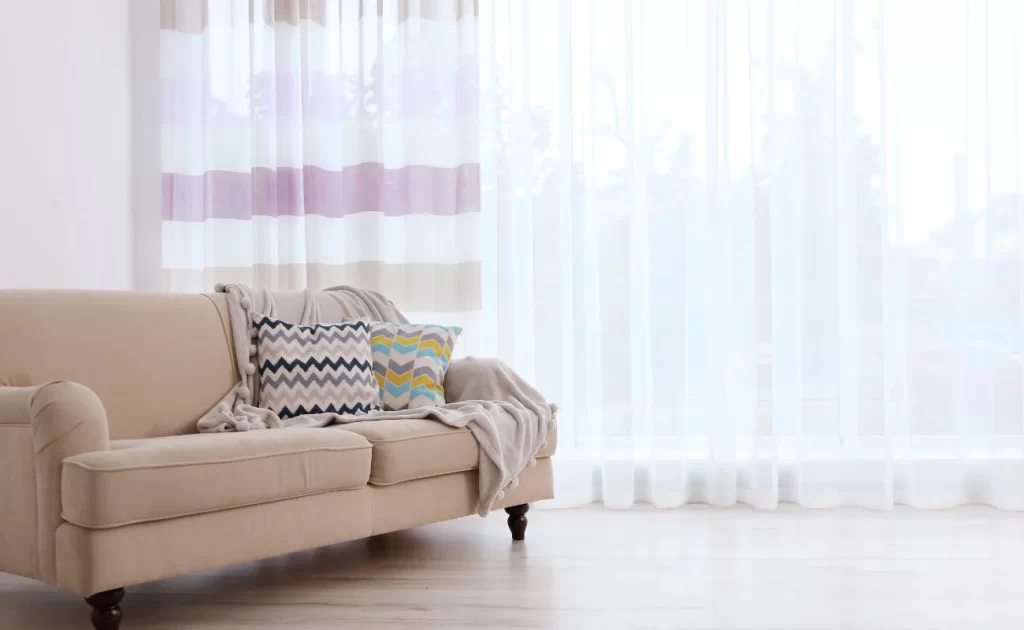
Most Bergen County living rooms have one wall doing all the work: a picture window facing the street, a bay in a colonial, or a slider out to the deck. Deciding how to choose curtains for living room windows comes down to five things you can settle in an afternoon. Light, privacy, measurements, fabric weight, and whether you layer panels over a shade. Here is the order we work through them on a free in-home measure, so you buy once and hang once.
What we would put on the window
- Street-facing window, neighbors closeSheer panels that stay closed all day, lined drapery to draw at night.
- Slider out to the deck or patioA roller shade sized to the door, with stationary drapery panels on the wall beside it.
- TV wall with afternoon glareRoom-darkening roller shade under medium-weight panels.
- Bay window in an older colonialA separate shade fitted to each opening, drapery only at the two outside edges.
- Drafty single-pane windowsCellular shade inside the frame with a lined panel over it.
How to Choose Curtains for Living Room Windows: Light and Privacy First
Fabric swatches are the fun part, so people start there and regret it. Start with two questions instead.
How much daylight do you want to keep?
- Keep the room bright. Translucent linens, cotton voiles, and unlined blends soften the light without shutting it down.
- Watch TV in there. Medium-weight fabric with a blackout or dim-out lining kills the glare on the screen. See our notes on blackout curtains if the room doubles as a movie room.
- South or west exposure. A UV-blocking lining helps protect the sofa fabric, the rug, and the hardwood from fading.
How private does the room need to feel?
Plenty of Bergen County homes sit close to the sidewalk or to the house next door. That is the classic case for layering: sheer panels for daytime cover, heavier drapes you close at dusk. If the window is a slider or a wide opening, a shade behind the panels usually does the privacy work better than fabric alone.
Measure the Window Before You Fall in Love With a Fabric
If you are working out how to measure your window for curtains, use a steel tape, not a cloth one, and write every number down. Four measurements decide whether the panels look tailored or homemade.
- Mounting width. Measure the full width of the window frame, then add 8 to 12 inches on each side so the open panels stack on the wall and not over the glass.
- Fullness. Multiply the finished rod width by 1.5 to 2 for lightweight fabrics, and by 2 to 2.5 for medium and heavy fabrics. That is what gives you real folds instead of flat, stretched panels.
- Mounting height. Set the rod 4 to 6 inches above the frame, or take it closer to the ceiling when you want the window to read taller.
- Panel length. A floor kiss sits about a quarter inch off the floor and suits tailored rooms. True floor length reads classic. A puddle of 2 to 6 inches on the floor is a traditional, romantic look. Our guide to whether curtains should touch the floor walks through the trade-offs, and floor-to-ceiling curtains covers the ceiling-mount version.
Older houses complicate this. Floors settle, frames are out of square, and a bay or an arch is never as symmetrical as it looks. That is the main reason we measure in the home rather than over the phone.
Match Fabric Weight to the Job
Curtain fabrics sort into four broad groups. Pick the group first, then shop color inside it.
| Fabric weight | Best for | Trade-off |
|---|---|---|
| Sheers: voile, gauze, light linen | Maximum daylight, layering under drapery | Little privacy at night, no real insulation |
| Medium: cotton, poly-cotton, light velvet | Everyday living rooms | Only moderate light blocking without a lining |
| Heavy: velvet, jacquard, wool blends | Formal rooms and drafty windows | Costs more and can overpower a minimal room |
| Performance: thermal, sun-out, noise-reducing | Bright exposures and busy streets | Fewer colors and patterns to choose from |
Lining changes the answer more than most people expect. A medium cotton with a blackout lining blocks more light than an unlined heavy fabric, and it hangs with less bulk. If winter drafts are the issue, read our thermal curtains guide. If the room faces a busy road, noise-reducing window treatments covers what fabric can and cannot do about traffic sound. For a deeper dive on one fabric, we have a page on velvet curtains.
Living Room Curtain Ideas That Hold Up Day to Day
Color is where most living room curtain ideas go sideways. Start with the largest pattern already in the room, usually the rug or the sofa, and make the curtains do one of two jobs.
- Echo a secondary color from that pattern for a quiet, cohesive room.
- Contrast with a complementary color when you want the window to be the focal point.
Safe and still interesting
- Tone-on-tone neutrals, like oatmeal linen against greige walls, make a small room feel bigger.
- Soft vertical stripes stretch a low ceiling.
- Micro-prints and woven textures add depth without visual noise.
Bolder moves
- A large-scale floral or geometric becomes the room’s focal point, which works when everything else is calm.
- Color-blocking at the hem grounds a tall window and keeps the top of the panel light.
You look at these panels every day, so favor a palette you will still like in five years over whatever is trending this season. Our curtain trends and top curtains for New Jersey homes posts are a decent temperature check.
Header Style and Fullness Set the Tone
Two rooms with the same fabric can look completely different depending on the header.
- Grommet or eyelet tops fall into crisp, even waves and read modern. See the grommet curtains guide.
- Pinch and French pleats give formal symmetry. For the dressier versions, look at goblet and cartridge pleats.
- Rod pockets feel casual and suit lightweight fabrics.
- Tab tops are relaxed but slide less easily, so they are better for panels you rarely draw.
Whatever header you pick, do not shortchange fullness. Panels should still gather when they are closed. Drapery rings with clips are the flexible option, since you can swap panels without changing hardware.
Layering Curtains With Shades
Designers rarely use one fabric on a living room window, and the reason is practical: one layer handles light, the other handles style.
- Sheer plus opaque panel. The sheer stays closed through the day, the heavier panel closes at night. A double rod keeps it tidy.
- Shade plus side panels. An inside-mounted Roman shade or roller shade does the light control, and stationary drapery panels frame the window and hide the shade hardware.
For a west-facing wall of glass, a solar shade cuts glare while you still see the yard. For drafty windows, a cellular shade traps air in the frame and the drapery goes over it. Our post on how to layer curtains gets into the hardware combinations, and large windows, bay windows, and sliding doors each have their own quirks worth reading before you order.
Hardware and Installation
Rods, rings, and finials are the jewelry. Pick a finish that echoes the metal already in the room, like lamp bases or door hardware, without matching it exactly. Matte black grounds a bright room, brushed brass warms up cool colors, and polished nickel works with both modern and traditional furniture. Size the rod to the panel weight: light sheers hang fine on a three-quarter inch rod, heavy velvet needs something closer to an inch and a quarter or thicker. The curtain rods and hardware guide has the details.
On installation day, steam or iron the panels before they go up, use a level on the brackets, and anchor into drywall properly. Do not assume a standard height fits your room, since ceiling heights vary house to house. After hanging, fold the pleats by hand and tie them loosely for a couple of days so the fabric learns the shape. Step-by-step help is in how to hang curtains.
Keeping Them Looking New
Vacuum panels monthly with a soft brush attachment, which does more for the look of a room than people realize. Wash or dry-clean by the care tag, roughly twice a year, and more often with pets and kids on the couch. Many households swap lighter cotton or linen in for spring and summer, then put the thermal-lined panels back up in the fall.
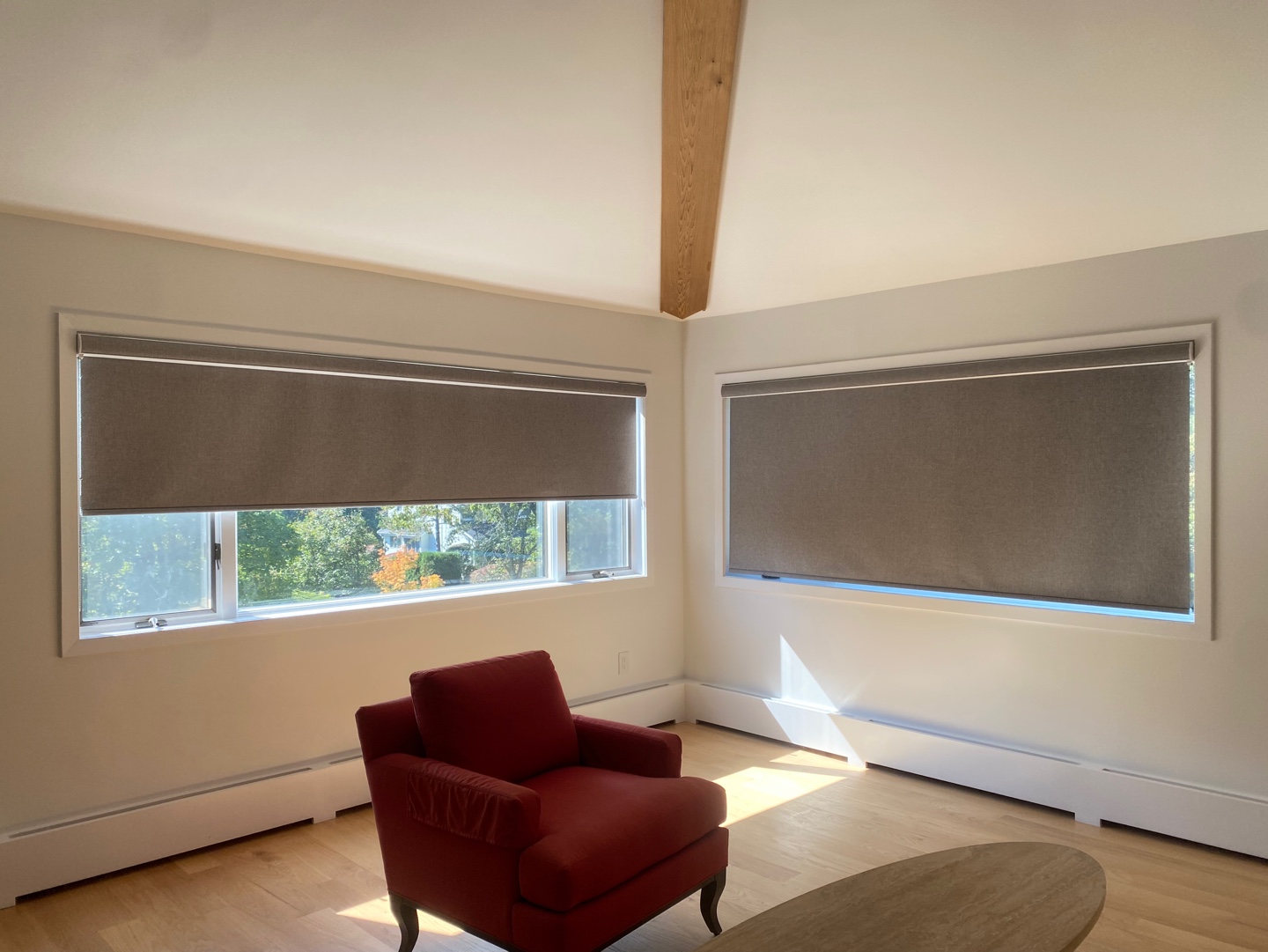
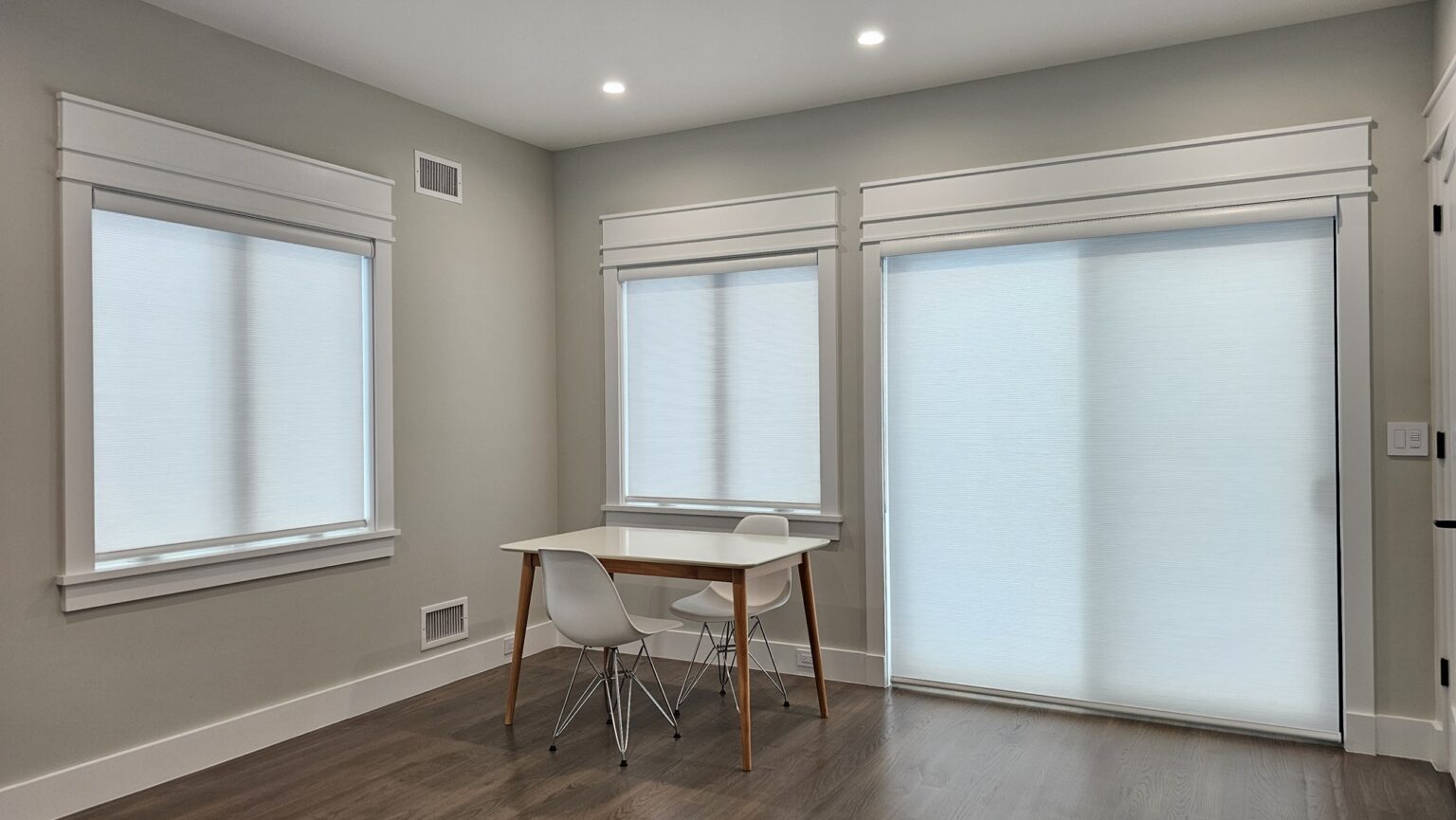
From our own installs in Bergen County
See the Fabrics Before You Commit
The Curtain is a family-owned window treatment showroom at 545 Broad Ave in Palisades Park, in business since 2007 and serving Bergen County. Sejun Park is the owner and designer. Seeing a linen or a velvet in person, in daylight, tells you far more than a screen does about how it will read in your room. We make custom drapery, and as a Hunter Douglas partner we sell and install Hunter Douglas shades, blinds, and shutters, so a layered living room can come from one place.
Measurement in your home is free and the quote is in writing. Call (201) 302-9111, book at free consultation, or check the towns we cover on areas we serve. You can also browse finished rooms in the gallery or read the custom window treatments guide before you come in.