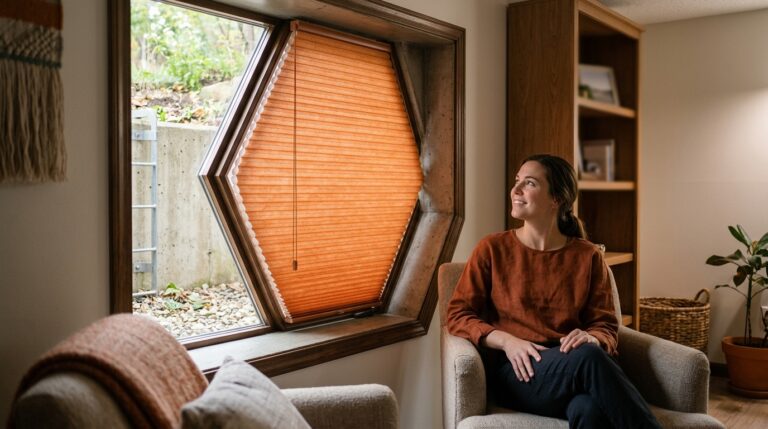
Your living room has a job conflict. It needs to flood with daylight by morning, shield you from the neighbor’s line of sight by evening, and still look intentional when guests walk in. Most living room curtain ideas solve exactly one of those problems and quietly sabotage the other two. That’s how you end up with panels you never open, or shades you never raise. Below are seven approaches that handle light, privacy, and style together — sheer shades, layered custom drapery, solar rollers, interior shutters. Stop choosing between a bright room and a private one.
How to Choose the Right Look Before You Shop
Light, Glare, and Fade Control
Start with three variables: window orientation, ceiling height, and where glare lands. Walk the room at 2 p.m. Then again at 6. If the sun crawls across your TV screen or hits the sofa where everyone sits, that’s the problem your treatment has to solve first. Everything else is decoration.
South- and west-facing living rooms across Bergen County take a beating in the afternoon. That angled summer light fades upholstery, bleaches hardwood, and turns a comfortable room into one you avoid for three hours a day. Light-filtering roller shades and cellular shades cut UV while keeping the view. Permanent solar film on the glass does similar work, but you can’t dial film back on a gray February morning.
Then decide the bigger question. Should the fabric vanish into the wall color, or be the loudest thing in the room? Both work. Quiet treatments let art and furniture lead, while a saturated panel becomes the anchor everything else answers to. Just don’t try to do both at once and end up with neither.
Measuring Realities That Limit Your Options
Note your hardware constraints before you fall in love with anything. Shallow window depth kills certain inside-mount options. Crown molding, a radiator under the sill, or a sliding glass door to the patio each rule things out fast. A steel tape and ten minutes will save you a return.
Measure the wall above the window too. That gap between the casing and the ceiling decides several of the ideas below, and four inches versus fourteen changes the whole plan. Narrow openings have their own rules, and reading up on curtains for small windows helps if your living room has a pair of flanking casements. Bay windows and odd angles need their own measurements, not estimates — more sizing guidance lives on this blog.
1. Floor-to-Ceiling Drapery Panels That Make the Room Taller
Rod Placement and Hem Length
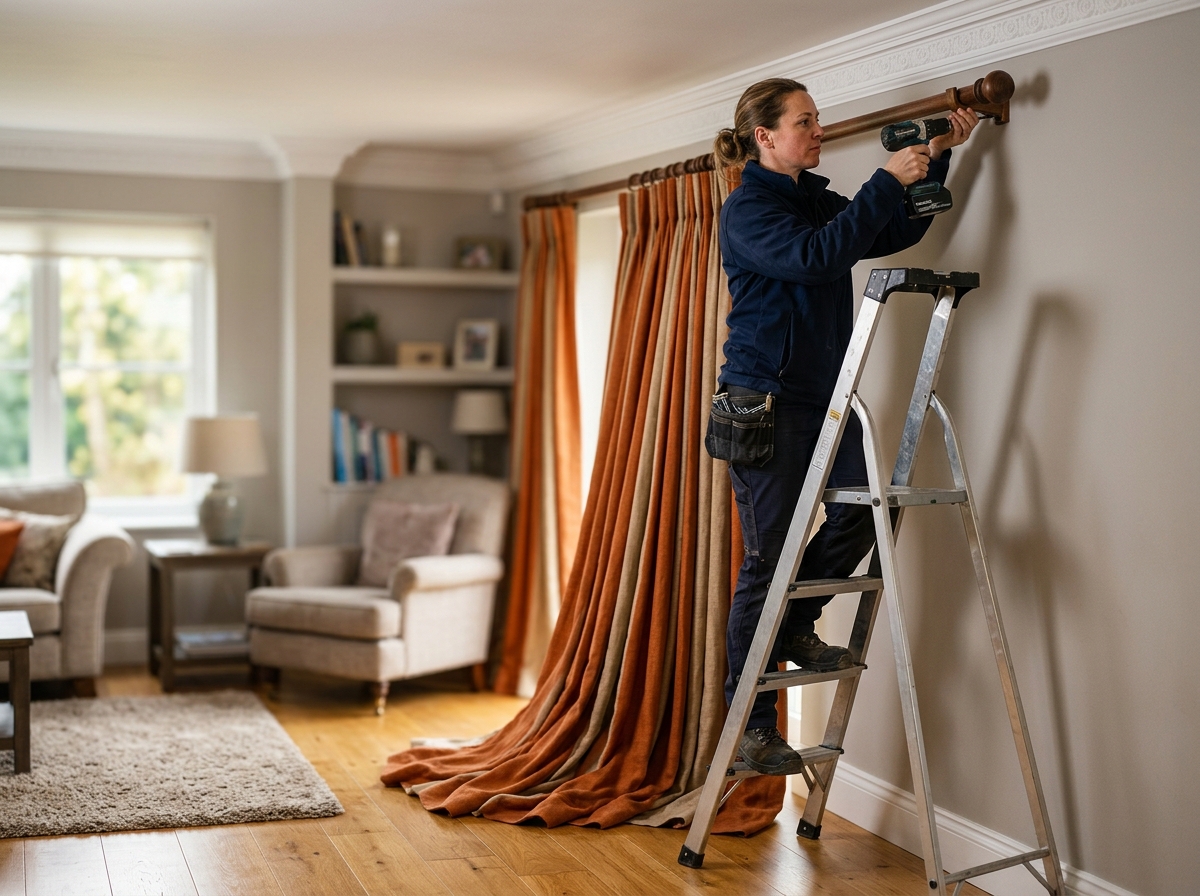
Most people hang the rod two inches above the window casing. That’s the mistake. Mount it 4 to 6 inches below the ceiling line instead, and the eye reads the whole wall as one tall vertical plane. On an 8-foot ceiling with a standard 5-foot window, that single change can make the room feel a full story taller. Extend the rod 8 to 12 inches past each side of the frame, too, so the glass looks wider than it is.
Then there’s the hem. Panels should either kiss the floor or puddle about an inch — anything higher looks like the fabric shrank in the wash. Hemming short is the most common DIY error, and once you’ve cut, you can’t go back. If you’re torn between a break and a float, the debate over whether curtains should touch the floor comes down to traffic, pets, and how often you’ll wash them. Arched or angled openings change the math entirely, and there are proven methods for hanging curtains on an arched window that keep the curve visible.
Fullness is the other half of the equation. Plan fabric at 2 to 2.5 times the rod width so panels hang in soft, gathered folds rather than flat sheets. Custom drapery also lets you match pleat style to the room’s formality — pinch pleats for traditional, Euro pleats for something cleaner, ripplefold for modern rooms with wide spans. Heavier lined fabrics do quiet work, too, absorbing echo in rooms with hardwood and little upholstery, much the way homeowners weigh comfort upgrades like air conditioning repair or added insulation against the cost of living with the problem.
2. Layered Sheers Under Drapery for Day-to-Night Flexibility
When Two Layers Beat One
A single panel has to pick a side. It either blocks the view or lets the light in. Layering solves that by splitting the job between two treatments. A sheer or light-filtering shade handles daytime, so you get privacy from the sidewalk while the room stays bright. At dusk, you draw the drapery for real darkness. If you’re weighing fabric density and weave for street-facing rooms, reading up on privacy curtains helps you match opacity to how close your neighbors actually are.
Sheer shades like Silhouette and Pirouette do something a flat panel can’t. The fabric vanes bounce sunlight up and across the ceiling instead of throwing hard stripes of glare onto your coffee table. At 2 p.m. on a south-facing window, that difference is dramatic. Think of it as the indoor answer to window film, which a glass tinting company applies permanently. Film never changes. Vanes tilt hour by hour as the sun moves.
Keep the palette quiet. Pair a neutral off-white or oyster sheer with one saturated side panel — deep olive, navy, rust — and the window reads calm instead of cluttered. Textured weaves work too, and linen curtains layer beautifully over a smooth sheer. This setup earns its keep most on picture windows, where one treatment simply can’t cover 9 feet of glass and still do both jobs well.
3–5. Three Hard-Treatment Alternatives to Traditional Curtains
Soft Fabric Shades vs. Rigid Louvers
Not every living room window wants fabric puddling on the floor. Roman shades split the difference — real fabric folds, but a clean horizontal line that stacks up top. They’re the right call behind a sofa or a console table, where panels would just get crushed. Woven wood shades bring texture instead: bamboo, reed, jute. Against white walls and walnut mid-century furniture they read organic rather than fussy, and if you’re wondering whether woven wood shades still work in 2026, the short answer is that natural fiber has outlasted three trend cycles already.
Interior plantation shutters go the other direction — architecture, not softness. Tilt the louvers and you control light down to a sliver while keeping sightlines blocked. One clarification worth making: these are interior light-and-privacy shutters. Storm shutters and exterior facade shutters are a licensed exterior contractor’s job, a completely separate scope.
Comparing Insulation, View, and Cost
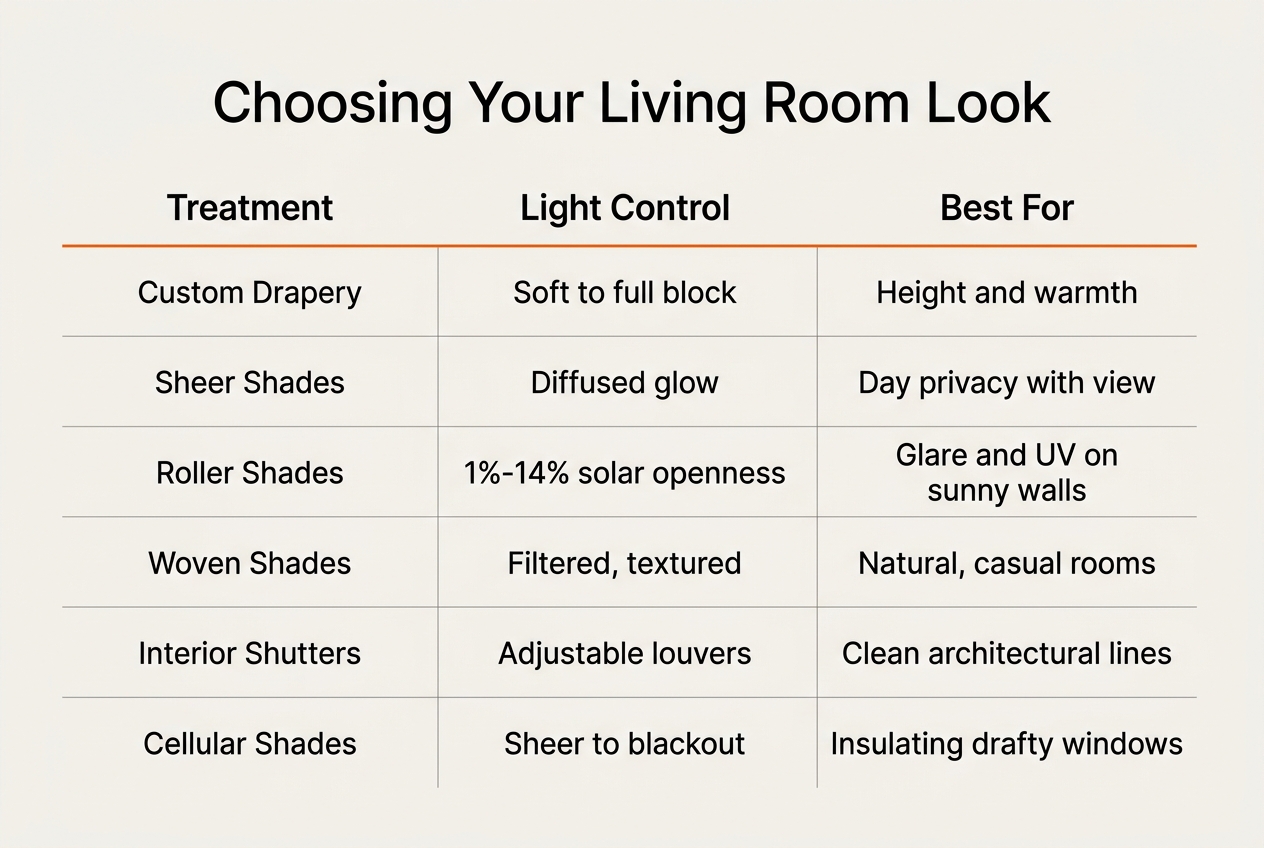
Here’s how the five hard-treatment options stack up on what people actually complain about — drafts, glare, and cost per window.
| Treatment | Insulation | View Retained | Typical Cost (per window) |
|---|---|---|---|
| Roman shades | Moderate (better lined) | None when lowered | $250–$600 |
| Woven wood shades | Low to moderate | Filtered, some light gaps | $200–$500 |
| Plantation shutters | Good (solid panel seal) | Adjustable via louvers | $400–$900 |
| Solar roller shades | Low | High — 3–5% openness | $150–$450 |
| Cellular shades | Best (honeycomb air pockets) | None when lowered | $180–$550 |
Solar roller fabric cuts glare and blocks most UV while you still see the street — a practical interior answer when exterior awnings aren’t possible. For drafts specifically, cellular shades win. Their honeycomb cells trap air right at the glass, and energy efficient window coverings can meaningfully reduce heat loss through older glass. Failed or single-pane windows may still need a window contractor, though.
6. Vertical Blinds and Wide Panels for Sliding Glass Doors
A sliding glass door is a wall of glass that also happens to be a doorway. That changes everything. Whatever you hang has to stack completely off the glass on one side, clear the handle, and survive being pushed aside three or four times a day without anyone thinking about it.
Vertical blinds remain the most practical choice for full-width glass doors in daily use. The vanes rotate for privacy and glare control without moving at all, then draw to one side when you actually need to walk through. Modern versions come in fabric, faux wood, and smooth PVC, so the dated office look isn’t a given anymore. If you’re weighing materials and control options, it’s worth reading up on vertical blinds for sliding glass doors before you commit to a stack direction, since that choice is hard to change later.
Stack-Back and Traffic Flow
Stack-back is the space your treatment takes up when it’s fully open. On an 8-foot slider, a one-way vertical stack eats roughly 10 to 14 inches of the opening. Plan for it. Mount the headrail a few inches wider than the frame and you’ll keep the glass clear.
Want something softer? Extra-wide drapery panels on a traverse rod do the job beautifully. Extend the rod 12 to 18 inches past the door frame on the stacking side, and the fabric lands on the wall instead of the glass. One-way draw is the key detail here. A center-split pair looks balanced but leaves fabric in your path every single trip outside.
Avoid anything that has to be lifted or re-stacked each time someone heads to the deck. A single Roman shade over a slider sounds elegant and gets annoying by day three. Traffic wins over styling, always.
One quick clarification, because it comes up constantly: sliding closet doors and panel-track room dividers are millwork purchases handled by a carpenter or door supplier, not a window treatment order. Everything here applies to glass doors leading outside. Same track idea, completely different trade.
7. Motorized Treatments and Cordless Safety Upgrades
Some windows are just awkward. The one above a stairwell, the pair flanking a fireplace, the transom over a built-in bookcase — you’re not dragging a stepladder into the living room every afternoon. Motorization turns unreachable windows into usable ones. PowerView automation runs on a schedule, so shades can drop at 2 p.m. when west sun starts baking the sofa and rise again at sunrise without you touching anything.
Scheduling Around Sun Exposure
A good schedule follows the sun, not the clock alone. Before you commit, comparing automated blinds and automated shades helps you decide which lift style suits your room’s light. Here’s what scheduling and scene control actually do day to day:
- Shades lower at peak afternoon glare, cutting the heat load on furniture and hardwood floors before it builds.
- Morning open times let in daylight gradually, so you’re not waking up to a dark room in January.
- Scene control groups a whole wall of windows, so five shades move together instead of five separate taps.
- Seasonal adjustments matter, since the sun sits much lower in the sky in November than it does in June.
- App and remote control both work, which helps when guests can’t find the wall switch.
Cord-Free Options for Family Rooms
Dangling cords are the reason cordless lifts exist. If you’ve got toddlers or a cat that treats a pull cord as a toy, cordless or motorized operation is the right call — not a nice extra. No loops, no tangles, nothing hanging within reach. Worth being clear on one thing: motorized shades aren’t whole-house automation. Broader smart home wiring, lighting control, and multi-system integration are an AV integrator’s job.
Common Living Room Curtain Ideas Mistakes and How to Fix Them
Most curtain regret traces back to three measurable errors, not bad taste. A rod that stops at the casing forces your panels to sit over the glass all day, so extend the rod 8 to 12 inches past each side and stack the fabric off the window entirely. Fabric weight matters just as much. Unlined linen looks gorgeous and does almost nothing against 4 p.m. glare on a west-facing wall.
Scale is the third trap. Two skinny 50-inch panels on a 10-foot window read as an afterthought, and no amount of styling saves them.
The bigger issue is expecting fabric to fix something structural. Here’s where the work actually belongs:
| Problem | What treatments can do | Who handles the rest |
|---|---|---|
| Cold drafts at the window | Insulating cellular shades cut heat loss for a fraction of replacement cost | Single-pane or failed units may still need a window contractor |
| Foggy or cracked glass | Nothing — this isn’t a fabric problem | A glazier |
| Broken lift cord, bent headrail | Often repairable, not a full replacement | A repair tech who knows the hardware |
| Dusty, tired panels | Rehang and re-dress the folds | A dedicated drapery cleaning service |
| Arched or angled windows | Custom-shaped shades built to the opening | Skylights and roof windows are a separate ask |
When you’re weighing custom over ready-made, understanding the design process of custom window treatments helps you judge quotes and lead times honestly. Measure twice, decide the job the fabric has to do, then pick. That order saves money.
Putting Your Plan Together With a Free In-Home Consultation
Showroom lighting lies. A fabric that reads warm beige under store fixtures can turn gray in a north-facing living room, and no photo fixes that. An in-home visit lets a designer hold real samples against your own windows at your own light levels, morning and afternoon, so you see how the weave drapes and how much glare actually gets through.
What to Have Ready
A little prep cuts the appointment down and makes the choices obvious. Pull your paint chip, a flooring scrap, and one upholstery swatch — sofa or chair, not all six pieces. That’s usually enough to narrow forty fabric options to five. Since layering is a common question, reading a sheer curtains guide beforehand helps you come in knowing whether you want daytime softness or full night privacy.
Expect the conversation to land on five points:
- Light control — filtered daylight, room darkening, or true blackout for a TV wall
- Privacy level — whether neighbors sit 15 feet away or across a yard
- Insulation goals — drafty glass often calls for cellular shades before anything else
- Operating style — cordless lift, wand, or motorized with a scene you can set once
- Mount depth — whether your frame allows an inside mount or needs an outside mount
Where the Design Help Starts and Stops
This session is window treatment design: fabric, color, light control, hardware, and measurements. It isn’t full room design. Furniture selection, staging, and whole-house color plans belong to an interior decorator, and a good one is worth hiring for that work. Homeowners in Fort Lee, Cliffside Park, Edgewater, Englewood, Tenafly, Ridgewood, and Franklin Lakes can book a no-cost in-home appointment or call (201) 302-9111.
Before you commit, it’s worth being honest about what you’re actually solving for: if the glass itself is failing — fogged panes, broken seals, cracks — that’s a glazier’s call, and no covering will fix what’s happening between the layers. But if the real problem is heat, glare, privacy, or a room that never quite feels finished, adjustable interior treatments like insulating cellular shades, solar roller shades, or plantation shutters give you control you can change with the season rather than a permanent decision baked into the window. Ask yourself which of those two problems keeps coming up, and you’ll know which conversation to have first.