If you are standing in a Bergen County living room asking should curtains touch the floor, the honest answer is that you have four choices, not one. Panels can float just above the floor, kiss it, break with a single soft fold, or puddle in a few inches of fabric. Each finish is measured differently, cleans differently, and suits a different room. This guide walks through all four, then shows how we settle the question during a free in-home measure for custom drapery.
The Short Answer: Should Curtains Touch the Floor?
For most rooms, yes, or within an inch of it. Panels that stop at the sill or halfway down the wall make a window look unfinished and a ceiling look lower. The two safest finishes are a kiss, where the hem just touches the floor, and a float, where the hem sits about half an inch to 1 inch above it. A break or a puddle adds softness and drama but needs more upkeep, so save it for low-traffic rooms.
Float, Kiss, Break, or Puddle: The Four Finishes
- Float (practical): the hem sits half an inch to 1 inch above the floor. Long, tailored line, no dust at the hem, no dragging when you open and close. Best for kids’ rooms, busy hallways, home offices, and any house with pets.
- Kiss (tailored): the hem touches the floor with no fold. It reads clean and custom, the “made for this window” look. Best for living rooms, dining rooms, and any spot where you want a crisp line.
- Break (soft): 1 to 3 inches of extra length so the hem folds once at the floor, like a well-cut trouser hem. Softer than a kiss, easier to live with than a puddle, and forgiving of a floor that is slightly out of level.
- Puddle (dramatic): 6 to 12 inches of extra length pooling on the floor. It belongs in low-traffic, formal rooms with heavy fabric.
When Curtains Should Go to the Floor
Choose a kiss or a light break when you want:
- A taller room. Mounting the rod high and running the panels all the way down draws the eye up. In a split-level with 8-foot ceilings, this is one of the cheapest ways to make the room feel bigger. See floor-to-ceiling curtains.
- Better light control. Long, lined panels hug the wall at the sides and cut light bleed at the bottom. Add a blackout lining in a bedroom.
- A finished main space. Living and dining rooms look complete with floor-length panels, even on a modest budget.
- Design unity. If one room has three windows at different heights, matching the hems at the floor keeps them reading as one set.
When Curtains Should Hover Above the Floor
Go with a small float of half an inch to 1 inch when you:
- Vacuum often or fight dust. The hem stays clean far longer.
- Have pets or kids. No tripping, tugging, or fur clinging to the fabric.
- Have uneven floors. A tiny float hides the slope you only notice once the panels are up. Older Bergen County houses rarely have a dead-level floor under the window.
- Open and close them daily. A floating hem glides; a puddled one drags and wears.
A float is not a short curtain. If you are weighing sill-length panels, read the short curtains guide first.
When to Let Curtains Puddle on the Floor
Curtains puddling on the floor are a deliberate choice, not a measuring mistake. They work when the room, the fabric, and your patience for upkeep line up:
- Light puddle (1 to 3 inches): a soft break at the floor that is easy to live with day to day.
- Heavy puddle (6 to 12 inches): full drama for formal living rooms, primary bedrooms, and dining rooms used a few times a year.
- Fabric weight decides it. Linen, velvet, and heavier cottons fold into a puddle with body. Thin polyester sheers just look crumpled.
- Upkeep is real. You will fluff and reshape the hems and wash less often. Skip it if anyone in the house has dust allergies or a robot vacuum runs the room.
For a soft bedroom, a light puddle in lined linen or velvet is the move. See romantic bedroom curtains for fabric ideas.
Your Measuring Game Plan
Measure in this order:
- Decide the mount height first. For a taller look, set the rod 4 to 8 inches above the window trim, or closer to the ceiling on a short wall. See hanging curtain rods for bracket placement.
- Pick your finish and adjust the number.
- Float: subtract half an inch to 1 inch from the floor-to-rod-ring measurement.
- Kiss: match the floor-to-rod-ring measurement exactly.
- Break: add 1 to 3 inches.
- Puddle: add 6 to 12 inches.
- Measure from the hardware, not the window. With rings and clips, measure from the bottom of the ring to the floor. With grommet panels, measure from the top of the rod and check the panel’s above-rod allowance, since the fabric rises above the rod.
- Measure at both ends of the rod. Floors are not level. If the two numbers differ by more than half an inch, a float or a break will hide it; a kiss will not.
- Plan for shrink and settling. Linen and cotton relax after hanging, and machine washing changes the length a little. Steam after hanging so the fabric drops to its true fall, then fine-tune with iron-on hem tape if a kiss is the goal. See how to get wrinkles out of curtains.
- Get the width right too. Panels per window should total 1.5 to 2 times the window width for full pleats. Skimpy width makes even a perfect hem look cheap.
For the full process, rod to rings to hem, see how to hang curtains.
Room-by-Room Advice
- Living room: kiss or light float. If you host often, choose the float so hems do not get scuffed under chairs. More in choosing curtains for living rooms.
- Bedroom: floor length for softness and light control. Kiss for tailored, light puddle for cozy if you are not opening them every morning. See the bedroom curtain guide.
- Dining room: kiss or a small break looks elevated without fuss.
- Kitchen and bath: moisture and splashes change everything. Use cafe lengths, a clean float, or keep fabric off the floor entirely with a shade. See the kitchen guide and bathroom guide.
- Kids’ rooms and playrooms: float. Less dust, fewer snags, easy cleaning.
- Home office: float if you roll a chair around; a kissing hem catches under casters.
- Sliding doors: drapery on a track with a light float so panels do not drag on the daily trip to the deck. See window treatments for sliding doors.
Fabric, Header Style, and Hardware: Why They Matter
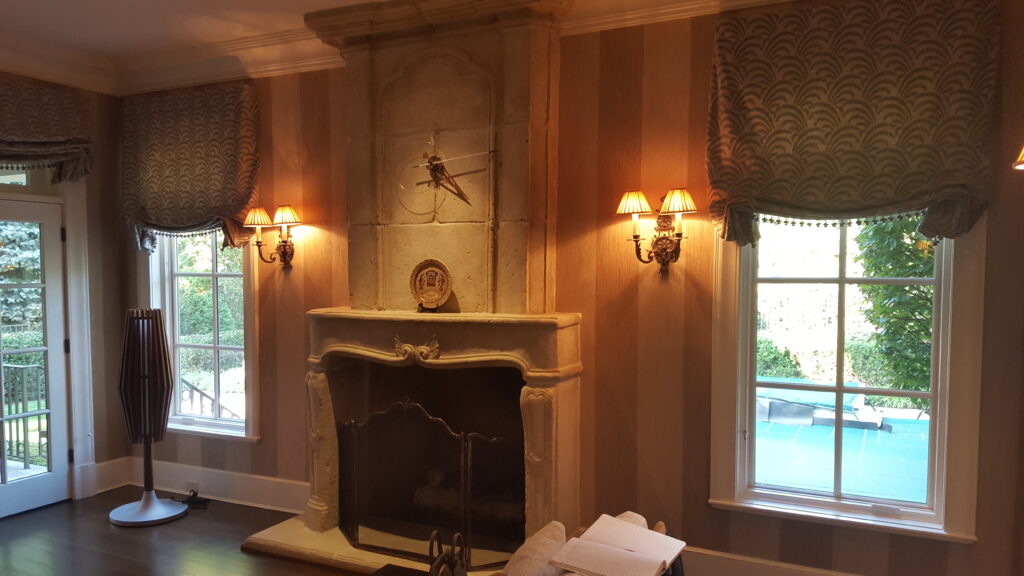
- Fabric weight: heavier fabrics hang straighter and hide small length quirks. Sheers show every wave and prefer a float.
- Header style:
- Pinch pleat and tailored pleat: the most polished header, and the best match for a kiss. Goblet and cartridge pleats fall into the same family.
- Grommet: casual, even waves, easy to slide, happiest with a float.
- Rod pocket: simple, but it sticks when opened often. Better for a decorative panel that stays put.
- Lining: adds body, protects the face fabric from sun fade, and helps the panel fall cleanly to the floor.
- Rod placement: higher means taller. Extending the rod 4 to 10 inches past each side of the frame shows more glass when the panels are open and closes the light gap at the edges. See the rods and hardware guide.
Common Mistakes (and Quick Fixes)
- Rod too low: the room feels shorter. Raise it a few inches and the wall opens up.
- Skimpy width: if panels do not stack into soft folds, add a second panel per side or size up.
- Uneven hems: switch to a small float, or hem each panel to the exact spot where it hangs.
- No steaming: wrinkles make the length look wrong. Steam after hanging so the fabric settles.
- Forgetting vents and baseboard heat: if a floor register or baseboard radiator sits under the window, choose a float or stack the panels clear of it.
- Puddling in a high-traffic room: switch to a kiss or a float and cut your cleaning time.
From our own installs in Bergen County
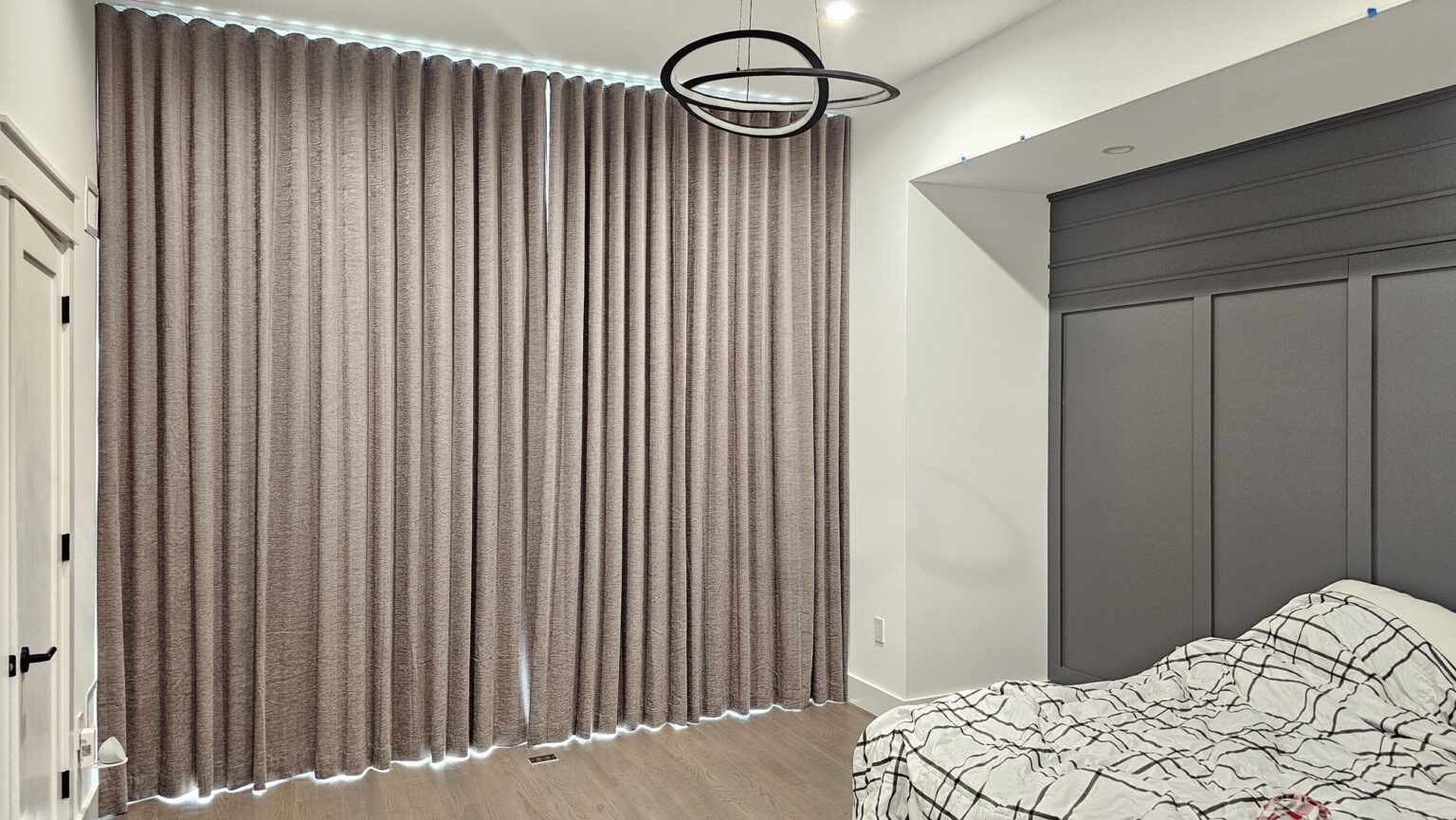

How We Decide Curtain Length at the Showroom
The Curtain is a family-owned window-treatment showroom at 545 Broad Ave in Palisades Park, in business since 2007 and serving homeowners across Bergen County. Owner and designer Sejun Park makes custom drapery, and length is one of the first things settled during the free in-home measurement. Here is how it works:
- The measurement happens in your home, free. Length is taken from the planned rod height to the actual floor at each window, at both ends of the rod, which is how a sloping floor gets caught before fabric is cut.
- We pick the finish with you, room by room. Who uses the room, whether the panels open daily, pets, vents, and baseboard heat all go into the decision.
- Fabric and header get matched to the finish. A puddle gets a fabric heavy enough to fold, a kiss gets a pleated header that hangs straight.
- Each panel is hemmed for its own window. That is the advantage of custom draperies over a stock panel: the length is not a guess from a package label.
- You get a written quote to compare at your own pace.
For kitchens, baths, and any window where fabric on the floor makes no sense, we are also a Hunter Douglas partner and sell and install Hunter Douglas shades, blinds, and shutters. Check the towns we serve, then book a free in-home measurement or call (201) 302-9111.