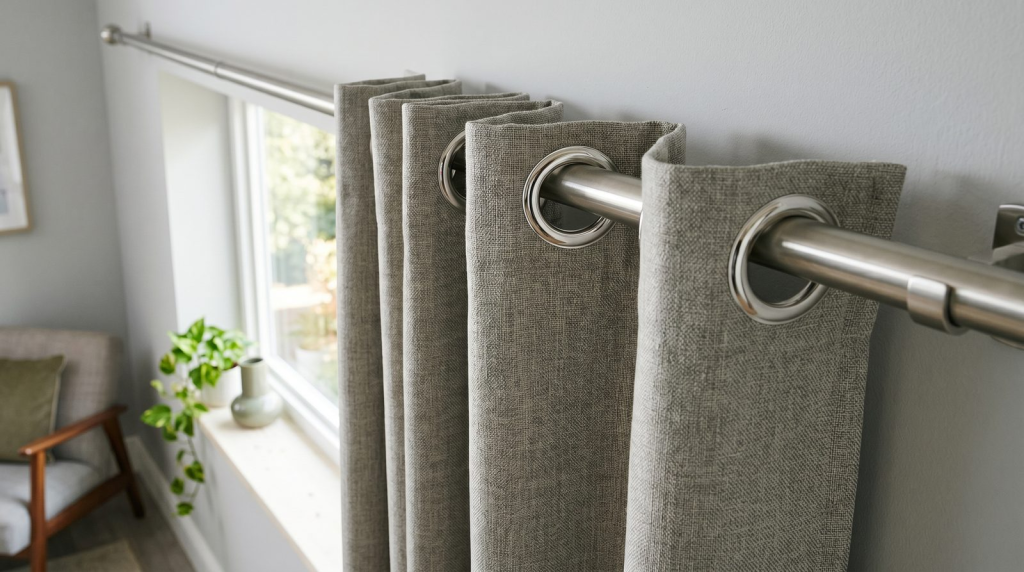
Grommet curtains, also called eyelet curtains, are panels with a row of metal rings set across the top that the rod slides straight through. They are the simplest header to live with and the easiest one to order wrong, because the rod has to physically fit through the ring. This guide covers how to hang grommet curtains, what rod diameter to look for, and how grommets compare with pinch pleat and ripplefold, the two other headers Bergen County homeowners weigh when they have drapery made.
Short answer
Mount the rod above the window frame and past the glass on both sides. Take off one finial, slide the rod through every grommet, then put the finial back. Before you buy, check that the rod diameter is smaller than the inside of the grommet ring, or the panel will not slide.
What grommet curtains are
The grommet is the reinforced metal ring set into the top hem of the panel. The rod threads through those rings, so the fabric falls into even, accordion style folds on its own. There are no rings to clip on, no pins to set, no pleat tape. Slide the rod through and the panel is hung.
That is the whole appeal. It goes up in ten minutes and glides when you pull it, which makes it a working header for a room you actually use.
Grommet vs pinch pleat vs ripplefold
If you are having custom drapery made rather than buying a stock panel, grommet is one of three headers you are really choosing between. They hang from completely different hardware, so the choice decides the rod or track you buy, not just the shape of the folds.
| What to compare | Grommet | Pinch pleat | Ripplefold |
|---|---|---|---|
| How it hangs | The rod slides through metal rings set into the panel top. | Sewn pleats hang from hooks dropped into rings or a traverse rod. | Snap carriers ride in a track and hold the fabric in a continuous wave. |
| The look | Casual and modern, with folds spaced by the grommets. | Tailored and formal. The pleats hold their shape open or closed. | Soft, even S curve from end to end, with no pleat detail at the top. |
| What you see | The rod shows between folds, so pick a rod you like. | A decorative rod and rings, or a traverse rod hidden behind the pleats. | Track only, usually ceiling mounted and close to invisible. |
| Best for | Everyday panels you open and close by hand. | Formal living and dining rooms, and layered looks over a shade. | Wide runs, sliding doors, and motorized draw. |
| Watch out for | The grommet ring has to clear the rod diameter. | More fabric fullness, and the pleats need occasional pressing. | The track has to be mounted dead level across the whole run. |
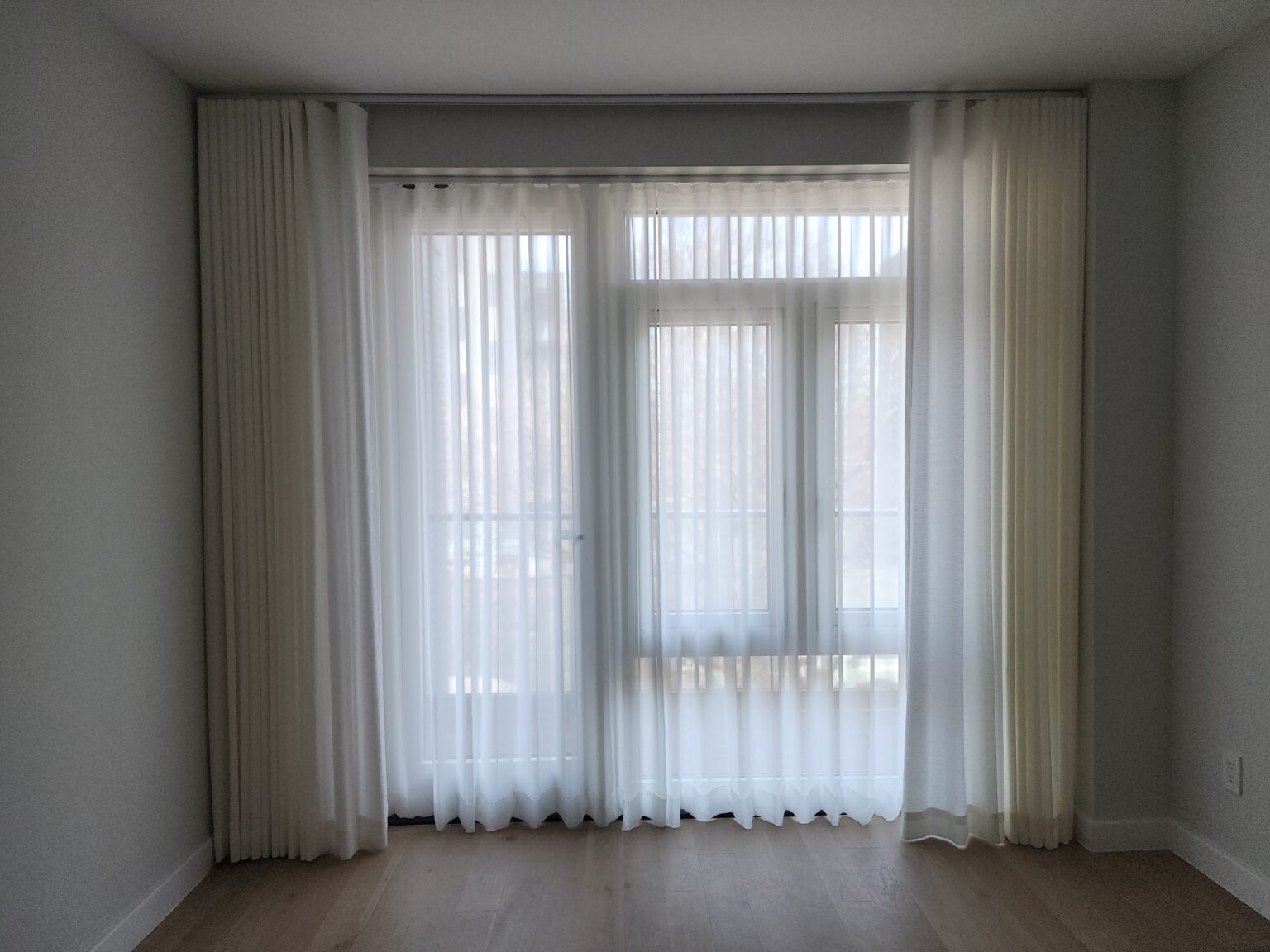
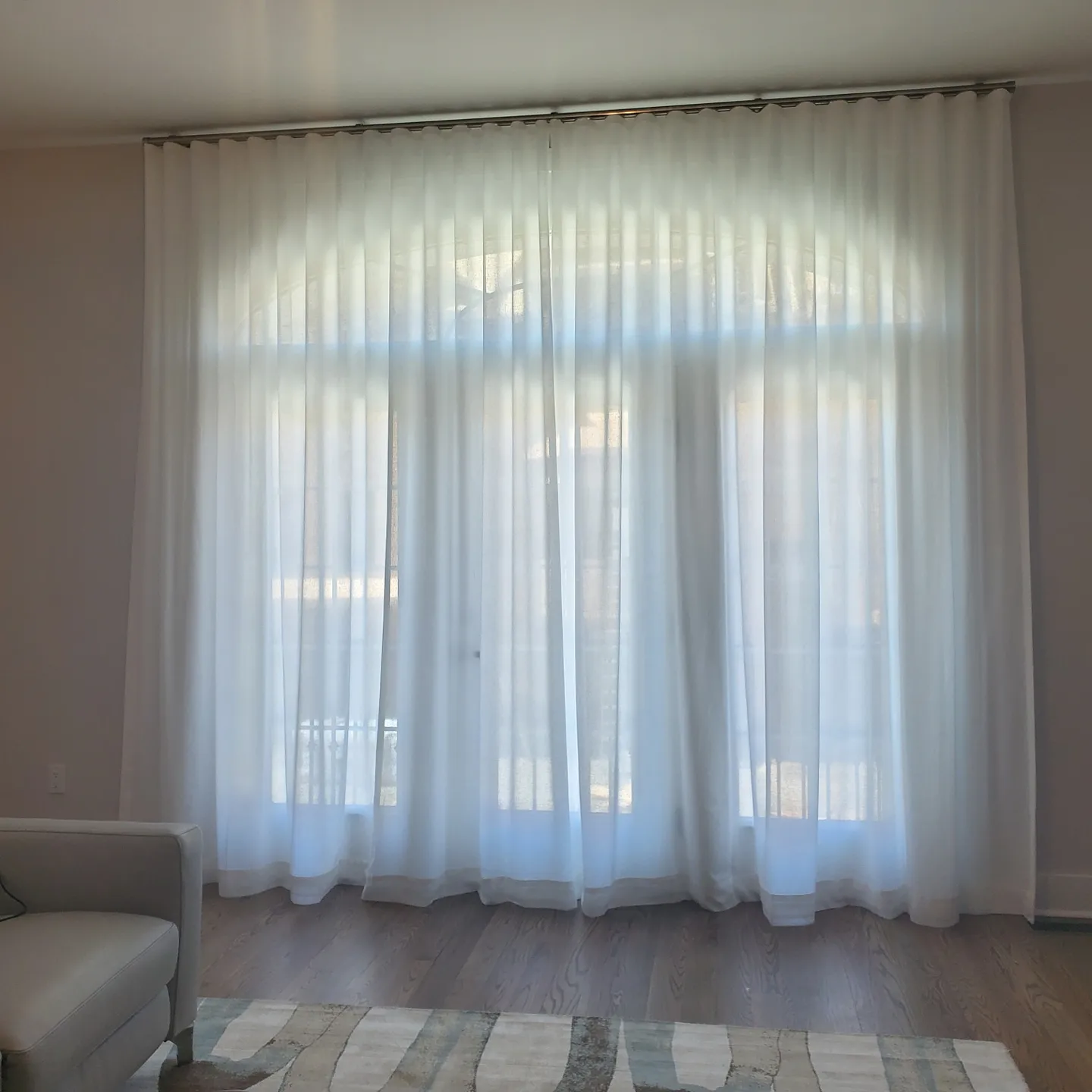
Pinch pleat is the traditional answer for formal rooms, and the goblet and cartridge pleat variations use the same hooks and rings. Ripplefold suits wide window walls and sliding doors, because the track runs the full width and the stack folds back tight against the wall.
What we would put on the window
- Living room window you open every dayGrommet panels on a rod worth looking at, mounted high and wide.
- Formal dining room or a traditional front roomPinch pleat drapery on decorative rings, hemmed to break at the floor.
- Wide slider or a wall of glassRipplefold on a ceiling track so the stack clears the door opening.
- Bedroom that has to go darkA blackout lined panel over a honeycomb or roller shade, not a grommet panel on its own.
What rod size do grommet curtains need?
This is the spec people skip, and it is the one that ruins the install. The rod diameter has to be smaller than the inside diameter of the grommet, or the rings will not slide.
- Most grommet panels are made with a 1.5 to 1.6 inch inner ring, which suits rods up to roughly 1 3/8 inch in diameter.
- Check the grommet inner diameter before you buy the rod, not after. A 1.5 inch ring on a 1.5 inch rod binds.
- The finials must be removable. If they are welded or glued on, the rod will not thread through the panel at all.
- Heavy lined panels need brackets that carry the weight. Our rods and hardware guide covers bracket spacing and center supports.
How to hang grommet curtains, step by step
- Mount the rod high and wide. Set the brackets above the window frame and past the glass on each side so the open panels stack on wall, not on window. Our hanging guide and the rod mounting walkthrough have the measuring detail.
- Level the brackets. A rod that is off by a quarter inch shows immediately on a long panel, because the hem runs out of parallel with the floor.
- Remove one finial, slide the rod through every grommet, then put the finial back and set the rod in the brackets.
- Face the folds. Walk the panel and turn it so all the front grommets face the window and all the back grommets face the room. That alternation is what makes the wave read evenly instead of looking twisted.
- Train the folds. Crease each fold gently front to back, then tie the panel loosely with a fabric strip for a day or two. The folds hold their spacing afterward.
Length is the other decision. Panels stopping an inch above the floor read cheap, and puddled panels collect dust. Our take on where the hem should land covers the options.
When a grommet header is the wrong choice
Grommets are not the answer for every window, and it is better to hear that before the fabric is cut.
- True blackout. Light slips through the small gaps at the top rings, and the rod sits away from the wall. For a nursery or a shift worker’s bedroom, pair a lined panel with a shade behind it. Our blackout curtains guide explains the layering, and how to layer curtains covers running two treatments on one window.
- Formal rooms. A grommet header is casual by nature. Next to crown molding and a dining set, pinch pleat carries the room better.
- Very wide openings. A single long grommet panel gets heavy and hard to pull. Split it into two panels, or move to a track.
How to add grommets to curtains you already own
You can convert plain panels with a snap together grommet kit, and most kits need no special tools.
- Add a strip of grommet or header tape across the top of the panel so the fabric is stiff enough to hold the rings.
- Mark even spacing. Use an even number of grommets, typically 6 to 8 inches apart, so both outer edges turn back toward the wall.
- Trace and cut each hole against the ring template.
- Snap the two halves together through the fabric, front piece to back piece.
Work slowly and measure twice. Even spacing is the only thing making the folds hang evenly, and a hole cut a half inch off shows for the life of the panel.
Grommet curtain questions we get in the showroom
What are grommet curtains?
Panels with metal rings, called grommets or eyelets, set across the top. The rod slides through the rings, which creates evenly spaced folds and a smooth glide with no clips, hooks or pleat tape.
What size rod do I need for grommet curtains?
A rod with a diameter smaller than the grommet inner ring. Most grommets fit rods up to about 1 3/8 inches. Check the inner diameter of the grommet before you buy the rod, and make sure at least one finial comes off.
Are grommet curtains good for blackout?
They are good for everyday light control, but light slips through the gaps at the top rings. For a room that has to go dark, add a blackout lining and put a shade behind the panel.
Can grommet panels be motorized?
A grommet panel is built to be pulled by hand. If you want a treatment that runs on a motor, ripplefold on a track is the drapery header made for it, and shades motorize easily.
How do you put grommets in curtains?
Use a snap together grommet kit. Add header tape for stiffness, mark an even number of grommets at even spacing, trace and cut each hole, then snap the grommet halves together through the fabric.
From our own installs in Bergen County
Compare the headers in our Palisades Park showroom
A grommet fold and a pinch pleat fold look completely different hanging in a real room, and neither one reads properly in a product photo. The Curtain is a family owned window treatment showroom at 547 Broad Ave in Palisades Park, fitting windows across Bergen County since 2007. Come in and handle the headers, or look through the gallery of finished rooms first.
Owner and designer Sejun Park works through the room with you: which windows you open daily, which ones face the street, where the furniture sits, and whether a panel alone will do the job or the window wants a shade behind it. We make custom drapery, and as a Hunter Douglas partner we also sell and install their shades, blinds and shutters. Our custom drapery guide and custom window treatments guide walk through the process.
Measurement is the part worth handing off. We come to the house, measure every window, and put the quote in writing before anything is ordered. Call (201) 302-9111 or book a free in-home consultation.