Knowing how to hang curtains the way a professional installer does comes down to five decisions: how wide the rod goes, how long the panels run, whether the rod is level, what holds the brackets in the wall, and how high the whole thing sits. Get those five right and even an off-the-shelf panel looks tailored.
This guide gives you the exact inches for each step so you can do the job with a drill and a level. It also covers where DIY stops making sense, and what happens instead when The Curtain, our family-owned showroom in Palisades Park, measures and installs custom drapery across Bergen County.
1) Measure Your Window Width
Use a metal tape, not a cloth one. Measure from the outside edge of the trim on one side to the outside edge on the other. That is your base width.
The rod needs to extend past that. Add 4 to 6 inches on each side as a minimum, so open panels stack on the wall instead of over the glass. For heavy lined drapery or a wide window, go 8 to 10 inches per side so the stacked fabric clears the glass completely.
Write down the rod width (base width plus both extensions) and the panel width you need. Curtains only look full when the fabric across the rod adds up to 1.5 to 3 times the rod width. Pleated custom drapery is usually made at 2 to 2.5 times. A single flat panel the same width as the window hangs like a bedsheet.
2) Choose the Right Curtain Length
Measure from where the panel hangs to the floor, not from the top of the window. Where it hangs depends on the heading. Grommet and rod-pocket panels start at the rod itself, so measure from the top of the rod. Ring-and-pleat drapery hangs from the bottom of the ring, about an inch below the rod, so measure from there.
Ready-made curtains come in standard lengths of 63, 84, 96, 108 and 120 inches. Pick the closest and hem if needed. Custom drapery is made to your measurement.
Then decide how the hem meets the floor:
- Float: about 1/2 inch above the floor. Cleanest for rooms that get vacuumed often.
- Kiss: the hem just touches the floor. The tailored look and the most common choice.
- Puddle: 1 to 3 inches of extra fabric. Formal, and it hides an uneven floor.
Sill-length panels, ending 1/2 inch above the sill, belong in kitchens and bathrooms. Our post on whether curtains should touch the floor covers the tradeoffs room by room.
3) Use a Level for Straight Rod Placement
Hold the first bracket where you want it and mark the screw holes with a pencil. Set a level against that mark and carry a light line across to the second bracket position. Do not measure down from the ceiling or up from the trim on each side and assume they match. In older Bergen County houses the trim, the ceiling and the floor are rarely all level with one another, and the rod will show it.
If the trim is visibly out of level, split the difference between true level and the trim line so the rod does not fight either one. Mount the brackets, then set the level on the rod itself and check again before you hang a panel.
4) Install Wall Anchors for Heavy Curtains
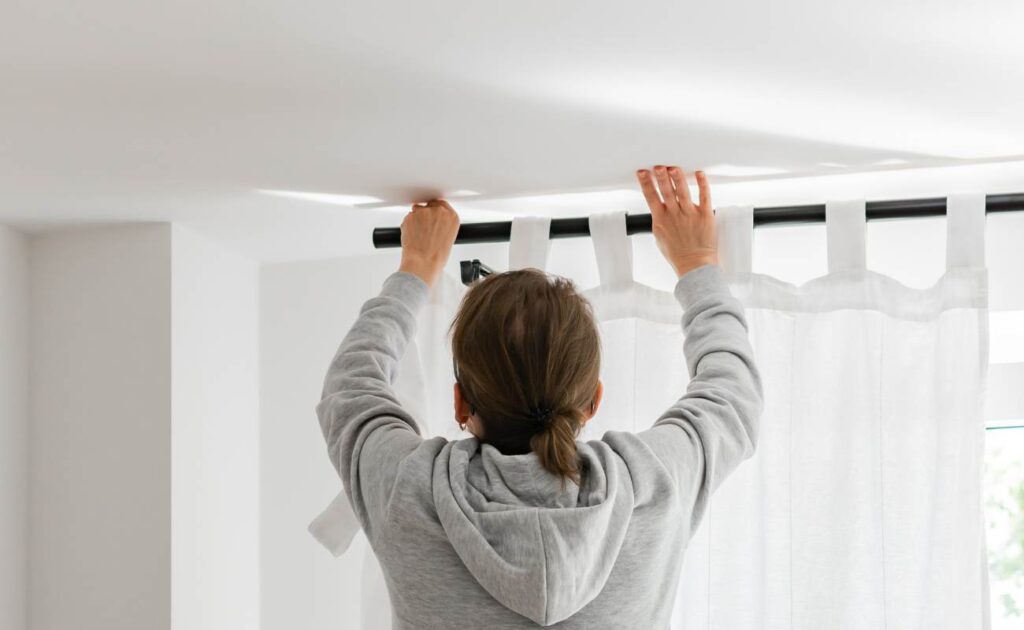
Lined drapery, velvet and anything on a rod wider than about 4 feet is more than a plain screw in drywall should carry. Run a stud finder across the bracket positions first. When a bracket lands on a stud, drive the screw straight into it.
When it lands on hollow drywall, drill a pilot hole and set a toggle anchor or a threaded drywall anchor rated for the load. Tap plastic anchors in gently with a hammer, then drive the screw until the bracket sits flush. In plaster-and-lath walls, common in the county’s older housing stock, drill the pilot hole slowly and skip the hammer, or the plaster cracks around it.
Any rod over 4 feet also needs a center support bracket, and heavy drapery wants one roughly every 3 to 4 feet. Without it the rod bows in the middle and the panels drag when you open them. Renters who cannot drill: see how to hang curtains without drilling and our tension rod guide for what those methods can and cannot hold.
5) How to Hang Curtains Close to the Ceiling for Height
The single change that makes a room look taller is mounting the rod well above the window. The eye follows the fabric from rod to floor and reads that as the height of the window. The rule for how high to hang curtains:
- Mount the rod at least 4 to 6 inches above the top of the trim. Never on the trim itself.
- If the space between the trim and the ceiling is 12 inches or less, go all the way up and mount 1 to 2 inches below the ceiling or crown molding.
- If the space is larger, about two-thirds of the way up the gap looks intentional. Halfway looks like a mistake.
Hanging from the ceiling itself takes a ceiling-mount bracket or a ceiling track instead of wall brackets. Locate the joists with a stud finder and screw into them; where a bracket falls between joists, use a toggle anchor rated for ceiling loads. Measure the panel length from the bottom of the track carrier or ring to the floor, as in step 2. This is the setup for floor-to-ceiling curtains, and the standard answer for a window with no wall above it.
Whichever height you choose, thread the panels onto the rod before lifting it onto the brackets, then step back and check that both panels meet the floor the same way.
Choosing the Right Curtains
Fabric and lining
Sheer voile or chiffon lets in nearly all the light and gives daytime privacy only. Linen filters light and softens the view without blocking it. Velvet and lined polyester block most light, which is what a bedroom or media room needs; our blackout curtains guide covers how much a lining changes the result. A lining also adds weight, which is why steps 3 and 4 matter more for lined drapery than for a sheer.
Rods and hardware
Standard metal or wood rods fit most windows. Decorative rods with finials usually need an extra 2 to 3 inches of wall on each side for the finial itself, so add that when you measure in step 1. A double rod carries a sheer on the inner track and a heavier panel on the outer one, so you can have daytime privacy and full blackout on the same window. See double vs single curtain rods and the full curtain rods and hardware guide.
Layering over a shade
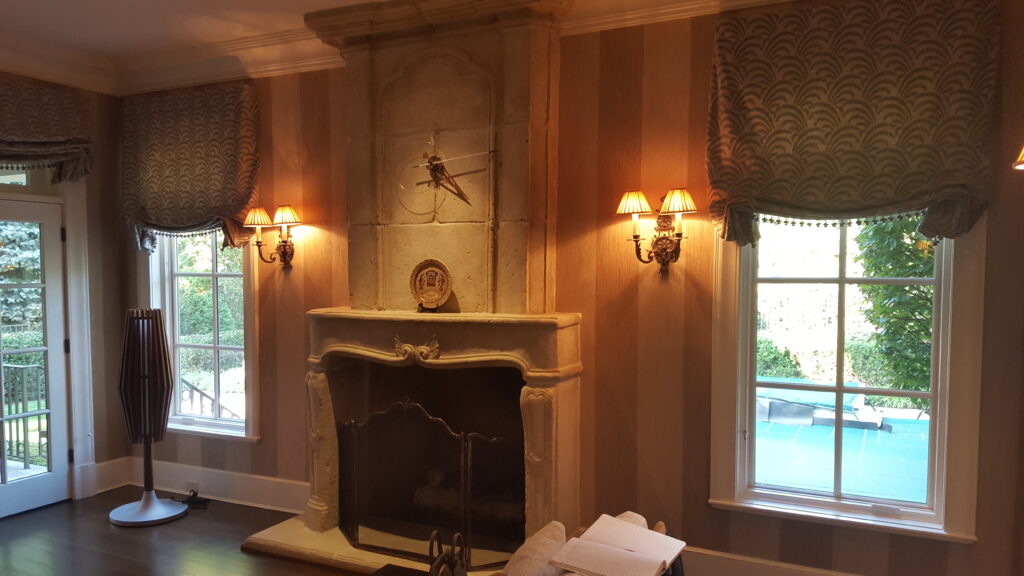
Curtains alone give you two settings, open and closed. Put a roman, cellular or roller shade inside the frame and the drapery on the wall outside it, and the shade handles daily light control while the panels stay open and frame the window. Mount the rod high enough that the stacked panels clear the shade’s headrail. Our guide to layering curtains shows the combinations, and the roman shades page shows what fits inside a standard frame.
When a Rod Is the Wrong Answer
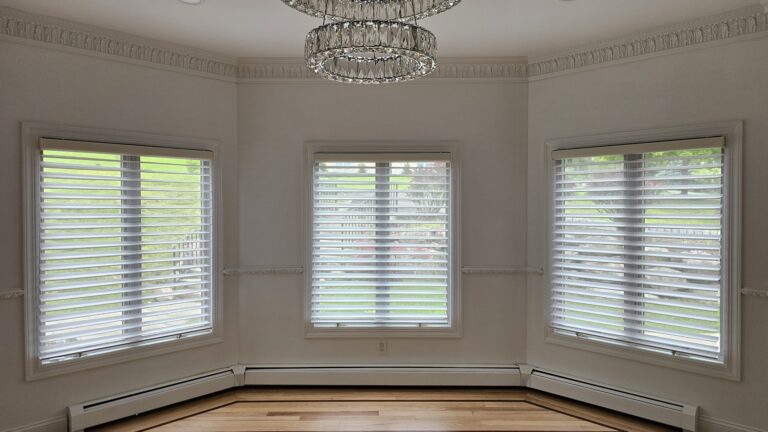
Some windows fight a curtain rod no matter how carefully you hang it. A bay window needs a bent rod or three separate rods, and the panels eat the window seat. A sliding door needs enough bare wall beside it for the open stack to clear the door track, and many rooms do not have it. A kitchen window over the sink puts floor-length fabric next to the faucet. In those spots a shade mounted inside the frame does the job with nothing in the way. Our bay window and sliding door pages show what works on each.
Two more reads: choosing and installing custom draperies covers fabric, fullness and heading styles, and how to get wrinkles out of curtains handles panels that arrived creased.
From our own installs in Bergen County
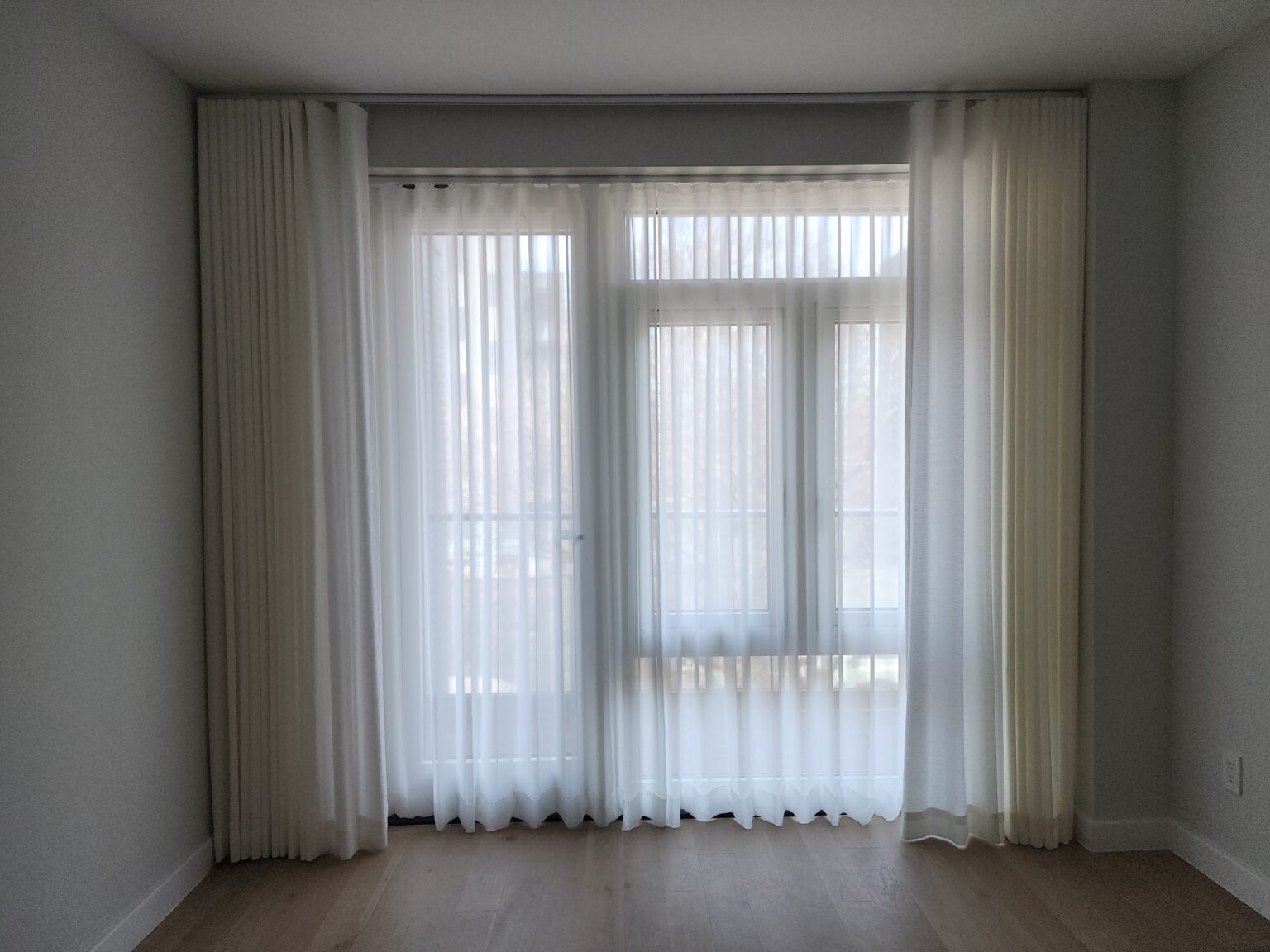

How We Hang Custom Drapery at Our Palisades Park Showroom
The Curtain is a family-owned window-treatment showroom at 545 Broad Ave in Palisades Park, New Jersey, in business since 2007 and serving homeowners across Bergen County. Owner and designer Sejun Park runs the design side. We are a Hunter Douglas partner, so we sell and install Hunter Douglas shades, blinds and shutters, and we also make custom drapery. If you would rather not drill your own walls, here is how the five steps play out:
- Free in-home measurement. We measure the window in your home, not from a photo. That visit settles the rod width, mounting height, panel length and what the brackets are going into.
- Written quote. You get the quote in writing after the measurement, before anything is made.
- Made to your numbers. Custom drapery is cut to the length and fullness from the measurement. No hemming, and no guessing between 84 and 96 inches.
- Installed, leveled and anchored. Our installers mount the hardware into studs or rated anchors, level the rod, hang the panels and dress the folds.
The gallery shows our installs and the reviews page has customer feedback. Check areas we serve for your town, browse the full range of window treatments if a shade or shutter is the better fit, or call (201) 302-9111 to book a free in-home measurement.