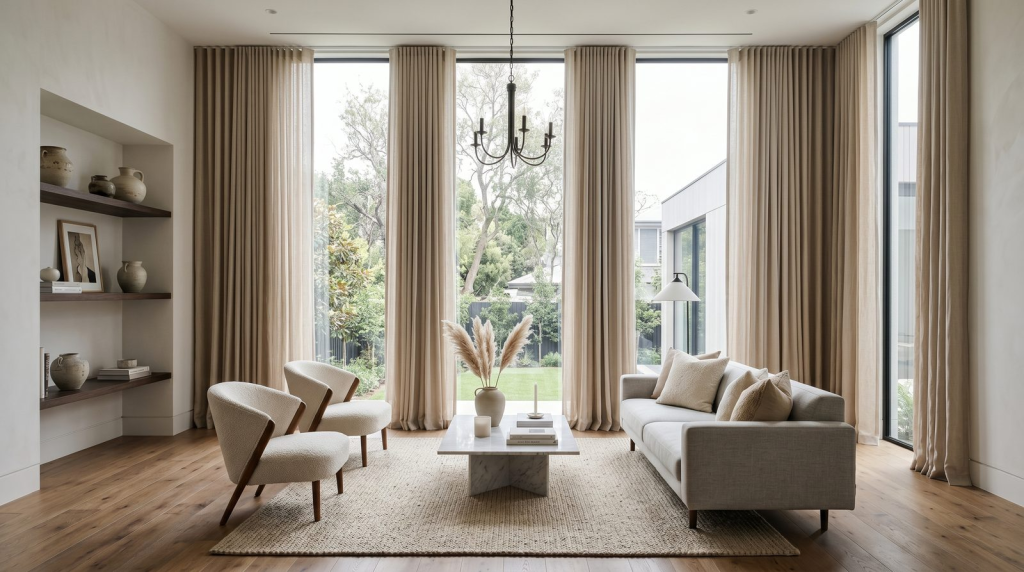
Floor to ceiling curtains do one thing no other window treatment does. They turn a wall into a single uninterrupted vertical line, so an 8 foot ceiling reads taller and a standard 60 inch window reads grander. That matters in Bergen County, where plenty of homes are split levels and colonials with 8 foot ceilings, and the newer builds have two story foyers with glass that runs well past arm’s reach. This guide covers where the look belongs, how high to mount the rod, how to get the length exact, and what we would actually fit on your window.
Where floor to ceiling curtains work, and where they do not
The look pays off most in rooms where you sit still and look at the walls:
- Living rooms and primary bedrooms, where you want a finished, designed feel rather than a functional one.
- Rooms with standard 8 foot ceilings that you want to read taller.
- Tall, stacked or two story windows that need a full height treatment. See large windows for the wider options.
- Sliding doors and patio doors, which call for floor length panels anyway. Our page on sliding door treatments covers stacking and clearance.
It is the wrong call over a kitchen sink, over a baseboard or cast iron radiator, or where a sofa, bench or built in sits tight under the window. Fabric that lands behind furniture wrinkles, collects dust and never hangs straight. In those spots use short curtains or a shade, and for cooking areas see kitchen window treatments.
How high and how wide to mount the rod
The single biggest mistake is fastening the rod to the window frame. That draws a line across the wall at the top of the glass and shortens the room. Instead:
- Go up. Set the rod 4 to 8 inches above the frame, or a few inches below the ceiling or crown molding for the full floor to ceiling effect.
- Go wide. Extend the rod 8 to 12 inches past each side of the window so the open panels stack on wall, not on glass. You keep more daylight and the window looks wider.
- Use ceiling mount hardware when there is no wall left. If crown molding eats the space above the frame, ceiling brackets or a recessed ceiling track give you the same line without fighting the trim.
Long lined panels are heavy, so anchoring matters more than it does on a short rod. Hit studs where you can, use proper toggle anchors where you cannot, and add a center support bracket on any rod over about 8 feet so it does not sag. Our curtain rod hanging guide and the hardware guide cover bracket spacing, and how to hang drapes covers the rings.
Getting the length exactly right
Measure from the point the fabric will hang from, which is the bottom of the ring or the top of the track carrier, straight down to the finished floor. Measure at the left edge, the center and the right edge. Floors in older homes are rarely perfectly level, and a half inch of slope across a 10 foot opening shows when the hem is supposed to float.
Then pick a hem style and stay with it through the whole room.
| Hem style | Where the fabric ends | Best for |
|---|---|---|
| Float | About one half inch above the floor | Most rooms. Crisp and tailored, easy to vacuum under, forgiving on uneven floors. |
| Break or kiss | Just touching the floor | A softer look that hides small measuring differences from panel to panel. |
| Puddle | Pooling 1 to 3 inches on the floor | Formal rooms and bedrooms. More upkeep, and not a good idea with pets or a busy walkway. |
Because the rod sits so high, stock lengths often will not reach. You are usually into 108 inch or 120 inch panels, and past that you are into custom. Anything shorter breaks the vertical line and undoes the whole effect. If you are weighing the hem question on its own, read should curtains touch the floor, and for how a made to measure panel is specified see choosing and installing custom draperies.
Fullness, pleats and how the fabric hangs
Height alone does not make the look. Fullness does. Total finished panel width should be about twice the rod width so the fabric hangs in deep folds instead of a flat sheet stretched across the wall. Cut the fullness and a tall panel starts to look like a bed sheet on a pole.
Two more things change how a long panel falls. The first is weight. Heavier goods like velvet, wool blends and lined linen hang plumb from a high rod, while thin unlined cotton tends to flare and wave. The second is the heading. A pinch pleat or a goblet or cartridge pleat holds a defined fold from the rod to the hem, ripplefold gives an even S curve that suits a long track, and grommets give a looser wave. On a drafty window, a lined or thermal panel also cuts the cold air that rolls off big glass in January.
Two story foyers, stacked windows and hard to reach tops
The tallest openings are where custom work earns its keep. A two story foyer window is often 12 to 18 feet to the top, sometimes with an arch or an angled head. A panel that long has to be cut and weighted so it hangs straight, and the hardware has to go into framing, not just drywall. If the top is arched, you can leave the arch bare and hang the panels below it, or cover it with a shaped treatment. See arched windows and how to hang curtains on an arched window.
Once the rod is out of arm’s reach, motorization is the only way the panels actually get used. A motorized drapery track opens and closes on a remote, a wall switch or a schedule, and keeps you off a ladder. The same logic applies to shades on high glass, which we compare in automated blinds vs automated shades.
Layering: what goes behind the panels
Floor to ceiling panels handle the look. They rarely handle privacy and light on their own, because most people leave them open all day, so it usually pays to put something on the glass behind them. A cellular shade adds insulation on a big cold window, a roller shade disappears into its cassette when it is up, and a blackout shade behind lined panels is what actually gets a street facing bedroom dark. We are a Hunter Douglas partner, so the shade behind your drapery can be specified, ordered and installed alongside the panels. For stacking the two layers cleanly, see how to layer curtains.
What we would put on the window
- Living room, 8 foot ceilings, standard windowLined pinch pleat panels on a rod set 6 inches below the ceiling and 10 inches wide of the frame, floating a half inch off the floor.
- Two story foyer, glass out of reachCustom length panels on a motorized ceiling track, with the arch left bare if there is one.
- Primary bedroom facing the streetBlackout roller or cellular shade on the glass, lined floor length panels over it on a ceiling mounted rod.
- Slider to the deck or patioRipplefold panels on a track that stacks fully onto the wall beside the door, hemmed to float clear of the threshold.
- Radiator or bench under the windowSkip the floor length look here. A shade or a sill length panel keeps fabric off the heat and off the furniture.
Common questions about floor to ceiling drapes
How high should you hang them?
Set the rod 4 to 8 inches above the window frame, or just below the ceiling or crown for the full height effect, and extend it 8 to 12 inches past each side of the window.
What length panels do I need?
Measure from the planned hanging point down to the floor. Because the rod sits high, that is usually 108 inches, 120 inches or a custom length. Order custom when the number falls between stock sizes.
Should the curtains touch the floor?
Yes, in one of three ways. Float a half inch above, break right at the floor, or puddle 1 to 3 inches. Panels that stop short of the floor break the vertical line the whole look depends on.
Do they really make a room look bigger?
They make it read taller. The unbroken vertical line pulls the eye up the full height of the wall, and the wide rod makes the window look wider than the glass actually is.
See the fabric at full height in Palisades Park
Fabric behaves differently at 10 feet than it does on a 3 inch swatch. Drape, sheen and how much light a lining blocks are all easier to judge in person. The Curtain is a family owned window treatment showroom at 545 Broad Ave in Palisades Park, in business since 2007 and serving homeowners across Bergen County. Owner and designer Sejun Park runs the showroom, and we make custom drapery as well as selling and installing Hunter Douglas shades, blinds and shutters.
We also offer a free in home measurement and a written quote, which is the part that matters most on a tall window. We measure the drop, check the floor for level, and put the panel length and fullness in writing before anything is ordered. Call (201) 302-9111, book a free consultation, browse the gallery, or start with the full range of window treatments.