Bifold and sliding closet doors jam off their tracks, show you half the closet at a time, and eat swing space you do not have in a small bedroom. Fabric fixes all three. If you are working out how to hang curtains for closet doors, the thing that decides whether the result looks built-in or looks like a patch is the hardware and where you mount it, not the panel you pull off a shelf. Here is how we size, make and hang closet panels for homeowners around Bergen County.
Short answer
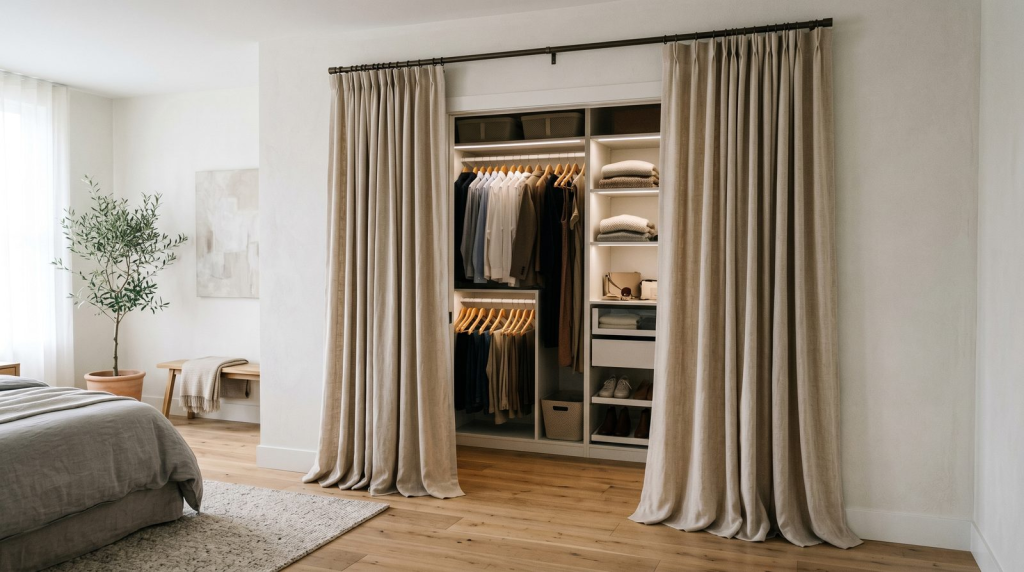
Mount the rod or track above the opening, not inside it, and run it wider than the opening on both sides so the panel has somewhere to stack when it is open. Order enough fabric to come to 1.5 to 2 times the opening width, so the panel still gathers when it is closed. Use a medium-weight, opaque cloth and take the length to the floor, and the closet reads as a designed feature instead of a curtain hiding a mess.
Why homeowners swap closet doors for curtains
- Space. No door swing and no bifold clearance, which matters in the older bedrooms and condo units common around Palisades Park, Fort Lee and Ridgefield.
- Full access. You see and reach the whole closet at once, not one half at a time.
- A softer room. Fabric adds warmth and texture a hollow-core door does not, and you restyle the wall by changing one panel.
- Renter friendly. Nothing permanent has to happen to the door frame, and the panel moves with you.
How to hang curtains for closet doors, step by step
- Set the mounting line first. Hold the rod a few inches above the top of the opening and step back. Higher reads taller. Mounting inside the opening reads like a temporary fix and leaves a band of trim above the panel.
- Go wider than the opening. Extend the rod or track past both sides so the panel stacks off the opening. Without that overhang the fabric sits in front of your shirts and you lose inches of reach.
- Find something solid. Above a closet opening you are often into the header, which is good news. Where you land on plain drywall, use a proper anchor rather than a screw on its own. Our guide to hanging curtain rods walks through the hardware, and our general guide to hanging curtains covers the rest of the sequence.
- Hang it, then dress the folds. Run your hand down each pleat so the panel breaks in the same place top to bottom, then leave it a day to settle. If the fabric arrived folded, steam it first. See getting wrinkles out of curtains.
- Check the close. Slide the panel shut and look for light and gaps at the sides. If the closet faces a bed, that gap is the difference between a soft look and a stripe of light across your pillow at six in the morning.
The same rules apply to a doorway between two rooms. See our door curtains guide for that version.
Tension rod, wall rod, or ceiling track
Almost every closet job comes down to these three. The heavier the panel, the further down this table you should be looking.
| Method | Best for | Watch for |
|---|---|---|
| Spring tension rod inside the opening | Light unlined panels, rentals, no drilling at all | Slips or sags under lined fabric, and it sits the panel inside the opening where it blocks reach |
| Wall-mounted rod above the opening | Lined panels, a built-in look, most bedroom closets | Needs clearance above the trim and the right anchors |
| Ceiling-mounted track | Wide openings, floor-to-ceiling panels, daily use | The line is fixed at the ceiling, so the drop has to be measured exactly |
If drilling is off the table entirely, start with our tension rod guide and the options in hanging curtains without drilling. For anything lined or heavy, a mounted rod or a track is the honest answer. Tracks can also be motorized, which is worth considering if the closet spans most of a wall and you would rather open the panels with one button than pull them by hand.
Measuring the opening
- Width. Measure the opening at the top, then decide how far past it you are mounting. Finished fabric width should come to 1.5 to 2 times the opening width so the panel gathers instead of hanging flat.
- Height. Measure from the mounting line down to the floor. Floor length is what makes it look built-in. A panel that stops a few inches short pulls the eye straight to the gap, and our post on whether curtains should touch the floor covers the trade-offs.
- One panel or two. A single panel that draws to one side suits a narrow reach-in closet. Two panels part in the middle, read more like doors, and let you walk straight in. Past about five feet of opening, two panels are easier to live with.
- Floors are not level. Older houses here rarely give the same drop at both ends of an opening. Measure at each side and in the middle, then work from the shortest.
If the closet runs wall to wall, treat it as a wall of drapery rather than a closet cover, and our notes on floor-to-ceiling curtains apply directly.
Fabric that works on a closet
- Medium weight and opaque. A sheer or thin cotton shadows every hanger and shoe box behind it. Linen blends, cotton twill and heavier wovens hang straight and hide the contents.
- Lining. A lining adds body and keeps the panel hanging flat. If the closet faces a bed, a blackout lining makes the opening disappear at night. See our blackout curtains guide.
- Weighted hem. Weights sewn into the corners keep the panel plumb and stop it drifting open every time somebody walks past.
- Header style. A pleated header holds its folds and looks tailored. Grommets glide easily by hand and suit a closet you open a dozen times a day.
- Color. Match the wall and the closet recedes. Contrast with it and the closet becomes a feature of the room. Both work, but pick one on purpose.
What we would put on the opening
- Rental bedroom, nothing permanentUnlined opaque cotton panel on a tension rod inside the opening.
- Closet facing the bedBlackout-lined panel on a wall-mounted rod, set above the trim and wider on both sides.
- Narrow reach-in closetOne pleated floor-length panel that draws fully to one side.
- Wall-to-wall closet in a bedroomCeiling track with two lined panels that part in the middle, so a long run still draws smoothly.
- Shared kids roomHand-drawn panel with no loose cords or hardware at child height.
Where a curtain is the wrong call
- Sound and dust. Fabric does less of both than a solid door. A full, floor-length panel beats an open closet, but it is not a seal.
- Anything that has to stay closed off. A pantry next to a kitchen, or a closet holding something that must stay dust free, is better served by a door.
- Pets and small children. They push straight through. Weighted panels help, and cordless hardware is safer around kids. Our notes on child-safe window treatments apply to closets too.
- No wall above the trim. If there is nothing to mount into above the opening, you are stuck hanging inside it, which is the least flattering version of this.
Common questions
Can you use curtains instead of closet doors?
Yes. Use a full, opaque, medium-weight panel at 1.5 to 2 times the opening width, hang it above and slightly wider than the opening, and choose two panels if you want it to part in the middle like doors.
What kind of curtains are best for a closet?
Medium-weight, opaque fabric so the contents do not show through, ideally lined and weighted so it hangs straight. Add a blackout lining if the closet faces a bed.
How do you hang curtains over a closet without drilling?
A spring tension rod inside the opening works for light, unlined panels. For anything lined or heavy, a wall-mounted rod or a ceiling track is the secure option.
Do closet curtains keep dust out?
Less than a solid door, but a full, floor-length panel hides the contents and cuts dust considerably compared with an open closet.
Should closet curtains match the window curtains in the room?
They do not have to match, but they should agree. Repeating the header style, or the same fabric family in a different color, ties them together without making the room feel like a sample book.
Have us measure it and make the panel
The Curtain is a family-owned window treatment showroom at 545 Broad Ave in Palisades Park, in business since 2007 and serving Bergen County. The owner and designer is Sejun Park. We measure the opening in your home, check the header and the floor, and put the fullness, the length and the hardware in a written quote. The in-home measurement and the quote are free.
We make custom drapery, which is what most closet openings actually need, and we are a Hunter Douglas partner for the shades, blinds and shutters on the windows in the same room. If you are doing the closet and the room’s windows in one go, it is easier to keep the fabrics and the light control consistent when both come out of the same visit. See finished work in our gallery, read more in our guide to custom draperies, or browse window treatments for the rest of the room.
Call (201) 302-9111, book a free consultation, or check the towns on our areas we serve page.