Two windows in the same house often want opposite things. The one facing the street needs weight and privacy after dark, the one facing the back yard wants light all afternoon. That is usually where the modern vs traditional curtains question actually starts. Traditional curtains lean on heavier cloth, deeper pleats and hardware you are meant to see. Modern panels lean on flat fabric, quiet color and a track you barely notice. Here is how the two differ in fabric, pleat and hardware, and what we would hang on a Bergen County window in each case.
What Makes Traditional Curtains Traditional
Traditional curtains are defined by weight and by the heading at the top. The fabrics are velvet, silk, brocade, jacquard and heavy cotton. The heading is usually a hand-formed pleat: a three-finger pinch pleat, a goblet pleat that holds a rounded cup at the top, or a cartridge pleat that keeps a soft tube. Those pleats need fullness, commonly 2.5 times the window width or more, which is why traditional panels swallow so much fabric.
The rest follows from that. Deeper colors, damask and floral prints, decorative trim or tassel tiebacks, and a wood or metal rod with real finials and rings. Lined and interlined, these panels hang in heavy vertical folds and hold their shape. They also block a lot of light, which is why they still make sense in a formal dining room, a primary bedroom or a study. Our guides to velvet curtains and goblet and cartridge pleats show those options up close.
What Makes a Curtain Read Modern
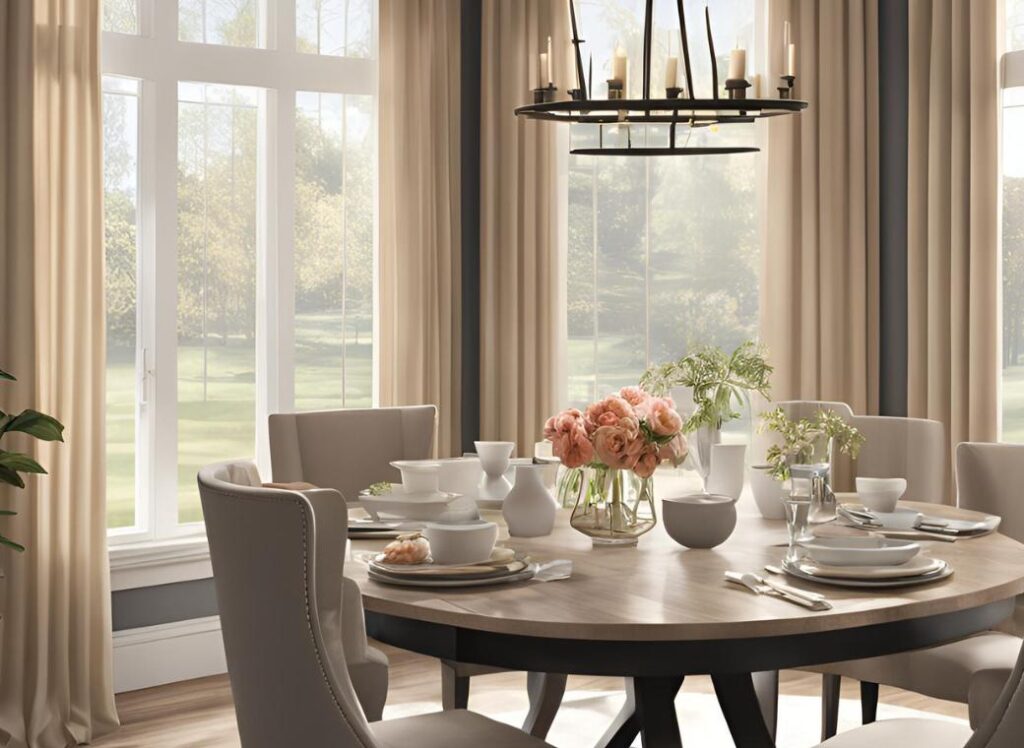
Modern panels are flatter and quieter. The heading is often ripplefold, where carriers on a track hold the fabric in an even S-wave, or a simple grommet, or a flat panel on a slim rod. Fullness runs closer to 2 times the width, so the folds are shallower and the panel reads as a plane of color rather than a column of drapery.
The fabrics are linen, cotton, sheer voile and textured blends, usually in off-white, greige or a muted solid. Hardware disappears: a ceiling-mounted track, a recessed pocket, or a thin rod in a matte finish. Motorization belongs here too, since a track hides a motor better than rings on a rod do. See grommet curtains and motorized options if that is the direction you are leaning.
Modern vs Traditional Curtains, Side by Side
| Element | Modern | Traditional |
|---|---|---|
| Fabric | Linen, cotton, sheer voile, textured blends | Velvet, silk, brocade, jacquard |
| Heading | Ripplefold, grommet, flat panel | Pinch pleat, goblet, cartridge |
| Fullness | About 2x the window width | 2.5x or more |
| Hardware | Slim track or thin rod, often hidden | Wood or metal rod, finials, rings |
| Color | Off-white, greige, muted solids | Burgundy, forest green, gold, damask, florals |
Bergen County Colonials vs New Builds
The house usually answers the question before your taste does. Older colonials and capes are common around Palisades Park, Fort Lee, Ridgewood and Tenafly: painted wood casings, a stool and apron at the sill, windows that stop well short of the ceiling. Traditional pleated panels suit that trim. Mount the rod four to six inches above the casing and run it wide enough that the stacked panels sit on the wall instead of over the glass, and a short window looks taller without the trim getting buried.
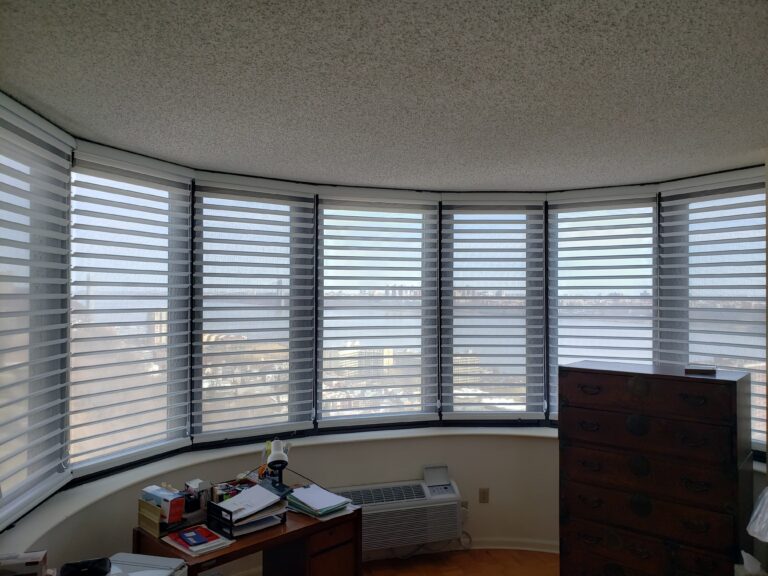
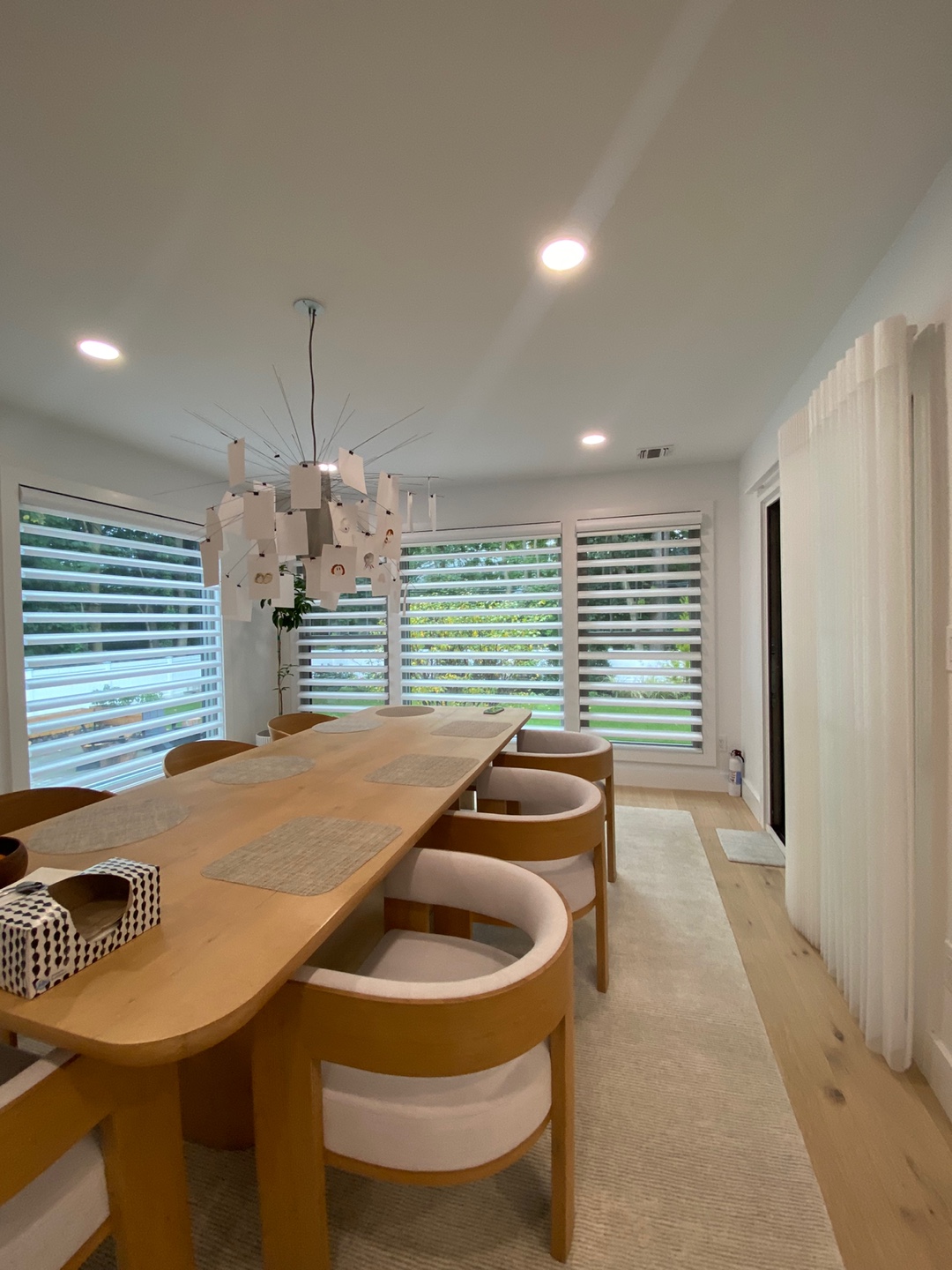
Newer construction and renovated great rooms are the opposite problem. Openings are tall, casings are thin or squared off, and there is frequently a slider or a wall of glass. Flat ripplefold on a long track handles that better, because one continuous wave crosses the whole wall and the stack pushes off the glass cleanly. Tall and wide openings have their own rules, which we cover for large windows and sliding doors. Bay windows sit in between: they get measured section by section, and drapery panels normally land at the outside edges only. See bay window treatments for how that gets laid out.
What we would put on the window
- 1930s colonial living room, painted casingsLined pinch-pleat panels in a medium-weight cotton, on a wood rod mounted above the trim.
- New build great room with a two-story wall of glassRipplefold panels on one long ceiling track, motorized.
- Street-facing bedroomBlackout-lined drapery over a light-filtering shade, so daytime light does not depend on the panels.
- Formal dining room with a bayA sheer shading in each bay section, with drapery panels at the outside edges.
- Slider to the deckWide traversing panels that stack fully off the glass, or a panel track if the door gets daily use.
Pleated Sheer Curtains With Hooks, and the Middle Ground
Most Bergen County homes do not land cleanly on one side. The usual compromise is layering, and the classic version of it is a pair of pleated sheer curtains with hooks: pinch-pleated sheer panels with drapery pins set into rings or a traverse rod carrier, hung on an inner rod, with an opaque outer panel on the second rod. The sheers stay closed through the day for softened light, the outer panels close at night. A double rod makes that possible on one bracket set, and our layering guide covers the order of operations.
The other middle ground is a shade under a drapery panel. A sheer shading or a light-filtering roller does the daytime work while the panels stay decorative and open. That combination reads modern in a new build and perfectly traditional in an older room, depending only on the panel you pick. Our shade collection shows what fits under drapery, and roman shades in particular bridge the two styles because the fold is soft but the line is clean.
Light, Privacy and Heat
Style decides the look. Lining decides how the room actually feels. An unlined linen panel passes plenty of daylight and gives you a silhouette at night, not privacy. A cotton lining cuts glare and protects the face fabric from sun fade. A blackout lining takes a bedroom close to dark, and interlining adds a flannel layer between face and lining that improves both insulation and the way the folds hang.
Heavy traditional drapery genuinely helps with a hot west-facing room in July and a drafty single-pane window in January, because the fabric slows the air moving at the glass. Cellular shades do the same job in less space. If summer heat is the reason you are shopping, start with thermal curtains and energy-efficient coverings. If night privacy is the reason, read what people can actually see before you choose a sheer.
Length and Hardware Details That Date a Room
Two measurements separate custom work from off-the-shelf. The first is the break at the floor. Traditional panels are usually cut to touch the floor or to break about half an inch onto it, and a deliberate puddle of two to four inches is a traditional move. Modern panels are cut to hover roughly half an inch above the floor so the hem stays crisp. Our guide on whether curtains should touch the floor goes through each option.
The second is rod placement. Height above the casing and width past it change the apparent size of the window more than the fabric does. Get the bracket spacing wrong on a heavy velvet panel and the rod bows in the middle within a season. Our rod and hardware guide covers weight, brackets and returns.
Care, and What Drives the Cost
Modern panels in cotton, linen blends and synthetics are the easier ones to live with. Many can be laundered, and a steam pass returns the folds. Velvet, silk and brocade generally go out for dry cleaning, and velvet should never be pressed flat with an iron. Vacuum the top third with a brush attachment a few times a year, since that is where dust settles. If the panels are already creased from storage, see how to get wrinkles out of curtains, and when to replace them if the lining is shot.
Cost tracks fabric yardage more than anything else. Traditional pleats at 2.5x fullness, plus lining, plus interlining, use noticeably more cloth than a flat modern panel on the same window, and hand-formed pleats take more labor than ripplefold carriers. Wide openings, ceiling-height drops and decorative hardware push it further. The variables are broken down in our custom curtain cost guide.
From our own installs in Bergen County
See Both Styles Before You Commit
The Curtain is a family-owned window-treatment showroom at 545 Broad Ave in Palisades Park, in business since 2007 and serving Bergen County. The owner and designer is Sejun Park. Holding a velvet next to a linen sheer under real light settles the modern vs traditional question faster than any photo. We are a Hunter Douglas partner for shades, blinds and shutters, and we make custom drapery, so you can compare a layered shade-and-panel plan against straight drapery on the same window.
We measure in your home at no charge and put the quote in writing. Call (201) 302-9111, book a free consultation, or check the towns on our service area page. You can also browse finished rooms in the gallery, read our reviews, or see where styles are heading in our 2026 trends and curtain trends write-ups. If the room in question is your living room, this guide gets more specific, and this one covers bedrooms.